Remove left high pressure pump
WARNING:
Working on 12 V electrical system.
Risk of short circuits! Risk of fire!
Risk of short circuits! Risk of fire!
- Make sure that there is no charger connected to the jump start terminal in the engine compartment.
- Detach battery ground lead from battery.
- For auxiliary batteries: Detach battery minus cables from all auxiliary batteries.
WARNING:
Working on fuel system.
Risk of fire! Danger of explosion!
Risk of fire! Danger of explosion!
- When working on the fuel system, make sure the workstation has sufficient ventilation, e.g., by means of extraction.
- Tightly seal off open lines and connections; collect any leakage fuel directly at the point of exit.
- No fire, sparks, open flames or smoking.
NOTE:
TECHNICAL INFORMATION
Collect and dispose of emerging fluids. Observe country-specific waste disposal regulations.
Collect and dispose of emerging fluids. Observe country-specific waste disposal regulations.
Preliminary work
- Refer to DISCONNECTING ALL BATTERY GROUND LEADS .
- Refer to REMOVING THE ACOUSTIC COVER .
- Refer to REMOVING INTAKE SILENCER HOUSING .
- Refer to REMOVE ALL LEFT IGNITION COILS .
- Refer to REMOVING THE COVER ON LEFT AND RIGHT IN THE ENGINE COMPARTMENT AT THE TOP .
- Refer to REMOVE THE LEFT AND RIGHT FRONT-END STRUT
- Refer to REMOVE FRONT CROSS CONNECTION .
- Refer to REMOVE THE REAR TOP CROSS CONNECTION .
- Refer to REMOVE FAN COWL .
- Refer to REMOVING THE LEFT UNFILTERED-AIR DUCT .
- Refer to RELEASING THE LEFT CHARGE AIR LINE FROM THE EXHAUST TURBOCHARGER
- Refer to REMOVE LEFT CLEAN AIR PIPE .
- Refer to PARTLY LOOSENING THE WIRING HARNESS FROM THE CYLINDER HEAD COVER ON THE LEFT <
- Refer to REMOVING THE SOUND INSULATION FROM CYLINDER HEAD COVER ON LEFT .
- Refer to REMOVE THE HIGH-PRESSURE RAIL ON THE LEFT .
- Refer to PARTIALLY DISENGAGE THE FUEL SUPPLY LINE
NOTE:
RISK OF DAMAGE
Contaminant or foreign body.
Contamination can result in malfunctions, loss of function or leaks.
Contaminant or foreign body.
Contamination can result in malfunctions, loss of function or leaks.
- Adhere to the utmost cleanliness.
- Protect components from contamination e.g. by covering.
- Close off line connections with seal plugs.
NOTE:
TECHNICAL INFORMATION
Collect and dispose of emerging fluids. Observe country-specific waste disposal regulations.
Collect and dispose of emerging fluids. Observe country-specific waste disposal regulations.
NOTE:
TECHNICAL INFORMATION
The high pressure pump is preloaded by the piston spring and must be removed by alternately unscrewing the screws without tilting.
Before installing the high pressure pump, the cam of the high pressure pump drive must be turned to bottom dead center.
If necessary, turn the engine in the direction of engine rotation on the central bolt of the crankshaft, otherwise there is a risk of piston breakage of the high pressure pump.
The high pressure pump is preloaded by the piston spring and must be removed by alternately unscrewing the screws without tilting.
Before installing the high pressure pump, the cam of the high pressure pump drive must be turned to bottom dead center.
If necessary, turn the engine in the direction of engine rotation on the central bolt of the crankshaft, otherwise there is a risk of piston breakage of the high pressure pump.
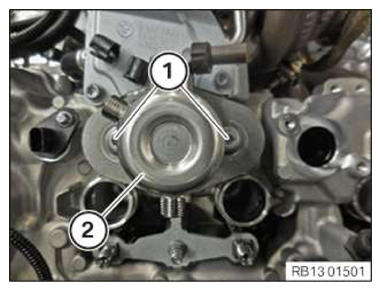
- Loosen screws (1).
- Remove the high pressure pump (2).