Remove the injectors for cylinders 1 to 3
WARNING:
Hot fluids.
Risk of scalding!
Risk of scalding!
- Conduct all work in the vehicle wearing appropriate personal protective equipment only.
Preliminary work
- Refer to DISCONNECTING ALL BATTERY GROUND LEADS .
- Refer to REMOVING THE ACOUSTIC COVER .
- Refer to REMOVE THE SEAL FOR THE HOOD REAR .
- Refer to REMOVING ACOUSTIC COVER AT REAR .
- Refer to REMOVE IGNITION COILS .
- Refer to REMOVE THE HIGH PRESSURE LINE BETWEEN THE RAIL AND THE HIGH PRESSURE PUMP .
Further information is available.
NOTE:
RISK OF DAMAGE
Contaminant or foreign body.
Contamination can result in malfunctions, loss of function or leaks.
Contaminant or foreign body.
Contamination can result in malfunctions, loss of function or leaks.
- Adhere to the utmost cleanliness.
- Protect components from contamination e.g. by covering.
- Close off line connections with seal plugs.
NOTE:
RISK OF DAMAGE
Damage to the ignition coil.
The silicone hose of the ignition coil must not be contaminated by fuel as this can lead to failure of the ignition coil.
Damage to the ignition coil.
The silicone hose of the ignition coil must not be contaminated by fuel as this can lead to failure of the ignition coil.
- When working on the fuel system, cover the ignition coils with suitable materials and remove where required.
- Do not oil or grease the silicone tube of the spark plug socket. Do not use any protection or maintenance products (e.g. silicone spray, rubber care products, rust remover, etc.).
NOTE:
RISK OF DAMAGE
Damage to the injector tips and Teflon ring.
Improper handling of the injector tips and Teflon ring can lead to malfunctioning of the injector.
Damage to the injector tips and Teflon ring.
Improper handling of the injector tips and Teflon ring can lead to malfunctioning of the injector.
- Avoid mechanical contact with injector tip.
- When exchanging Teflon ring, hands and work surface must be clean and free of oil. Do not use any lubricating agents.
- Do not use fingernails to slide Teflon ring on.
NOTE:
RISK OF DAMAGE
Damage to injectors.
Excessive force may damage the injector and this means having to replace the injector.
Damage to injectors.
Excessive force may damage the injector and this means having to replace the injector.
- Twist the injectors with a torsional movement of maximum 13 Nm.
NOTE:
RISK OF DAMAGE
Electrostatic discharge.
Damage to or destruction of electrical components.
Electrostatic discharge.
Damage to or destruction of electrical components.
- Leave the electrical components in their original packaging until they are being installed. Only use the original packaging for returning the product. Always package removed components straight away.
- Read and comply with user information on using the associated special tool 12 7 060.
- Only tap the housings of electrical components. Do not tap pins or multi-pin connectors directly.
- Wear electrically conductive clothing and antistatic shoes (with ESD symbol).
- For additional information see: 61 35... NOTES ON ESD (ELECTROSTATIC DISCHARGE) PROTECTION
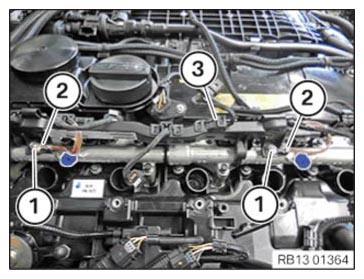
- Loosen nuts (1).
- Feed out ground cable (2) and set it aside.
- Feed out cable duct (3) and set it aside.
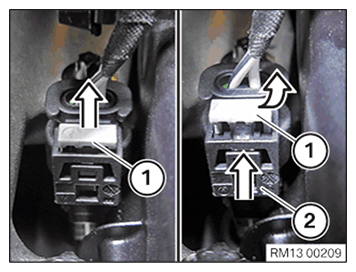
- Unlock lock (1) arrow direction from the top.
- Press lock (1) together and release in direction of arrow.
- Detach connector (2) from the injectors.
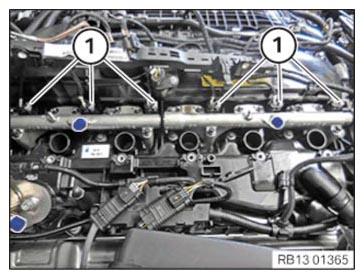
- Unlock and release all connectors (1) of the injectors.NOTE: TECHNICAL INFORMATION
When the vehicle is under dusty/sandy operating conditions, the injector shafts must be cleaned before removing the injectors.
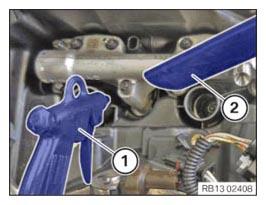
For additional information see: 13 53... CLEANING THE CYLINDER HEAD IN AREA OF INJECTORS IF THERE IS SANDY/DUSTY CONTAMINATION - Before releasing the high pressure lines: Use an air gun to blow out the injector shafts (1) with a little pressure.
- At the same time, use an explosion-protected vacuum cleaner (2) to suck out the dirt particles.
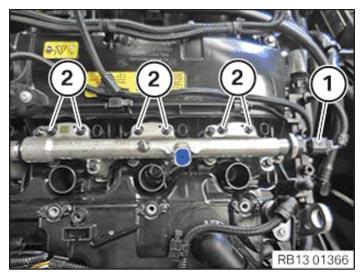
- Unlock and loosen connector (1).
- Release screws (M5x30) (2).
Do not reuse the bolts (2).
- Catch and dispose of leakage fuel with suitable materials.
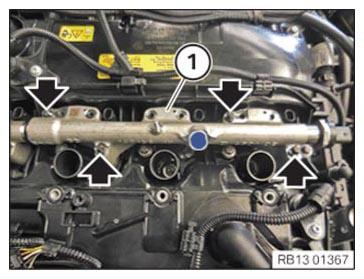
- Unscrew the screws (M6x70) (arrows).
The screws (arrows) may not be reused.
- Remove rail (1) in upward direction.
The injectors remain in the cylinder head.
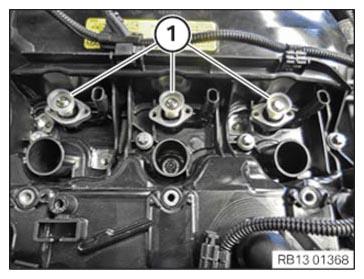
- Remove the gaskets (1).
The seals (1) are required during first assembly within the works only and will not be installed again.
NOTE: RISK OF DAMAGE
Damage to injectors.
Excessive force may damage the injector and this means having to replace the injector.- Twist the injectors with a torsional movement of maximum 13 Nm.
- If the specified value for the tensile force is exceeded: Replace injector.
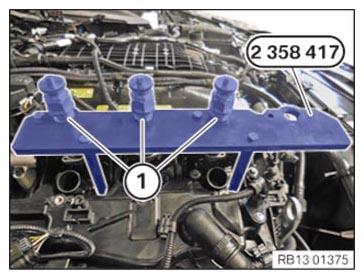
- Use the special tool 2 358 417
to remove the injectors.
Special tool 2 358 417 is used to ensure that the tensile force is not exceeded.
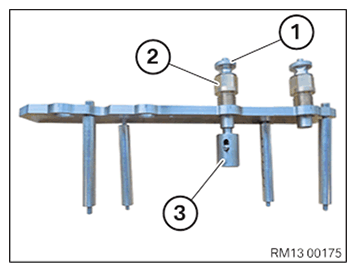
The special tool 2 358 417 consists of:
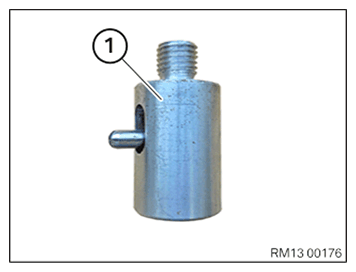
- (1) Threaded sleeves
- (2) Pull-out thread (left-hand thread)
- (3) Mounting for the injectors
- Unscrew the stand for the injectors (1) from the special tool 2 358 417.
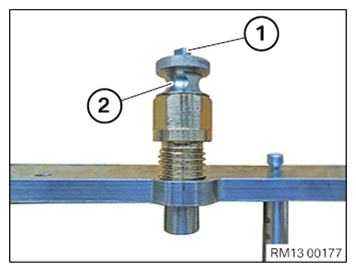
- Press the lock (1) and remove threaded sleeve (2) from the special tool 2 358 417
.
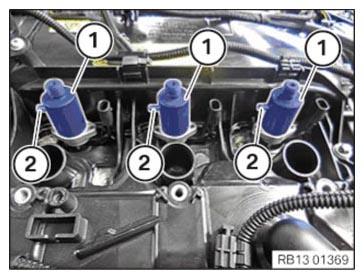
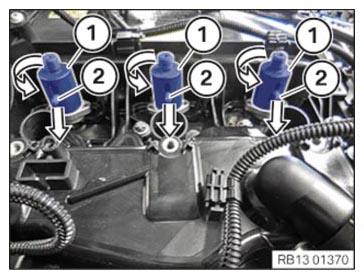
- Install all stands (1) for the injectors.
The mountings (1) are not yet locked when the levers (2) are up.
- Turn intakes (1) 90° and lock the lever (2) downwards.NOTE: RISK OF DAMAGE
Damage to injectors.
Excessive force may damage the injector and this means having to replace the injector.- Do not use the puller plate as a support.
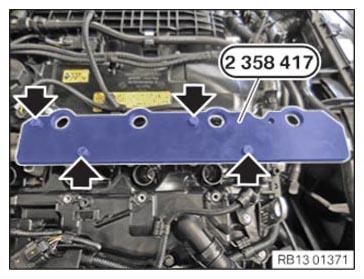
- Attach special tool 2 358 417 to cylinder head.
- Hand-tighten the bolts (arrows).NOTE: TECHNICAL INFORMATION
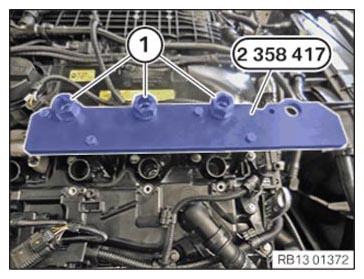
The extraction thread is a left-hand thread. - Screw in pull-out thread (1) on the special tool 2 358 417
fully.
- Insert thread bushings (1) and screw completely onto the fixtures for the injectors.
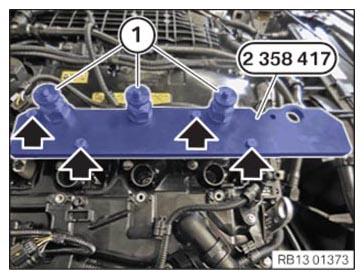
- Tighten the screws (arrows) on the special tool 2 358 417
to 5 Nm.
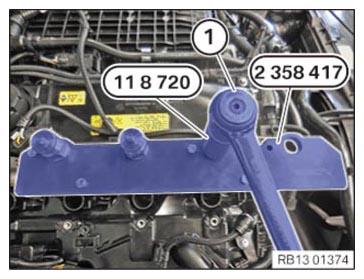
- Adjust the torque wrench to 13 Nm clockwise rotation .
- Turn torque wrench (1) in clockwise direction with special tool 0 496 106 (11 8 720) until the injector is pulled out.
- Disassemble all injectors individually.
- Before removing the special tool 2 358 417
with the injectors, check if all the injectors were completely pulled out of the cylinder head.
This can be recognized by the completely visible threads of the threaded sleeves (1).
- Loosen screws on special tool 2 358 417
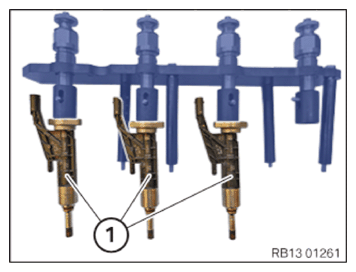
- Carefully remove the special tool 2 358 417 with the injectors (1) vertically straight up from the cylinder head.
- Place the combination of the special tool 2 358 417
and the injectors (1) flat onto a clean table.
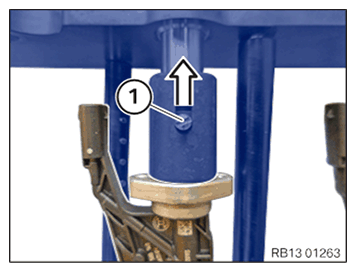
- Unlock the stand lock (1) from the top.
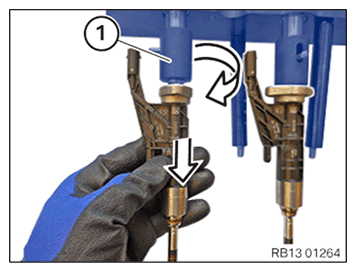
- Turn the unlocked stand (1) by 90°.
- Release and remove the injector downwards.