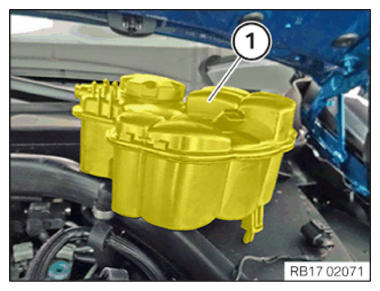
Remove coolant expansion tank
WARNING:
Hot surfaces.
Risk of burning!
Risk of burning!
- Perform all work only on components that have cooled down.
WARNING:
Hot fluids.
Risk of scalding!
Risk of scalding!
- Conduct all work in the vehicle wearing appropriate personal protective equipment only.
CAUTION:
Materials harmful to health.
Contact with fluids harmful to health!
Contact with fluids harmful to health!
- Note and follow safety instructions on containers.
- Conduct all work in appropriate personal protective equipment only.
NOTE:
TECHNICAL INFORMATION
Immobilization period-long fill of coolant!
Do not reuse used coolant.
Immobilization period-long fill of coolant!
Do not reuse used coolant.
When replacing and removing components which rely on the corrosion protection effect of the coolant, it is essential to change the coolant. The cooling system must therefore be emptied and refilled.
In the case of other removal work involving the draining of part quantities of coolant, the coolant level must be topped up with new coolant.
NOTE:
TECHNICAL INFORMATION
Notes on work at the cooling system form the basis of these repair instructions and must be complied with at all times.
For additional information see: 17 00... INSTRUCTIONS FOR REPAIR WORK ON COOLING SYSTEM
Notes on work at the cooling system form the basis of these repair instructions and must be complied with at all times.
For additional information see: 17 00... INSTRUCTIONS FOR REPAIR WORK ON COOLING SYSTEM
NOTE:
TECHNICAL INFORMATION
Collect and dispose of emerging fluids. Observe country-specific waste disposal regulations.
Collect and dispose of emerging fluids. Observe country-specific waste disposal regulations.
Preliminary work
- Refer to DISCONNECTING ALL BATTERY GROUND LEADS .
- Refer to REMOVING THE COVER PANEL OF THE LEFT DME CONTROL UNIT .
- Refer to REMOVE TOP CLEAN AIR PIPE .
- Refer to REMOVING THE CONTROL UNIT BRACKET FOR CYLINDERS 5 TO 8 .
WARNING:
Hot surfaces.
Risk of burning!
Risk of burning!
- Perform all work only on components that have cooled down.
NOTE:
RISK OF DAMAGE
Injectors contaminated with coolant.
Damage to and failure of injectors that were coated with coolant for an extended period.
Injectors contaminated with coolant.
Damage to and failure of injectors that were coated with coolant for an extended period.
- Covering injectors with suitable auxiliary materials before testing or topping up the coolant is mandatory.
- Covering injectors with suitable auxiliary materials before working on the cooling system in the area of the injectors is mandatory.
- If necessary, draw off all of the coolant from the coolant expansion tank.
- Always clean injectors or injector shafts contaminated with coolant (e.g. with compressed air).
NOTE:
TECHNICAL INFORMATION
Collect and dispose of emerging fluids. Observe country-specific waste disposal regulations.
Collect and dispose of emerging fluids. Observe country-specific waste disposal regulations.
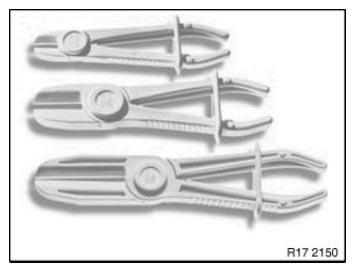
- Use commercially available disconnection tools to pinch off the coolant lines.
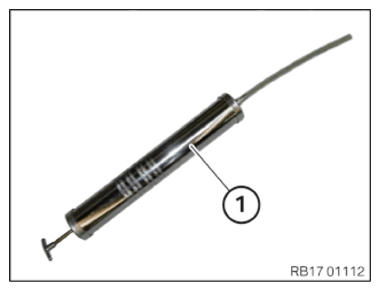
- Use commercially available syringe (1) or suitable tool to draw off coolant expansion tank.
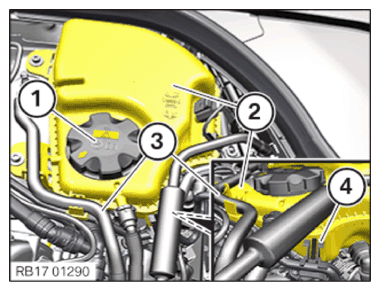
- Loosen sealing cap (1).
- Draw off coolant using standard pump from the coolant expansion tank (2) and dispose of it.
- Disconnect the coolant hose (3) from the coolant expansion tank (2).
- Unlock and loosen holder (4).
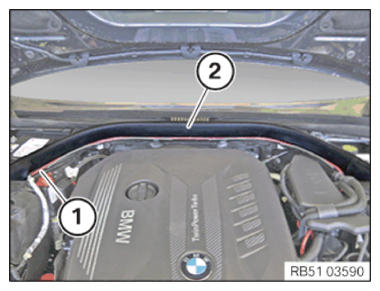
- Equipment specification with gasoline particulate filter:
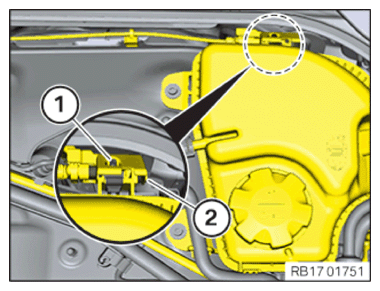
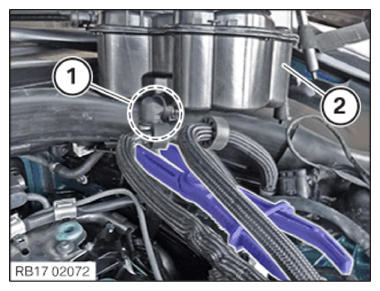
Feed the cable (1) out of the brackets toward the front.
Detach the rear hood seal (2) inward out of the guide.
- Equipment specification with gasoline particulate filter:
- Loosen screws (1).
- Carefully slide the coolant expansion tank (2) upwards and to the front.
- Equipment specification with gasoline particulate filter:
Release the screws (1) several thread starts.
Lift the holder of the GPF (2) upward and out of the guide.
- Thread out coolant expansion tank (2) and remove.
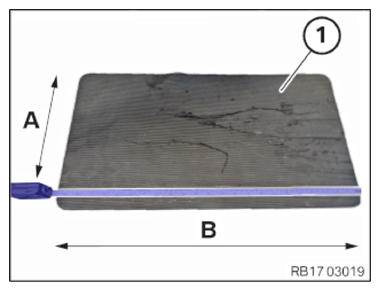
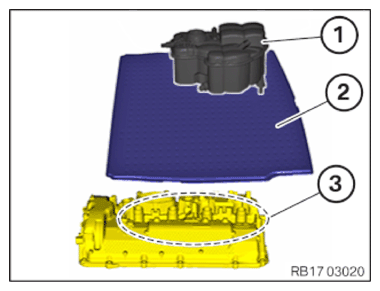
- Prepare a standard waterproof rubber mat (1).
Letter: Dimension in cm A 32.00 B 52.00 NOTE: Schematic diagram is for example purposes. Some parts may differ in certain details. - Illustrated on the S63T4:
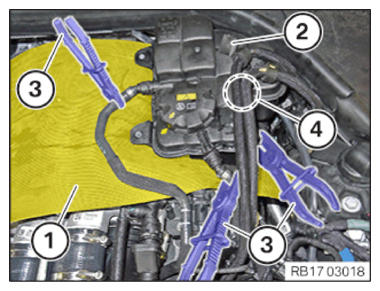
- Unclamp the coolant hoses with clamping pliers (3).
- Raise coolant expansion tank (2).
- Position the rubber mat (1) between the expansion tank and the cylinder head cover.
- Unclip the fuel lines in area (4) from expansion tank (2).
- Make sure that the rubber mat (2) covers the areas between the expansion tank (1) and cylinder head cover in the area of the injector shafts (3).
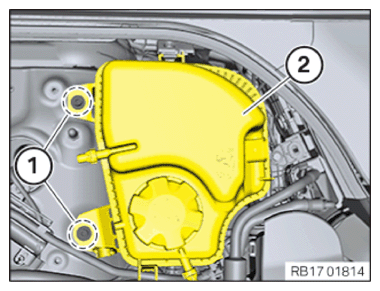
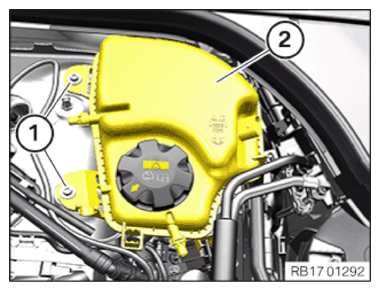
- Loosen screws (1).
- Thread out coolant expansion tank (2) and remove.NOTE: TECHNICAL INFORMATION
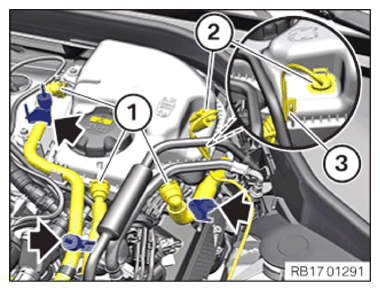
Only flexible hose pipes may be disconnected. - Disconnect the coolant hoses (1) with standard disconnection tools (arrows).
- Unlock and release coolant line (1).
- Catch and dispose of escaping coolant.
- Unlock plug connection (2) and disconnect.
- Disconnect clamp (3).NOTE: Schematic diagram is for example purposes. Some parts may differ in certain details.
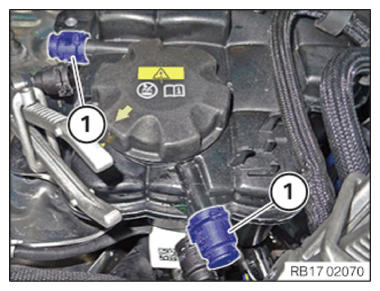
- Illustrated on the S63T4:
- Seal the connections to the coolant expansion tank with seal plugs (1) part number 17 12 8 515 062.NOTE: Schematic diagram is for example purposes. Some parts may differ in certain details.
- Illustrated on the S63T4:
- Set coolant expansion tank (1) aside.NOTE: Schematic diagram is for example purposes. Some parts may differ in certain details.
- Illustrated on the S63T4:
- Ensure that the coolant hose is clamped with clamping pliers.
- Unlock and disconnect coolant hose in area (1).
- Remove the coolant expansion tank (2).NOTE: RISK OF DAMAGE
Injectors contaminated with coolant.
Damage to and failure of injectors that were coated with coolant for an extended period.- Covering injectors with suitable auxiliary materials before testing or topping up the coolant is mandatory.
- Covering injectors with suitable auxiliary materials before working on the cooling system in the area of the injectors is mandatory.
- If necessary, draw off all of the coolant from the coolant expansion tank.
- Always clean injectors or injector shafts contaminated with coolant (e.g. with compressed air).
CAUTION: Swirling dirt particles caused by compressed air.
Injury hazard!- Collect dirt particles, e.g. when blowing out, use cloth to do so.
- Wear safety goggles.
CAUTION: Materials harmful to health.
Contact with fluids harmful to health!- Note and follow safety instructions on containers.
- Conduct all work in appropriate personal protective equipment only.
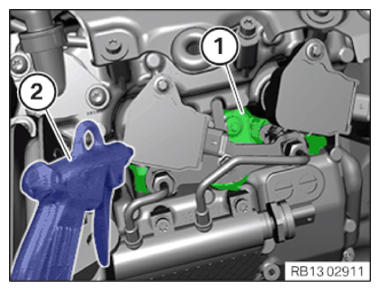
- Check the injector shafts for coolant residues (1).
- If there are coolant residues (1) in the injector shaft: Clean the injector shafts with an air gun (2).