Removing coolant pump for low-temperature, left
WARNING:
Hot fluids.
Risk of scalding!
Risk of scalding!
- Conduct all work in the vehicle wearing appropriate personal protective equipment only.
CAUTION:
Materials harmful to health.
Contact with fluids harmful to health!
Contact with fluids harmful to health!
- Note and follow safety instructions on containers.
- Conduct all work in appropriate personal protective equipment only.
NOTE:
TECHNICAL INFORMATION
Follow notes for repair work on the cooling system.
For additional information see:
INSTRUCTIONS FOR REPAIR WORK ON COOLING SYSTEM
Follow notes for repair work on the cooling system.
For additional information see:
INSTRUCTIONS FOR REPAIR WORK ON COOLING SYSTEM
NOTE:
TECHNICAL INFORMATION
Immobilization period-long fill of coolant!
Do not reuse used coolant.
When replacing and removing components which rely on the corrosion protection effect of the coolant, it is essential to change the coolant. The cooling system must therefore be emptied and refilled.
In the case of other removal work involving the draining of part quantities of coolant, the coolant level must be topped up with new coolant.
Immobilization period-long fill of coolant!
Do not reuse used coolant.
When replacing and removing components which rely on the corrosion protection effect of the coolant, it is essential to change the coolant. The cooling system must therefore be emptied and refilled.
In the case of other removal work involving the draining of part quantities of coolant, the coolant level must be topped up with new coolant.
NOTE:
TECHNICAL INFORMATION
Filling without the vacuum filling equipment (watering can filling) is not permitted.
If this is not observed, there is a risk of component damage or engine damage.
The filling specification must be observed.
It is essential to visually check the vacuum filling equipment before use to check that it is functioning correctly and clean.
It is not permissible to operate the vehicle if the filling procedure has not been fully completed. Otherwise there may be functional limitations (degradation) or overheating.
A bleeding procedure is required after a part has been exchanged in the cooling system and/or after refilling the cooling system.
Filling without the vacuum filling equipment (watering can filling) is not permitted.
If this is not observed, there is a risk of component damage or engine damage.
The filling specification must be observed.
It is essential to visually check the vacuum filling equipment before use to check that it is functioning correctly and clean.
It is not permissible to operate the vehicle if the filling procedure has not been fully completed. Otherwise there may be functional limitations (degradation) or overheating.
A bleeding procedure is required after a part has been exchanged in the cooling system and/or after refilling the cooling system.
NOTE:
TECHNICAL INFORMATION
Collect and dispose of emerging fluids. Observe country-specific waste disposal regulations.
Collect and dispose of emerging fluids. Observe country-specific waste disposal regulations.
Preliminary work
- Refer to REMOVING THE COVER ON LEFT AND RIGHT IN THE ENGINE COMPARTMENT AT THE TOP .
- Refer to REMOVING LEFT INTAKE FILTER HOUSING WITH LEFT FRONT-END STRUT .
- Refer to REMOVING RIGHT INTAKE FILTER HOUSING WITH RIGHT FRONT-END STRUT .
- Refer to REMOVING FRONT CROSS CONNECTION .
- Refer to REMOVING THE REAR TOP CROSS CONNECTION .
- Refer to REMOVING FAN COWL .
- Refer to REMOVING THE FRONT RIGHT LOWER WHEEL ARCH COVER .
- Refer to REMOVING THE LEFT FRONT BOTTOM WHEEL ARCH COVER .
- Refer to REMOVING THE FRONT UNDERBODY PROTECTION OR FRONT THRUST FIELD .
- Refer to REMOVING THE UNDERBODY PROTECTION OF THE STEERING GEAR AND THRUST FIELD RESPECTIVELY .
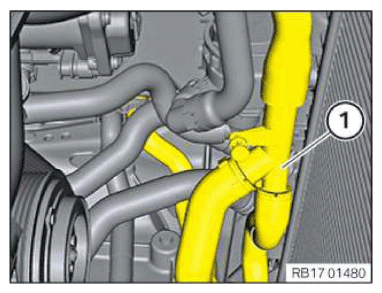
- Push the coolant hose (1) aside.
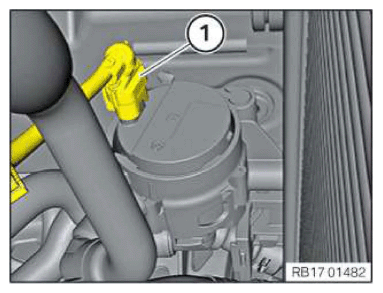
- Unlock plug connection (1) and disconnect.
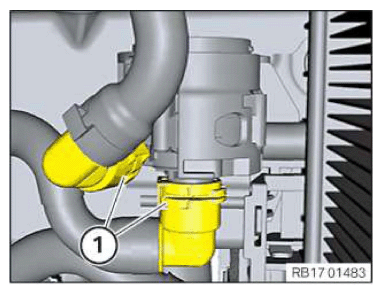
- Unlock and disconnect the coolant hoses (1).
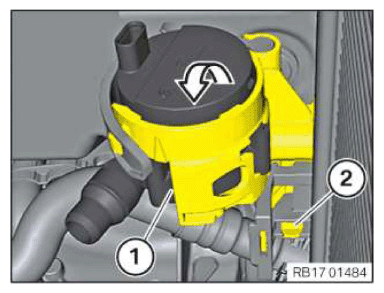
Releasing electric coolant pump of feed line from holder