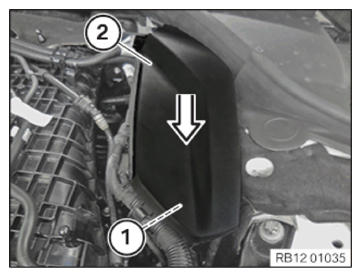
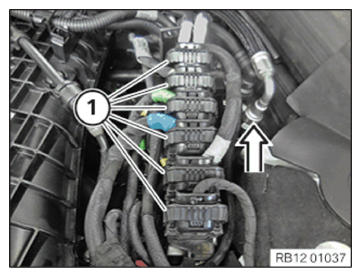
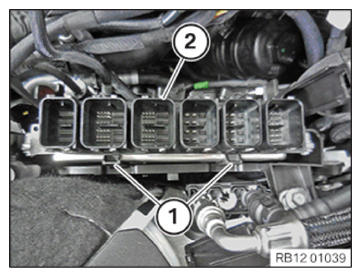
Removing the DME control unit
WARNING:
Working on 12 V electrical system.
Risk of short circuits! Risk of fire!
Risk of short circuits! Risk of fire!
- Make sure that there is no charger connected to the jump start terminal in the engine compartment.
- Detach battery ground lead from battery.
- For auxiliary batteries: Detach battery minus cables from all auxiliary batteries.
NOTE:
RISK OF DAMAGE
Damage to battery terminal, the safety battery terminal or the intelligent battery sensor (IBS).
Damaged battery terminals can lead to malfunctions or vehicle electrical system faults.
Damage to battery terminal, the safety battery terminal or the intelligent battery sensor (IBS).
Damaged battery terminals can lead to malfunctions or vehicle electrical system faults.
- Detach battery terminal from battery pole by carefully shifting to and fro. Do not pry off using a tool.
Preliminary work
- Refer to DISCONNECTING ALL BATTERY GROUND LEADS .
- Refer to REMOVING THE ACOUSTIC COVER .
NOTE:
RISK OF DAMAGE
Electrostatic discharge.
Damage to or destruction of electrical components.
Electrostatic discharge.
Damage to or destruction of electrical components.
- Leave the electrical components in their original packaging until they are being installed. Only use the original packaging for returning the product. Always package removed components straight away.
- Read and comply with user information on using the associated special tool 12 7 060.
- Only tap the housings of electrical components. Do not tap pins or multi-pin connectors directly.
- Wear electrically conductive clothing and antistatic shoes (with ESD symbol).
- For additional information see: NOTES ON ESD (ELECTROSTATIC DISCHARGE) PROTECTION .
NOTE:
TECHNICAL INFORMATION
Follow instructions for removing and installing control units.
For additional information see: INSTRUCTIONS FOR REMOVAL AND REPLACEMENT OF CONTROL UNITS .
Follow instructions for removing and installing control units.
For additional information see: INSTRUCTIONS FOR REMOVAL AND REPLACEMENT OF CONTROL UNITS .
NOTE:
TECHNICAL INFORMATION
In a warranty case, you must always provide a fault memory printout with the defective part, even if the fault memory does not contain an entry.
In a warranty case, you must always provide a fault memory printout with the defective part, even if the fault memory does not contain an entry.
NOTE:
TECHNICAL INFORMATION
Control unit must be programed after it is replaced.
For additional information see: PROGRAMING/ENCODING THE CONTROL UNIT(S) INCLUDING DELETION OF FAULT MEMORY (AFTER VEHICLE TEST) .
Control unit must be programed after it is replaced.
For additional information see: PROGRAMING/ENCODING THE CONTROL UNIT(S) INCLUDING DELETION OF FAULT MEMORY (AFTER VEHICLE TEST) .
NOTE:
TECHNICAL INFORMATION
Disconnecting control units may cause fault code entries and functional limitations. Fault code entries must be read out and deleted if necessary.
Disconnecting control units may cause fault code entries and functional limitations. Fault code entries must be read out and deleted if necessary.