Remove air conditioning compressor
CAUTION:
Refrigerant circuit under high pressure.
Danger of injury!
Danger of injury!
- Note and follow safety information on containers.
- Avoid contact with refrigerant wear safety goggles and protective gloves.
- For additional information see: 64 50 HANDLING REFRIGERANT and 64 50 NOTES on air conditioning repair work
NOTE:
RISK OF DAMAGE External damage to air conditioning compressor. Excessive force applied during removal will result in damage to the air conditioning compressor.
- Remove the air conditioning compressor without damaging it and without applying external force.
- Avoid impacts/knocks to plastic belt pulley (caused by tools, contact with base).
- Return faulty air conditioning compressors in their original packaging only.
NOTE:
TECHNICAL INFORMATION
If mechanical failure of the air conditioning compressor occurs resulting in chips entering the refrigerant circuit, replace the following parts: air conditioning compressor, air conditioning condenser with desiccant insert, line to air conditioning condenser and refrigerant oil.
If mechanical failure of the air conditioning compressor occurs resulting in chips entering the refrigerant circuit, replace the following parts: air conditioning compressor, air conditioning condenser with desiccant insert, line to air conditioning condenser and refrigerant oil.
Preliminary works
- Draw off the AIR CONDITIONING .
- Remove the acoustic COVER .
- Remove RESONATOR .
- Release the charge AIR LINE
- Remove the front engine acoustic COVER .
- Remove the alternator DRIVE BELT .
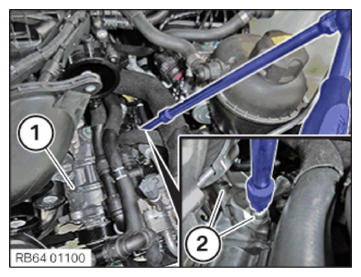
- Release the connecting piece REFRIGERANT LINE
CAUTION:
Residual pressure in the air conditioning.
Danger of injury!
Danger of injury!
- Wear safety goggles and protective gloves when disconnecting the refrigerant line.
- Seal refrigerant lines with seal plugs.
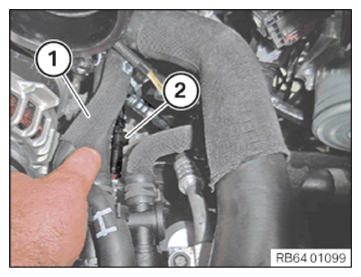
- Slide the coolant hose (1) slightly to the side.
- Unlock and disconnect connector (1).
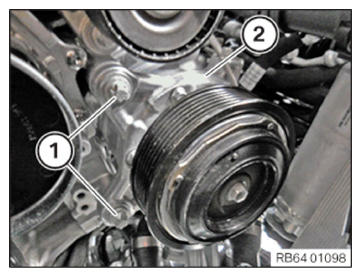
- Loosen the screws (1) on the air conditioning compressor (2).
- Push the air conditioning compressor (2) slightly to the side.
NOTE:
TECHNICAL INFORMATION
Secure component against falling.
Secure component against falling.