Long-Term Vehicle Storage And Cleaning Recommendations (SI B00 04 16)
Publication date: 2020-04-10Reference number: SI B00 04 16
LONG-TERM VEHICLE STORAGE AND CLEANING RECOMMENDATIONS
SERVICE CAMPAIGN BULLETIN
| BMW: | All new, Certified Pre-Owned (CPO) and other Pre-Owned vehicles |
SERVICE INFORMATION
This Service Information Bulletin (Revision 1) replaces SI B00 04 16 dated April 2016 .
What's New (Specific text highlighted):
- Title expanded
- Pre-Owned vehicles added
- Short-term vehicle storage
- Cleaning resources during Coronavirus
SITUATION
- Recommended procedures for storing BMW vehicles up to approx. 1 year.
- Vehicle Interior Cleaning measures as precautions for the Coronavirus (COVID-19), as of March 2020
CAUSE
Long-term storage of those vehicles that are not operated due to lack of availability of the essential repair parts for Delivery Stops and Recalls.
The amount of time vehicles may be remaining in your inventory can increase from the impending COVID-19. These storage procedure recommendations should be reviewed and applied as necessary to your vehicle inventory (new and pre-owned) in an effort to help maintain and protect them.
CORRECTION
Vehicle storage information is based on the ISTA/AIR operations-
00 00... "Upkeep measures for stored vehicles (new and used cars)..."
00 00 742 "Pre-delivery check of service and parking brakes with transport and immobilization periods of 3-6 weeks"
00 00 744 "Pre-delivery check, service brake and electromechanical parking brake for transport and immobilization periods over 6 weeks"
Vehicle cleaning considerations for COVID-19: TIS, Technical Documentations section, COVID-19 Resources.
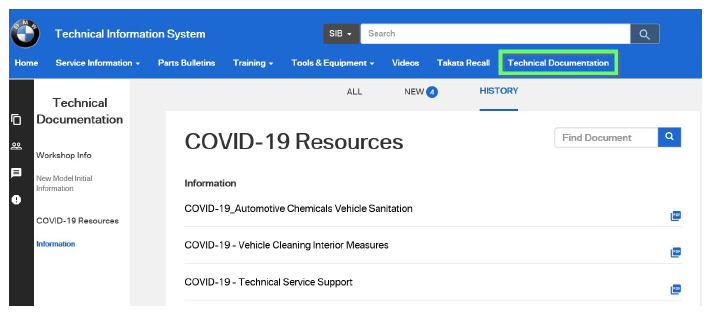
- BMW Aftersales Bulletin B-2-0320-0241 includes chemicals and Personal Protection Equipment (PPE) for cleaning of the interior and exterior of new and used vehicles
PROCEDURE
New vehicles:
If you receive a new vehicle from either your facing Vehicle Distribution Center or Plant Spartanburg, it will already have the following equipment in place which facilitates long-term storage:
- Bodyguard® protective wrap* on the hood, trunk lid and hardtop roof surfaces
- Tires inflated to "transport" pressures, approx. 50 - 55 psi
- Transport mode activated
- Color-coded battery charging label on windshield
- Protective covers for front seat, driver's footwell, and driver's door panel
Perform the following:
- Obtain a commercially-available fuel stabilizer (e.g. STA-BIL®), and mix it per the recommended dosage for the vehicle's fuel tank size.
- Drive the vehicle, or at least let the engine idle for approx. 10 minutes to ensure full mixing of the stabilizer within the fuel system. If driving the vehicle, be aware of different vehicle handling characteristics due to the increased tire pressures.
- Fill the fuel tank
- Fully close all windows
- Make certain that the hood, trunk, fuel filler flap, and all doors are fully closed
- Note the in-storage date in the vehicle file
- Check the battery voltage per SI B61 18 08
- Maintain exterior paint surfaces against airborne pollutants
*Keep the Bodyguard protection on the vehicles - especially when stored outside - for a maximum of 6 months. Warranty claims for damage found when the protective film is eventually removed are permitted for up to six months after date of production.
IMPORTANT NOTE: The Bodyguard film must not remain on any vehicle beyond six (6) months from its date of production. Refer to SI B01 04 13 .
Guidelines for storage:
BMW has developed specific guidelines which reduce the risk of damage to new vehicles during storage, or while they are otherwise stationary. These include:
- No storage in the proximity of industrial, power generation, refinery companies and/or ship/vessel port facilities that create and/or are subject to heavy (particulate) air pollution.
- Avoid parking underneath trees. Covered storage is preferable, especially for convertibles (e.g. F12, F23, E89). If a covered storage area is not available, apply a quality, weather-resistant car cover such as one offered by BMW Accessories.
- Protect vehicles parked outdoors against direct sunlight (especially upholstery and plastic parts).
- Always keep vehicles locked
- Do not write on the windows
- Recommended minimum distance to other vehicles or fixed objects:
- Bumper to bumper: 1 foot
- Side to side: 2 feet, to allow opening the driver's door
- Check each tire's inflation pressure to be aware of possible slow leaks. A useful tool is the BMW Electronic Tire Pressure Gauge, P/N 82 12 1 467 187.
- Manual transmissions: release the parking brake and engage a gear. Apply wheel chocks if parked on an incline.
- Automatic transmissions: place in "park", but do not activate the parking brake.
Monthly check:
All new vehicles that have already been stored for one month must be checked for storage damage and other deficiencies before the storage period continues. In general, this inspection should be repeated at least once a month. Any damage that is discovered must be repaired immediately.
- Perform a key read to check for new Service Actions, Delivery Stops or recalls.
- The passenger and luggage compartment are to be examined for moisture. If condensation is discovered, ensure adequate ventilation and remedy the causes.
- The adjoining panels situated directly below all doors, the hood and trunk lid/tailgate are to be examined for cavity wax leakage. If discovered, remedy the soiling with special cleaning to prevent permanent marks on painted surfaces.
- To prevent tire pressure loss, each vehicle must be moved every four weeks. In doing so, ensure that the tires do not come to rest on the same contact surface. Mark one tire sidewall with white chalk at the point where the tire touches the ground.
- A brief drive is recommended to check the brakes and reduce brake disc surface corrosion
- Start the engine. Run the air conditioning system for 10 min. to circulate the A/C oil.
- Examine the ground beneath the engine and below the exhaust pipes for evidence of rodent activity. If present, take appropriate action.
CPO and other Pre-Owned Vehicles:
Perform all operations listed for "New vehicles", except for applying a protective body film. In addition:
- Increase tire pressure to 55 psi (approx. 4 bar) to resist flat-spotting while parked. Do not exceed the tire manufacturer's inflation pressure which is found on the sidewall.
- Fill the windshield washer fluid reservoir with undiluted washer fluid anti-freeze, for maximum freezing resistance
- Activate Transport Mode to reduce battery drain while in sleep mode. Refer to B04 22 14 .
- F-and G-Series cars in transport mode will show the state of charge right away when the Start/Stop button is pressed (for F-Series models, already by unlocking the vehicle). If the vehicle gets charged, values change immediately.
- Disconnect the battery per the ISTA operation 61 20 900 "Disconnecting and connecting battery earth lead" for the specific vehicle
- High Voltage batteries on hybrid, plug-in hybrid and i models must be checked and maintained at the same intervals as the 12V batteries
- Brake fluid: Replace the fluid prior to storage, if the Key Read indicates the operation is close to the 2 year replacement interval
- Diesel engines, cold regions: Pour a commercially available cold-flow improver into the fuel tank following the manufacturer's instructions for dosage.
- Any CPO vehicle which still has coverage under the 4-year ConnectedDrive program cannot have this program postponed for the duration of the storage period. It will expire based on the contract duration based on the original in-service, or activation date.
- For vehicles with diesel engines, no additional Diesel Exhaust Fluid is needed. If the engine is started during freezing conditions, the system will warm up when idling.
PARTS INFORMATION
Refer to part numbers for cleaning resources in the COVID-19 documents found in TIS, Technical Documentations section, COVID-19 Resources.
WARRANTY INFORMATION
Not applicable.