Brake Noise - Helpful Facts For Effective Customer Communication (SI B34 05 20)
Publication date: 2022-03-30Reference number: SI B34 05 20
BRAKE NOISE - HELPFUL FACTS FOR EFFECTIVE CUSTOMER COMMUNICATION
SERVICE CAMPAIGN BULLETIN
Reference Number(s): SI B34 05 20, Date of Issue:
March 30, 2022
| BMW: | All except Motorsport vehicles |
SERVICE INFORMATION
This Service Information Bulletin (Revision 1) replaces SI B34 05 20 dated June 2020.
What's New (Specific text highlighted):
- Model Info
SITUATION
Noise while braking
INFORMATION
This bulletin intends to explain some typical brake noise phenomena and provide some recommendations about the usage and maintenance of the braking system.
- The below information can be used during the customer interaction but is not intended as a replacement for a proper diagnosis
- Every customer complaint should be taken seriously and if necessary, addressed using the support of the BMW Technical Support resources
General information about the root cause of brake noises
- The root cause of brake noises can be very different according to the vehicle's mileage, ambient conditions, and driving style
- Noises occurring in specific conditions (e.g., brakes squeak in the morning or in stop and go traffic) usually disappear by themselves when the conditions change. By contrast, if noises are present in every condition, this likely indicates the need for a repair
- A differentiation between "break-in phase" and "normal operation" is needed in order to properly address the customer complaints
"BREAK-IN" PHASE
- When the brake discs (aka rotors) and pads are new, their contacting surfaces need some mileage in order to adapt to each other and to create a perfect match. This adaptation phase is also called "break-in" phase
- Due to the stick-slip of the microscopic surface roughness of the still new contacting surfaces, some noises(especially squeaking) can arise
- The length of the "break-in" phase is strongly dependent on traffic conditions and driving style (customer profile) and usually lasts for the first 300-400 miles
- During the "break-in" phase the brakes should be applied rather gently (if traffic conditions allow), in order to ease the matching process
- Please note that in some extreme cases the "break-in" phase can last up to 1000 miles
- Many noises occurring in specific conditions during the "break-in" phase usually disappear with increasing mileage
- After installing new brake pads and/or discs, another "break-in" phase is needed
PROCEDURE FOR CUSTOMER COMPLAINTS DURING THE "BREAK-IN" PHASE
- Ask the customer under which driving condition the noise appears and try to reproduce the issue
- Check for proper functionality of the brake system
- Check the brake discs and pads for abnormal wear and/or corrosion (in this phase abnormal wear and corrosion are rather unlikely)
- If the noise is present only in specific conditions and the brake pad and disc characteristics are within the normal service specifications for the car mileage:
- Inform the customer about the physics of the "break-in" phase (see root causes above)
- Suggest the customer to wait until the cars reaches a higher mileage for further investigation
- Use your best judgment and your knowledge of the customer profile and driving conditions of your area in order to identify a reasonable threshold for the end of the "break-in" phase
- If the noise is present in every condition and the brake pads and discs characteristics are within the normal service specifications for the car mileage, please contact the Technical Support for further assistance
"NORMAL OPERATION" PHASE
- After the "break-in" phase, the contact surfaces of brake discs and pads are matched. The brakes operate in their optimal design window. This phase is called "normal operation" phase
- While the noise should lessen in the "normal operation" phase, a variety of individual factors including driving style, local environment and weather conditions can influence the amount of noise
- Extremely low and high ambient temperatures can change the material properties of the brake pads and system lubricants. Noises related to extremely low or high temperatures usually disappear by themselves at normal temperatures.
- Noise and occasional vibrations may occur with increasing age and wear of the brake discs and pads as well. Vibrations are generally caused by thickness variations of discs and/or pads on vehicles with higher mileage.
PROCEDURE FOR CUSTOMER COMPLAINTS DURING THE "NORMAL OPERATION" PHASE
- Ask the customer in which conditions the noise appears and try to reproduce the issue
- Check for proper functionality of the brake system
- Check the brake discs and pads for abnormal wear and/or corrosion. For brake discs corrosion categorization and treatment please refer to SIB 34 10 16
- If the noise is present only in specific conditions and the brake pads and discs characteristics are within the normal service specifications for the car mileage:
- Inform the customer about the physics of the "normal operation" phase, (see root causes above)
- If the noise is present in low temperature conditions, suggest the customer to increase the functioning temperature of the brakes discs and pads by applying the brakes a few times moderately (if traffic conditions allow)
- If the noise is present after a severe application, ask the customer if the noise disappears after cooling down the brakes. Please emphasize the importance of cooling down the brakes after severe use
- After severe use, try to avoid applying the brake pedal while waiting at a traffic light. Instead shift the transmission into the "P" position.
- If the noise is present in every condition and the brake pad and disc characteristics are within the normal service specifications for the car mileage, please contact the Technical Support for further assistance
CORROSION
- Driving and parking repeatedly in corrosive environments, such as those with high humidity and road salt content can accelerate the disc corrosion process
- Long vehicle down times can result in strong disc corrosion that cannot be removed simply by brake application
PROCEDURE FOR CUSTOMER COMPLAINTS REGARDING CORROSION (VISUAL OR CORROSION-RELATED NOISE NOISES AND/OR VIBRATION)
- For brake disc corrosion categorization and treatment, refer to SIB 34 10 16
- Inform the customer about the following best practices:
- Moderate to sporty brake application (ABS intervention) can remove light surface corrosion (i.e., after letting the car parked over the weekend). Make sure that this procedure does not endanger other traffic
- Avoid long standing times if possible
- After a car wash, gently press the brake pedal every few miles, ensuring that this action does no ten danger other traffic. The heat generated during braking dries brake discs and brake pads and protects them against corrosion. This procedure is called "dry braking"
- The dry braking is strongly recommended if the car has been washed before a long storage time (for example before winter)
- Dry braking is also suggested when roads are wet, salted, or in heavy rain. Always make sure that this action does not endanger other traffic
OTHER MAINTENANCE BEST PRACTICES
When cleaning the wheels:
- Use acid/alkaline-free wheel cleaners to reduce the risk of corrosion
- Avoid an excessive use of tire shine products, as they might contaminate the brake pad surface
- Avoid pointing high-pressure cleaners directly onto brake parts. Using high-pressure cleaners can cause brake components to bind, resulting in brake noises
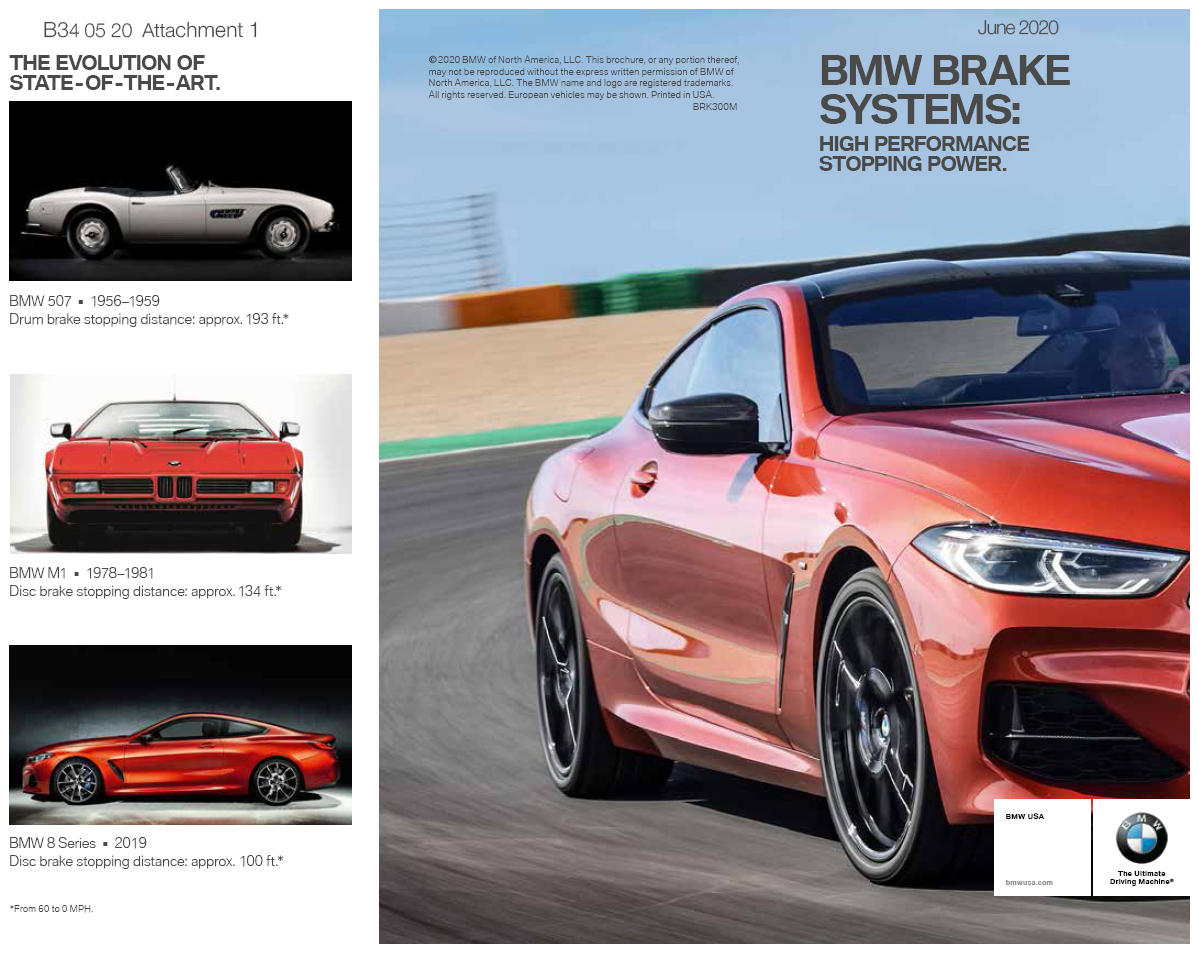
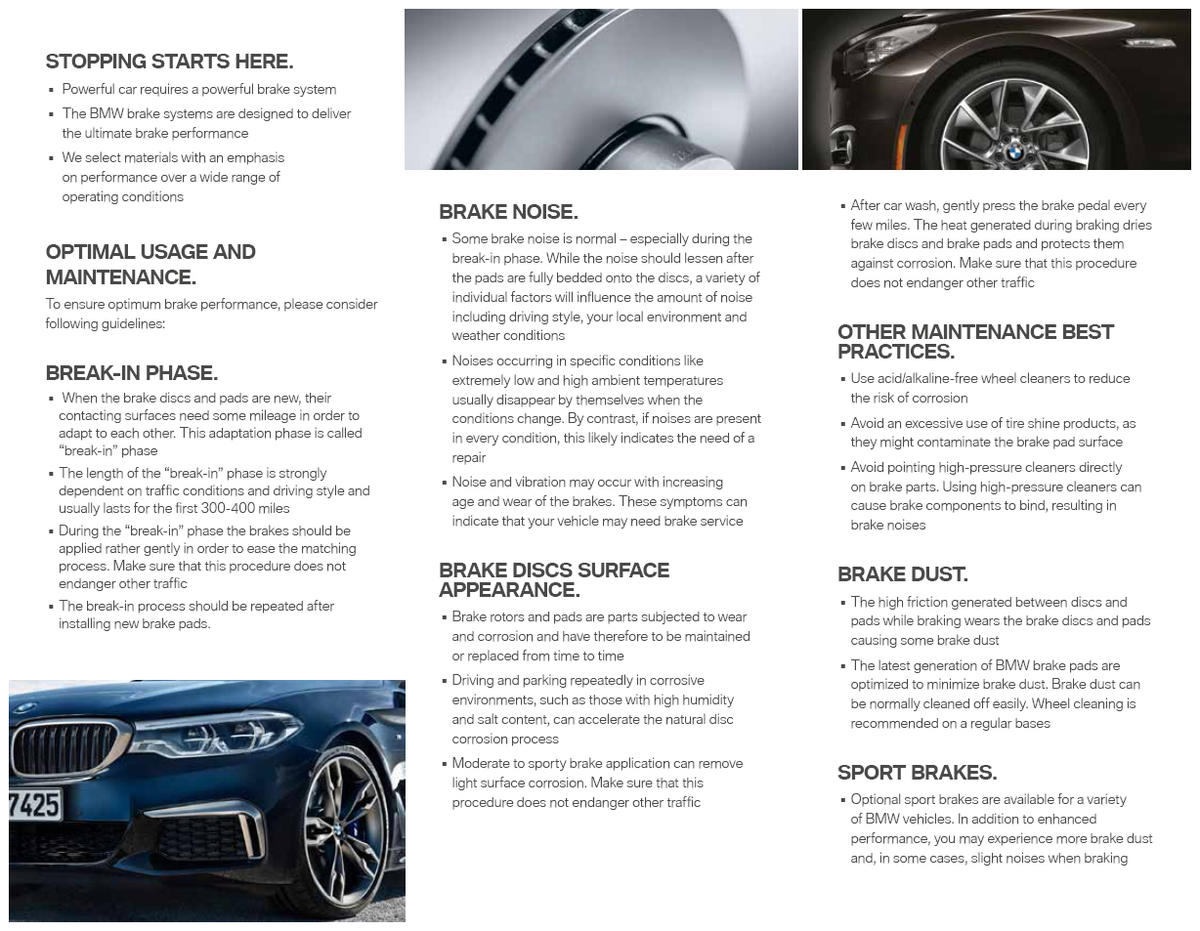
In addition, BMW North America has published the following customer brochure:
"BMW Brake Systems: High-Performance Stopping Power" (Shown).
Supporting Materials
picture_as_pdf B34 05 20 BMW_Brake_Brochure.pdf