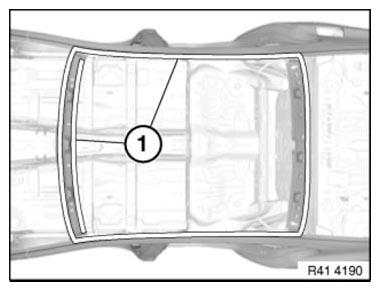
BMW/MINI BONDING INSTRUCTIONS (530i 2017-2022, 530i xDrive 2017-2022, 530e PHEV 2018-2022, 530e xDrive PHEV 2018-2022, 540i 2017-2022, 540i xDrive 2017-2022, M550i xDrive 2018-2022)
Required special tools:
- 2 357 309
Attention!
Conform with safety regulations!
- Brief overview of surface preparation
- 1.1 Structure
Material (surface condition)
Type of repairPreparation Aluminum (used part)
Repairs on front end/rear end
Example: Replacement of engine mount or front wheel arch- Remove coarse dirt from the bonding surfaces using solvent cleaner R2
- Clean with cleaning agent R1
- Grind bonding surfaces to a metallic bright-finish
- Clean with cleaning agent R1
- Flame-coating
- Bond with adhesive K1
Aluminum (new part)
Repairs on front end/rear end
Example: Replacement of engine mount or front wheel arch- Do not sand bonding surface
- Remove coarse dirt from the bonding surfaces using solvent cleaner R2
- Clean with cleaning agent R1
- Bond with adhesive K1
Carbon Fiber Reinforced Plastic (new part)
Bonding new parts on the body using K1 adhesive in conjunction with blind rivets
Example: Replacement of rear wheel arch- Remove coarse dirt from the bonding surfaces using solvent cleaner R2
- Clean with cleaning agent R1
- Sand with non-woven abrasive S1
- Clean with cleaning agent R1
- Activate with Betawipe 4800
- Bond with adhesive K1
Carbon Fiber Reinforced Plastic (used part)
Bonding new parts on the body using K1 adhesive
Example: Replacement of B-pillar- Remove coarse dirt from the bonding surfaces using solvent cleaner R2
- Clean with cleaning agent R1
- Sand adhesive residue
- Clean with cleaning agent R1
- Bond with adhesive K1
Sheet steel (used part and new part)
Partial replacement of components
Example: Replacement of B-pillar or rear wheel arch- Remove coarse dirt from the bonding surfaces using solvent cleaner R2
- Clean with cleaning agent R1
- Grind bonding surfaces to a metallic bright-finish
- Clean with cleaning agent R1
- Bond with adhesive K1
- 1.2 Outer skin (without roof outer skin made of aluminum/CFRP)
Material (surface condition)
Type of repairPreparation Sheet steel (used part)
Adhesion for outer skin component
Example: Replacement of rear quarter panel or tail panel- Remove coarse dirt from the bonding surfaces using solvent cleaner R2
- Clean with cleaning agent R1
- Grind bonding surfaces to a metallic bright-finish
- Clean with cleaning agent R1
- Bond with adhesive K5
Sheet steel (new part)
Adhesion for outer skin component
Example: Replacement of rear quarter panel or tail panel- Do not sand bonding surface
- Remove coarse dirt from the bonding surfaces using solvent cleaner R2
- Clean with cleaning agent R1
- Bond with adhesive K5
- 1.3 Roof outer skin made of aluminum/CFRP
Material (surface condition)
Type of repairPreparation Aluminum (new part)
Bonding a roof outer skin made of aluminum- Do not sand bonding surface
- Remove coarse dirt from the bonding surfaces using solvent cleaner R2
- Clean with cleaning agent R1
- Bond with adhesive K2
Sheet steel (primer undamaged)
Bonding a roof outer skin made of aluminum- Remove coarse dirt from the bonding surfaces using solvent cleaner R2
- Clean with cleaning agent R1
- Cut back adhesive bead
- Clean with cleaning agent R1
- Bond with adhesive K2
Sheet steel (primer damaged)
Adhesion for roof outer skin- Remove coarse dirt from the bonding surfaces using solvent cleaner R2
- Clean with cleaning agent R1
- thin coat with adhesive K1
- Bond with adhesive K2
Carbon Fiber Reinforced Plastic (used part)
Adhesion for roof outer skin- Remove coarse dirt from the bonding surfaces using solvent cleaner R2
- Clean with cleaning agent R1
- Cut back adhesive bead
- Clean with cleaning agent R1
- Bond with K2/K3 adhesive
Carbon Fiber Reinforced Plastic (new part)
Adhesion for roof outer skin- Remove coarse dirt from the bonding surfaces using solvent cleaner R2
- Clean with cleaning agent R1
- Sand with non-woven abrasive S1
- Clean with cleaning agent R1
- Activate with Betawipe 4800
- Bond with K2/K3 adhesive
- 2.1 The following basic conditions apply to all bonding:
- The working temperature of glue cartridge must be more than 18°C.
- Object temperature, vehicle and new parts, at least 15°C.
- Refer to the vehicle-specific REP for the position and thickness of the adhesive bead.
- After applying the adhesive, check whether an adhesive component has emerged at the back of the glue cartridge. If yes, break off the bonding procedure. Clean new part. Use new glue cartridge.
- Join components and secure in position.
- Remove excess adhesive. Do not use solvent cleaning agents.
- 2.2 Surface preparation (structural):
- 2.2.1 Flame-coating (aluminum):
- Clean bonding surfaces with cleaning agent R1.
- Remove oxide layers or paint from bonding surfaces using a stainless steel wire brush or sandpaper with 120 graining.
- Clean bonding surfaces with cleaning agent R1.
Allow cleaned surfaces to dry for approx. 5 min.
Bonding surfaces must be completely dry.
- Flame spray the surface:
Slowly move over the bonding surfaces in their entirety with the flame.
Avoid flaming with the blue part of the flame.
Condensation water appears on the area that is still uncoated. The condensation water in the line of the flame must evaporate completely.
Immediately after the flame treatment, coat the still warm bonding surfaces (approximately 50°C) with P1 primer.
Prime with a brush, cotton or similar item.
Allow the coated surfaces to dry for approx. 5 minutes.
- 2.2.2 Surface preparation (Carbon Fiber Reinforced Plastic new part):
This surface preparation applies to new CFRP parts.
Remove coarse dirt from the bonding surfaces using solvent cleaner R2.
Clean bonding surfaces with cleaning agent R1.
Sand bonding surfaces with non-woven abrasive S1.
Clean bonding surfaces with cleaning agent R1.
Let cleaned bonding surfaces dry for at least 2 min.
Bonding surfaces must be completely dry.
Activate bonding surfaces with Betawipe 4800.
Let activated bonding surfaces dry for at least 2 min.
Bonding surfaces must be completely dry.
- 2.2.3 Surface preparation (Carbon Fiber Reinforced Plastic used part):
This surface preparation applies to the top area of the B-pillar.
Attention!
Carbon Fiber Reinforced Plastic component not damaged!
Components must be replaced if showing signs of damage.
Remove coarse dirt from the bonding surfaces using solvent cleaner R2.
Clean bonding surfaces with cleaning agent R1.
Grind off adhesive residue to a thickness of approx. 0.5 mm.
Clean bonding surfaces with cleaning agent R1.
Let cleaned bonding surfaces dry for at least 2 min.
Bonding surfaces must be completely dry.
- 2.2.1 Flame-coating (aluminum):
- 2.3 Surface preparation (outer skin (without roof outer skin)):
The procedure is described here.
- 2.4 Surface preparation (roof outer skin):
- 2.4.1 Surface preparation of roof frame and convertible top bow from sheet steel: WARNING: Injury hazard by the sharp edge of the scraper!
Cut back adhesive remnants (1) with scraper 2 357 309 to a minimum of 0.5 mm.
Primed surface must not be damaged.
Smaller damage to 5 mm or scratch marks can be ignored.
In the event of larger damage to primer (greater than 5 mm), proceed as follows:
Clean damaged area with cleaning agent R1.
Apply K5 adhesive to the bare areas using a spatula or (fine) brush. Apply a uniformly thin layer (max. 0.5 mm). After a curing period of 24 hours, the roof outer skin can be bonded.
The adhesive flange area must not be painted over when the roof frame is being repaired or replaced.
- 2.4.2 Surface preparation of Carbon Fiber Reinforced Plastic (used part): WARNING: Injury hazard by the sharp edge of the scraper!
Remove coarse dirt from the bonding surfaces using solvent cleaner R2.
Clean bonding surfaces with cleaning agent R1.
Cut back adhesive bead with scraper 2 357 309 to a minimum of 0.5 mm.
Clean bonding surfaces with cleaning agent R1.
Let cleaned bonding surfaces dry for at least 2 min.
Bonding surfaces must be completely dry.
- 2.4.3 Surface preparation of Carbon Fiber Reinforced Plastic (new part):
Prepare the surface as described under point 2.2.2.
- 2.4.1 Surface preparation of roof frame and convertible top bow from sheet steel:
- 1.1 Structure