Removing all spark plugs
NOTE:
DANGER
High-voltage system.
The high-voltage system operates on the basis of hazardous, electrical voltage and high currents. Mortal hazard through electric shock!
High-voltage system.
The high-voltage system operates on the basis of hazardous, electrical voltage and high currents. Mortal hazard through electric shock!
- All work on the high-voltage system may only be carried out by specially trained and technically experienced personnel.
- For additional information see:
- For additional information see:
Preliminary work
- Refer to REMOVING THE ACOUSTIC COVER .
- Refer to RELEASING THE SERVICE OPENING IN SOUND INSULATION ON TOP OF ENGINE .
- Refer to REMOVE ALL IGNITION COILS .
WARNING:
Hot surfaces.
Risk of burning!
Risk of burning!
- Perform all work only on components that have cooled down.
CAUTION:
Swirling dirt particles caused by compressed air.
Injury hazard!
Injury hazard!
- Collect dirt particles, e.g. when blowing out, use cloth to do so.
- Wear safety goggles.
NOTE:
TECHNICAL INFORMATION
Clean spark plug slot with compressed air.
The spark plug shaft must be cleaned using compressed air after having removed the ignition coils and before removing the spark plugs. After having removed the spark plugs, once again check the sealing surface for contamination and (if necessary) clean using a moist cloth or clean using compressed air.
Deposits that are not removed according to instructions may enter the combustion chamber and lead to uncontrolled combustion. Remaining deposits on the spark plug sealing surfaces may lead to leaks and the spark plugs may come loose during engine operation.
Spark plug threads must not be greased or oiled. Insufficiently tightened spark plugs may cause leaks and the sparks plugs may come loose during engine operation.
Clean spark plug slot with compressed air.
The spark plug shaft must be cleaned using compressed air after having removed the ignition coils and before removing the spark plugs. After having removed the spark plugs, once again check the sealing surface for contamination and (if necessary) clean using a moist cloth or clean using compressed air.
Deposits that are not removed according to instructions may enter the combustion chamber and lead to uncontrolled combustion. Remaining deposits on the spark plug sealing surfaces may lead to leaks and the spark plugs may come loose during engine operation.
Spark plug threads must not be greased or oiled. Insufficiently tightened spark plugs may cause leaks and the sparks plugs may come loose during engine operation.
NOTE:
The description is for one component only. The procedure is identical for all further components.
NOTE:
TECHNICAL INFORMATION
Exclusively swiveling extensions may be used for the reversible ratchet. Rigid mounting tool and variable plug connections with rigid option may not be used; there is a risk that the insulator breaks.
Exclusively swiveling extensions may be used for the reversible ratchet. Rigid mounting tool and variable plug connections with rigid option may not be used; there is a risk that the insulator breaks.
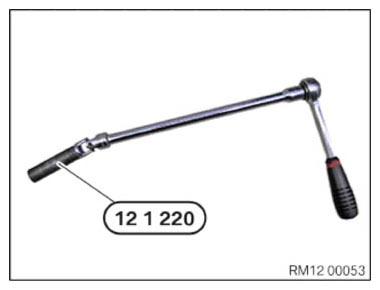
- Mount the special tool 0 495 560 (121 220)
to a pivotable extension.
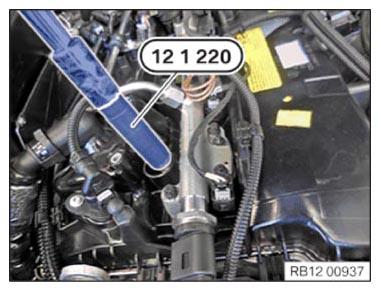
- Unscrew the spark plugs using the special tool 0 495 560 (12 1 220) along with a pivotable extension.