Vent the high-temperature coolant system
Vent the high-temperature coolant system
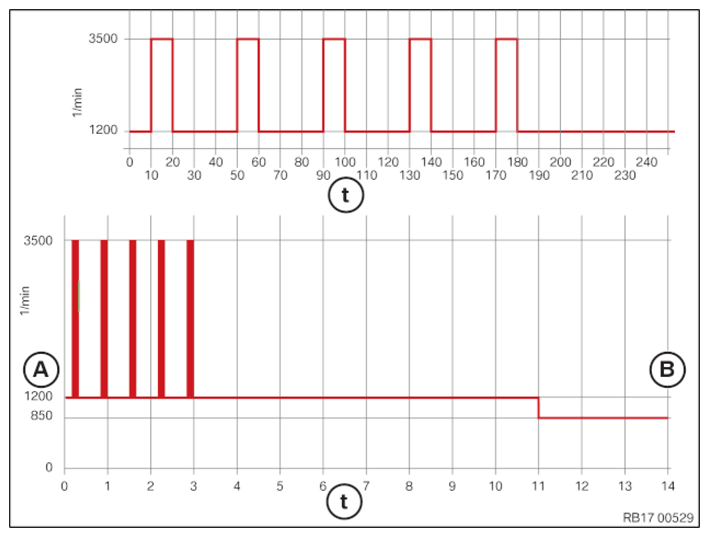
A = B = increased Cooling idle t system speed = bleeding Time procedure finished
NOTE:
TECHNICAL INFORMATION
Before starting the automatic cooling system bleeding procedure, make sure that both coolant circuits are filled . The cooling system bleeding procedure is automatically started simultaneously for both coolant circuits. If the cooling system bleeding procedure is started while one of the coolant circuits is empty, there is a risk of damage to the electric coolant pump when running it dry.
Make sure that terminal 15 is not disconnected for the bleeding procedure . Switch on low-beam headlights and hazard warning lights. If the low-beam headlights and hazard warning lights are not switched on, the ignition (terminal 15) will switch off automatically after a certain period of time and interrupt the bleeding procedure.
Before starting the automatic cooling system bleeding procedure, make sure that both coolant circuits are filled . The cooling system bleeding procedure is automatically started simultaneously for both coolant circuits. If the cooling system bleeding procedure is started while one of the coolant circuits is empty, there is a risk of damage to the electric coolant pump when running it dry.
Make sure that terminal 15 is not disconnected for the bleeding procedure . Switch on low-beam headlights and hazard warning lights. If the low-beam headlights and hazard warning lights are not switched on, the ignition (terminal 15) will switch off automatically after a certain period of time and interrupt the bleeding procedure.
NOTE:
TECHNICAL INFORMATION
Filling without the vacuum filling equipment (watering can filling) is not permitted.
If this is not observed, there is a risk of component damage or engine damage.
The filling specification must be observed.
It is essential to visually check the vacuum filling equipment before use to check that it is functioning correctly and clean.
It is not permissible to operate the vehicle if the filling procedure has not been fully completed. Otherwise there may be functional limitations (degradation) or overheating.
A bleeding procedure is required after a part has been exchanged in the cooling system and/or after refilling the cooling system.
Filling without the vacuum filling equipment (watering can filling) is not permitted.
If this is not observed, there is a risk of component damage or engine damage.
The filling specification must be observed.
It is essential to visually check the vacuum filling equipment before use to check that it is functioning correctly and clean.
It is not permissible to operate the vehicle if the filling procedure has not been fully completed. Otherwise there may be functional limitations (degradation) or overheating.
A bleeding procedure is required after a part has been exchanged in the cooling system and/or after refilling the cooling system.
NOTE:
TECHNICAL INFORMATION
Immobilization period-long fill of coolant!
Do not reuse used coolant.
When replacing and removing components which rely on the corrosion protection effect of the coolant, it is essential to change the coolant. The cooling system must therefore be emptied and refilled.
In the case of other removal work involving the draining of part quantities of coolant, the coolant level must be topped up with new coolant.
Immobilization period-long fill of coolant!
Do not reuse used coolant.
When replacing and removing components which rely on the corrosion protection effect of the coolant, it is essential to change the coolant. The cooling system must therefore be emptied and refilled.
In the case of other removal work involving the draining of part quantities of coolant, the coolant level must be topped up with new coolant.
- Open the bleeder screw on the coolant expansion tank for the high-temperature coolant circuit and close it again after approx. 10 s.
The bleeder screw can be closed before 10 s have elapsed if coolant escapes.
- Adjust the fill level in the coolant expansion tank of the high-temperature coolant circuit to the maximum mark.
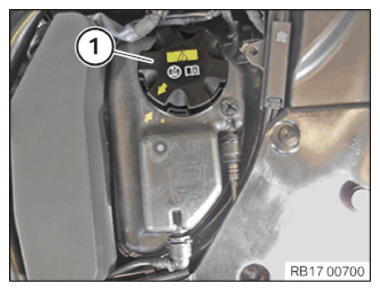
- Close the sealing cap (1) on the coolant expansion tank of the high-temperature coolant circuit.
- Connect battery charger.
- Close driver's seat belt.
- Activate testing-analysis-diagnosis (PAD) by quickly pressing the START-STOP button three times.
- Set the heating to the maximum and the blower to the lowest setting.
- Depress the accelerator pedal and hold for 15 s.
The automatic cooling system bleeding procedure is initiated.
- Start engine.
The idle speed is automatically increased to 1200 RPM.
- Depress the accelerator pedal to approximately 3500 RPM; maintain that engine speed for 10 s.
- Maintain idle speed for 30 s.
- Depress the accelerator pedal to approximately 3500 RPM; maintain that engine speed for 10 s.
- Maintain idle speed for 30 s.
- Depress the accelerator pedal to approximately 3500 RPM; maintain that engine speed for 10 s.
- Maintain idle speed for 30 s.
- Depress the accelerator pedal to approximately 3500 RPM; maintain that engine speed for 10 s.
- Maintain idle speed for 30 s.
- Depress the accelerator pedal to approximately 3500 RPM; maintain that engine speed for 10 s.
The cooling system bleeding procedure is ended about 11 min after the engine has started.
The engine speed drops back to the idle speed.
- Let the engine warm up at idle until the coolant has reached a temperature of 100°C.
The temperature display in the instrument cluster (KOMBI) is in the center position.
- Depress the accelerator pedal to approximately 3500 RPM; maintain that engine speed for 10 s.
- Maintain idle speed for 30 s.
- Depress the accelerator pedal to approximately 3500 RPM; maintain that engine speed for 10 s.
- Maintain idle speed for 30 s.
- Depress the accelerator pedal to approximately 3500 RPM; maintain that engine speed for 10 s.
- Maintain idle speed for 30 s.
- Depress the accelerator pedal to approximately 3500 RPM; maintain that engine speed for 10 s.
- Maintain idle speed for 30 s.
- Depress the accelerator pedal to approximately 3500 RPM; maintain that engine speed for 10 s.
- Stop engine.
- Allow the engine to cool down.
- Adjust the fill level in the coolant expansion tank of the high-temperature coolant circuit to 100 ml above the maximum mark.
- Close coolant expansion tank.
- Close the sealing cap (1) until the arrows align.