Remove the coolant expansion tank for the low-temperature coolant circuit
NOTE:
DANGER
High-voltage system.
The high-voltage system operates on the basis of hazardous, electrical voltage and high currents. Mortal hazard through electric shock!
High-voltage system.
The high-voltage system operates on the basis of hazardous, electrical voltage and high currents. Mortal hazard through electric shock!
- All work on the high-voltage system may only be carried out by specially trained and technically experienced personnel.
- For additional information see:
- For additional information see:
Preliminary work
- Refer to REMOVING THE UNDERBODY PROTECTION OF THE STEERING GEAR AND THRUST FIELD RESPECTIVELY .
- Refer to REMOVE THE COVER IN THE ENGINE COMPARTMENT ON TOP .
- Refer to REMOVE LEFT FRONT-END STRUT .
WARNING:
Hot surfaces.
Risk of burning!
Risk of burning!
- Perform all work only on components that have cooled down.
NOTE:
TECHNICAL INFORMATION
Use commercially available pinch-off tools to pinch off the coolant hoses.
Use commercially available pinch-off tools to pinch off the coolant hoses.
NOTE:
TECHNICAL INFORMATION
Immobilization period-long fill of coolant!
Do not reuse used coolant.
When replacing and removing components which rely on the corrosion protection effect of the coolant, it is essential to change the coolant. The cooling system must therefore be emptied and refilled.
In the case of other removal work involving the draining of part quantities of coolant, the coolant level must be topped up with new coolant.
Immobilization period-long fill of coolant!
Do not reuse used coolant.
When replacing and removing components which rely on the corrosion protection effect of the coolant, it is essential to change the coolant. The cooling system must therefore be emptied and refilled.
In the case of other removal work involving the draining of part quantities of coolant, the coolant level must be topped up with new coolant.
NOTE:
TECHNICAL INFORMATION
Collect and dispose of emerging fluids. Observe country-specific waste disposal regulations.
Collect and dispose of emerging fluids. Observe country-specific waste disposal regulations.
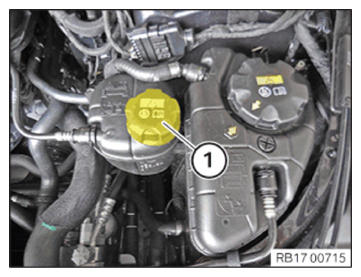
- Loosen sealing cap (1).
- Draw the coolant off with a conventional pump
.
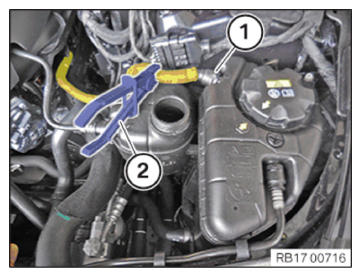
- Secure clamping pliers (2) on the coolant line (1).
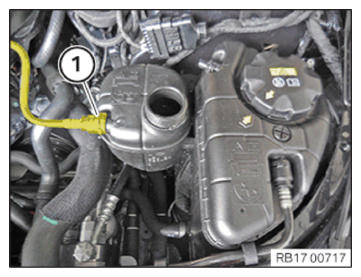
- Unlock and loosen coolant line (1).
- Catch and dispose of leakage coolant.
- Unlock and loosen coolant line (1).
- Catch and dispose of leakage coolant.
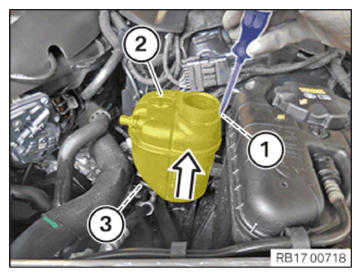
- Unlock the lock (1).
- Loosen the coolant expansion tank (2) in the direction of the arrow.
- Unlock and loosen coolant line (3).
- Dispose of emerging coolant.
- Thread out coolant expansion tank (2) and remove.