Remove heat management module
WARNING:
Hot surfaces.
Risk of burning!
Risk of burning!
- Perform all work only on components that have cooled down.
WARNING:
Hot fluids.
Risk of scalding!
Risk of scalding!
- Conduct all work in the vehicle wearing appropriate personal protective equipment only.
NOTE:
TECHNICAL INFORMATION
Collect and dispose of emerging fluids. Observe country-specific waste disposal regulations.
Collect and dispose of emerging fluids. Observe country-specific waste disposal regulations.
Preliminary work
- Refer to BRINGING FRONT COMPARTMENT LID IN THE SERVICE POSITION .
- Refer to DEACTIVATING THE 48 V ELECTRICAL SYSTEM .
- Refer to DISCONNECTING ALL BATTERY GROUND LEADS .
- Refer to REMOVING THE ACOUSTIC COVER .
- Refer to REMOVING THE SEAL FOR THE HOOD REAR .
- Refer to REMOVING ACOUSTIC COVER AT REAR .
- Refer to REMOVING THE COVER ON LEFT AND RIGHT IN THE ENGINE COMPARTMENT AT THE TOP .
- Refer to REMOVING BOTH FRONT-END STRUTS .
- Refer to REMOVING FRONT CROSS CONNECTION .
- Refer to REMOVING THE REAR TOP CROSS CONNECTION .
- Refer to REMOVING THE FAN COWL .
- Refer to REMOVING THE INTAKE FILTER HOUSING (TENSION STRUT ON SHOCK TOWER REMOVED) .
- Refer to REMOVING THE RESONATOR WITH THE TOP CLEAN AIR PIPE .
- Refer to REMOVING THE DME CONTROL UNIT .
- Refer to REMOVING THE INTEGRATED SUPPLY MODULE (PDM) PARTIALLY .
- Refer to REMOVING THE CONTROL UNIT HOLDER .
- Refer to REMOVING THE FRONT UNDERBODY PROTECTION OR FRONT THRUST FIELD .
- Refer to REMOVING THE UNDERBODY PROTECTION OF THE STEERING GEAR AND THRUST FIELD RESPECTIVELY .
- Refer to DRAINING THE COOLANT FROM THE HIGH-TEMPERATURE COOLING SYSTEM .
- Refer to DRAINING THE COOLANT FROM THE LOW-TEMPERATURE COOLING SYSTEM .
- Refer to CONNECTING THE COOLANT LINES FOR THE HIGH-TEMPERATURE COOLANT CIRCUIT .
- Refer to CONNECTING THE COOLANT LINES FOR THE LOW-TEMPERATURE COOLANT CIRCUIT .
- Refer to REMOVING TANK VENT VALVE .
- Refer to REMOVING THE INTAKE PLENUM .
Further information is available.
NOTE:
RISK OF DAMAGE
Coolant leaking from the starter motor generator.
Damage and loss of function of the starter motor generator.
Coolant leaking from the starter motor generator.
Damage and loss of function of the starter motor generator.
- Cover the starter motor generator with suitable, watertight auxiliary materials.
- Close off line connections with seal plugs.
- If necessary: Rinse off the coolant leaking from starter motor generator with at least 1 l of water.
NOTE:
RISK OF DAMAGE
Electrostatic discharge.
Damage to or destruction of electrical components.
Electrostatic discharge.
Damage to or destruction of electrical components.
- Leave the electrical components in their original packaging until they are being installed. Only use the original packaging for returning the product. Always package removed components straight away.
- Read and comply with user information on using the associated special tool 12 7 060.
- Only tap the housings of electrical components. Do not tap pins or multi-pin connectors directly.
- Wear electrically conductive clothing and antistatic shoes (with ESD symbol).
- For additional information see: NOTES ON ESD (ELECTROSTATIC DISCHARGE) PROTECTION
NOTE:
RISK OF DAMAGE
Damage to wires when disconnecting connectors and plug connections.
Sheared wires can cause a short circuit.
Damage to wires when disconnecting connectors and plug connections.
Sheared wires can cause a short circuit.
- Do not pull on wires when disconnecting connectors and plug connections.
NOTE:
TECHNICAL INFORMATION
Collect and dispose of emerging fluids. Observe country-specific waste disposal regulations.
Collect and dispose of emerging fluids. Observe country-specific waste disposal regulations.
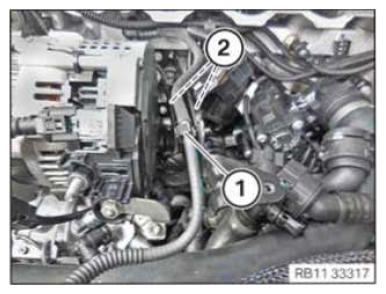
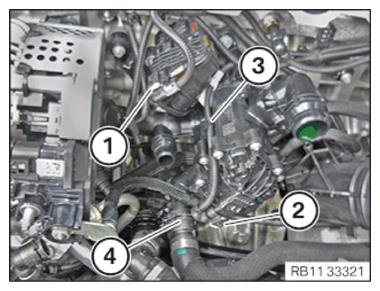
- Loosen clamp (1).
- Loosen clamps (2).
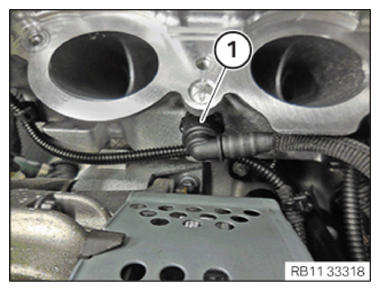
- Unlock and loosen coolant line (1).
- Catch and dispose of escaping coolant.
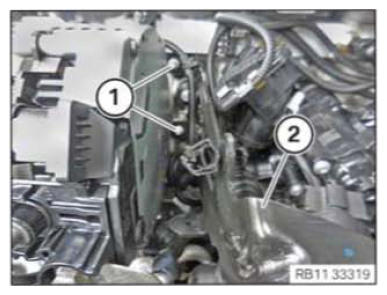
- Release screws (1).
- Feed out the support (2) for the intake plenum and remove it.
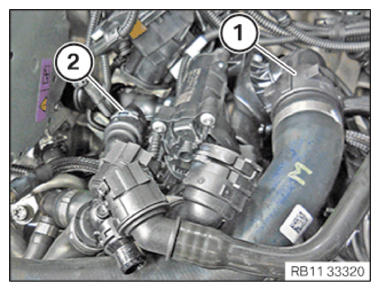
- Unlock and loosen coolant line (1).
- Unlock and loosen coolant line (2).
- Catch and dispose of escaping coolant.
- Unlock and disconnect the plug connection (1) for the heat management module.
- Unlock and disconnect the plug connection (2) for the heat management module.
- Loosen clamp (3).
- Unlock and release the coolant line (4).
- Catch and dispose of escaping coolant.
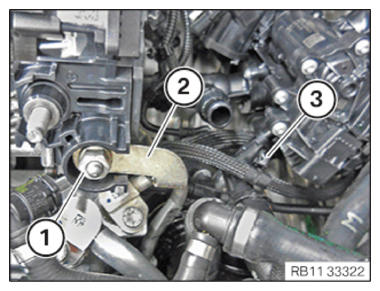
- Loosen nut (1).
- Feed out the grounding cable (2) and set aside.
- Loosen clamp (3).
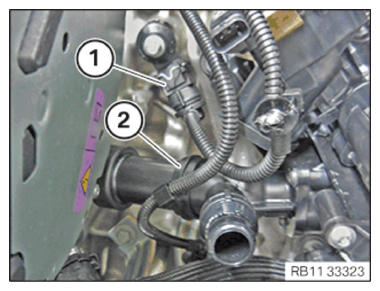
- Unlock and disconnect the plug connection (1) on the knock sensor.
- Loosen clamp (2).
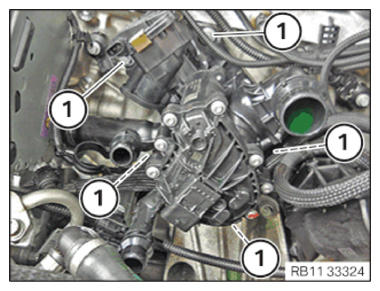
- Loosen screws (1).
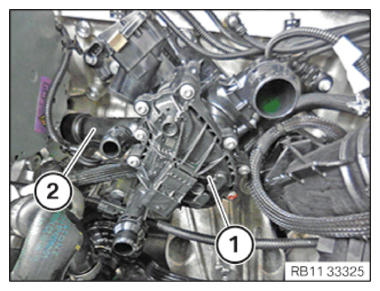
- Feed out and remove the heat management module (1) with the connecting pipe (2).
- Catch and dispose of escaping coolant.
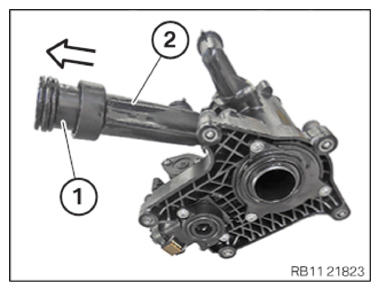
- Guide out and remove connecting pipe (1) from heat management module (2) in the arrow direction .