Assembling the cylinder head
Install all valves
Contaminant or foreign body
Contamination can result in malfunctions, operating failure or leaks.
- Adhere to the utmost cleanliness.
- Protect components from contamination e.g. by covering.
- Close off line connections with seal plugs.
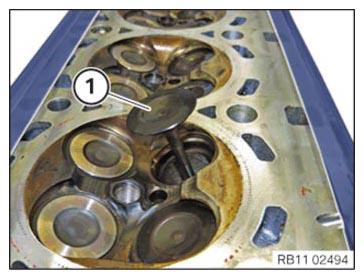
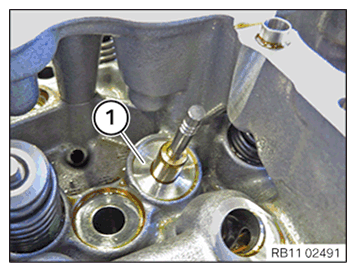
- Slide the valve (1) carefully in the cylinder head.
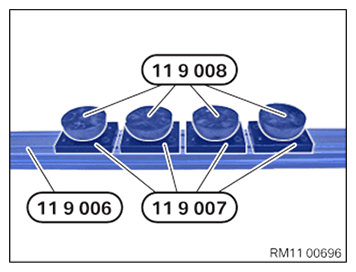
- B46/B48:
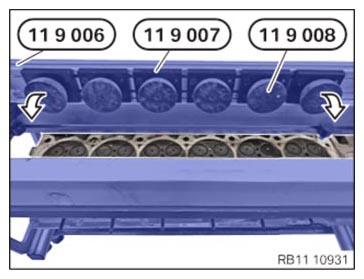
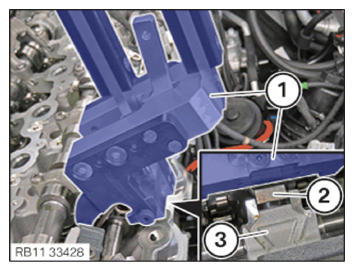
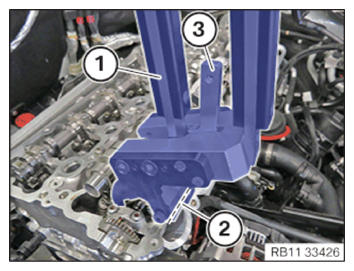
Prepare the special tools 0 494 371 (11 9 006), 0 494 372 (11 9 007) and 0 494 373 (11 9 008) as shown.
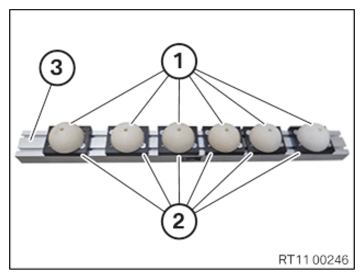
- B58t:
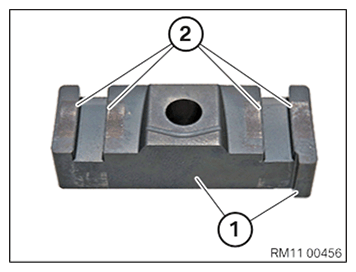
Prepare the plastic shaped parts (1) with shaped parts (2) and aluminum strip (3).
- Version B46/B48:
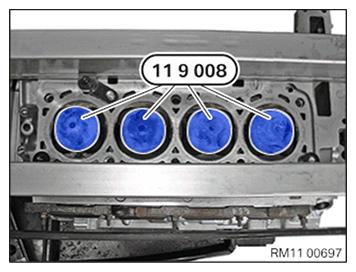
0 494 373 (11 9 008) Prepare for the corresponding alignment in the next step.
NOTE: TECHNICAL INFORMATION
The figure shows the engine B58. - Position special tools 0 494 371 (11 9 006), 0 494 372 (11 9 007)
and 0 494 373 (11 9 008)
in the center on the cylinder head in the direction of the arrow.
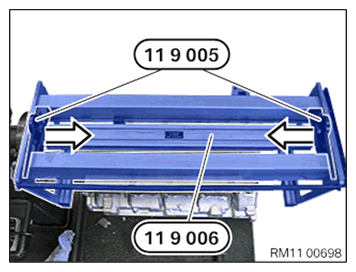
- Turn round special tool 0 494 371 (11 9 006) and insert as shown.
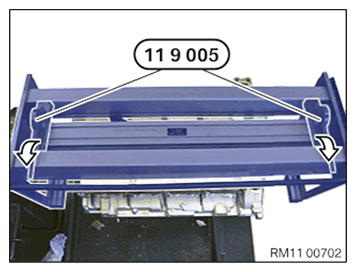
- Lock the special tools 0 494 370 (11 9 005)
in the direction of the arrow.
- Move and lock special tools 0 494 370 (11 9 005)
in the direction of the arrow over the edges of special tool 0 494 371 (11 9 006)
.
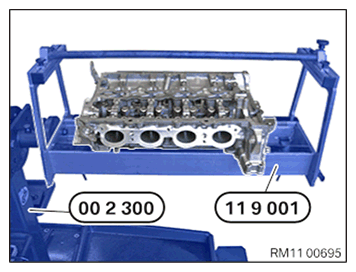
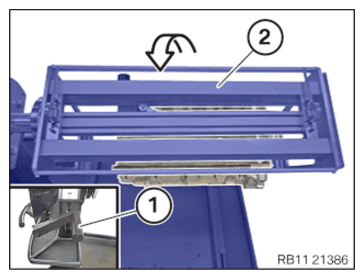
- Turn the special tool 0 494 366 (11 9 001)
(2) on the crank (1) by 180° in the direction of arrow
.
Installing valve stem seals
NOTE: RISK OF DAMAGE
Contaminant or foreign body.
Contamination can result in malfunctions, operating failure or leaks.- Adhere to the utmost cleanliness.
- Protect components from contamination e.g. by covering.
- Close off line connections with seal plugs.
NOTE: The description is for one component only. The procedure is identical for all further components. - Remove oil and dirt from the contact surface (1).NOTE: TECHNICAL INFORMATION
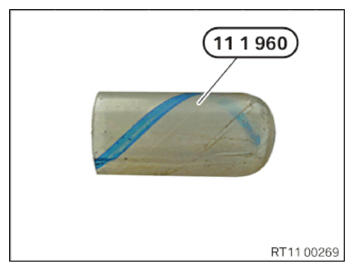
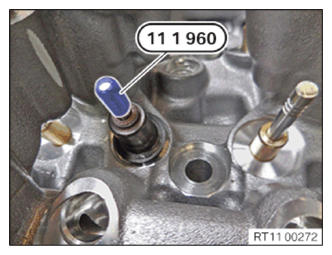
As an alternative to the special tool 0 490 797 (11 1 960) you can also use the assembly sleeves supplied with the replacement part (see the applicable BMW parts catalogue). - Make sure that the special tool 0 490 797 (11 1 960) is used and the assembly sleeves when installing the valve stem seal.
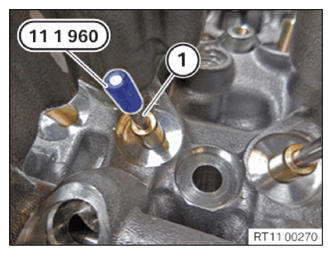
- Guide in and install the special tool 0 490 797 (11 1 960)
and assembly sleeves on valve (1).
- Replace the valve stem seal (1) and assembly sleeves.
Parts: Valve stem seal, assembly sleeves
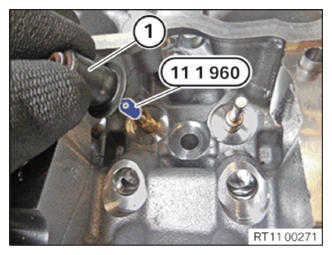
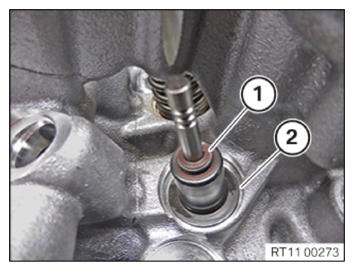
- Feed in and install the valve stem seal (1) on the special tool 0 490 797 (11 1 960)
and assembly sleeves.
- Feed out and remove the special tool 0 490 797 (11 1 960)
and the assembly sleeves.
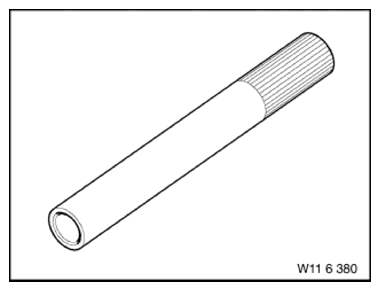
- Prepare special tool 0 493 249 (11 6 380)
.
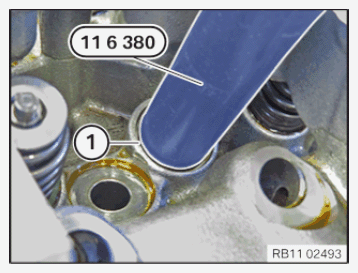
- Press the valve stem seal (1) onto the cylinder head till the limit position using special tool 0 493 249 (11 6 380)
.
- Make sure that valve stem seal (1) is positioned correctly on cylinder head (2).
Install all valve springs
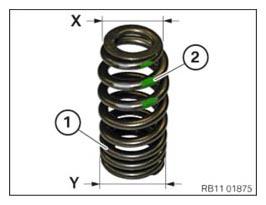
- Note the installation position of the valve spring.NOTE: Install the valve spring so that the larger diameter (Y) points to the bottom spring cup.
- Make sure that the intake valves are not switched with the exhaust valves.NOTE: Valve springs (1) are marked in color (2). Color for the intake valves: Green
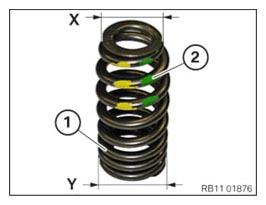
- Note the installation position of the valve spring.NOTE: Install the valve spring so that the larger diameter (Y) points to the bottom spring cup.
- Make sure that the intake valves are not switched with the exhaust valves.NOTE: Valve springs (1) are marked in color (2). Color for the exhaust valves: green/yellow
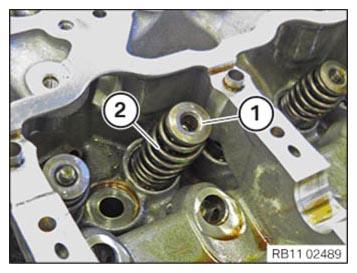
- Install the valve spring (2) and spring cup (1).CAUTION: Component with preload.
Danger of injury!- Reduce preload as far as possible before disassembly. Relieve component.
- Align special tool in direction of valve axis.
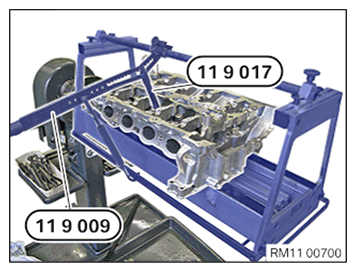
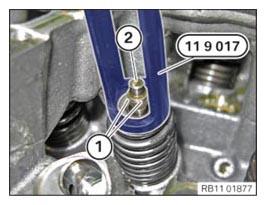
- Select the corresponding groove using special tool 0 495 028 (11 9 017) .
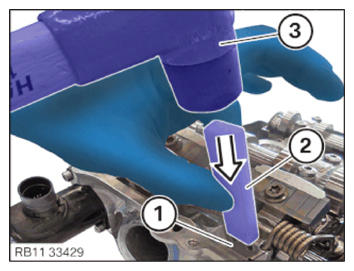
- Press down the valve spring on the upper spring cup with the special tools 0 494 374 (11 9 009) and 0 495 028 (11 9 017) .
- Hold the valve spring in the pressed down position using special tool 0 494 375 (11 9 011)
.
- Keep the valve spring pressed down with the special tool 0 495 028 (11 9 017) .
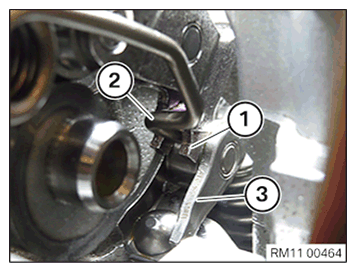
- Install the valve shims (1) of the valve (2) with a magnet.
- Relieve load on valve spring.
- Unlock special tool 0 494 370 (11 9 005)
in the direction of arrow and remove.
Installing all hydraulic valve clearance compensating elements
NOTE: TECHNICAL INFORMATION
If the hydraulic valve clearance compensating elements are reused, they must be reinstalled at the same position. - Install all the hydraulic valve clearance compensating elements (1) in the direction of arrow.
Install all roller cam followers
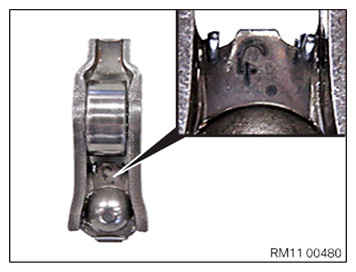
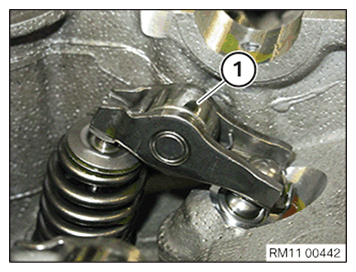
- Observe the classification of the roller cam followers.
The classification in digits from 1 to 5 has been printed on the roller cam follower.
Classification Idle speed 1 Repair case - slow engine speed when idling 2 Installed as standard/Initial installation 3 Installed as standard/Initial installation 4 Installed as standard/Initial installation 5 Repair case - high engine speed when idling - Install the roller cam follower (1) on the intake side.
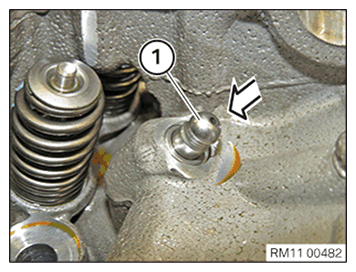
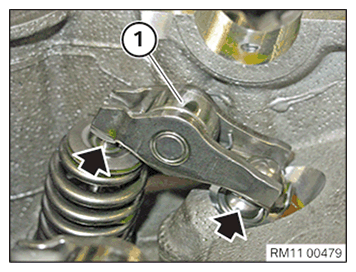
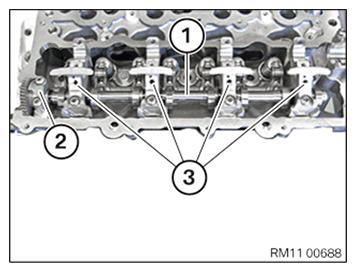
- Make sure that the roller cam follower (1) is correctly positioned on the hydraulic valve clearance compensating element (arrows) and the intake valves.
- Install the roller cam follower (1) on the exhaust side.
- Make sure that the roller cam follower (1) is positioned correctly on the hydraulic valve clearance compensating elements (arrows) and the exhaust valves.
Install exhaust camshaft
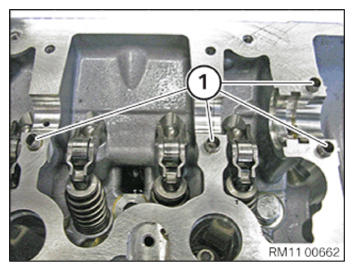
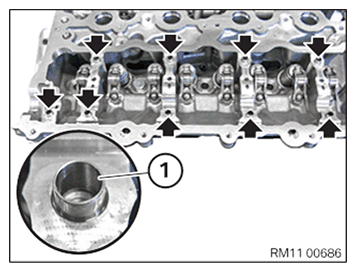
- Check the fitting sleeves (1) for a correct
fit and damage, replace if necessary.
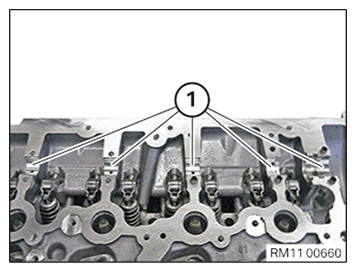
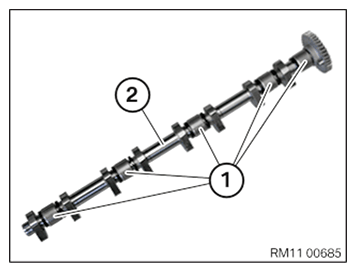
- Coat all bearing positions (1) with fresh
engine oil.
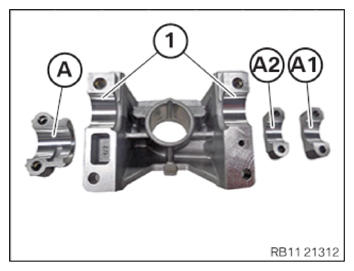
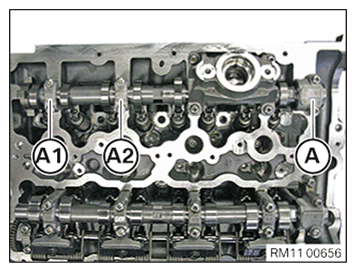
- Clean all bearing positions of the exhaust camshaft bearing cap (A1), (A2) and (A) and coat with fresh engine oil.
- Clean the bearing positions (1) of the high pressure pump bracket and coat with fresh
engine oil.
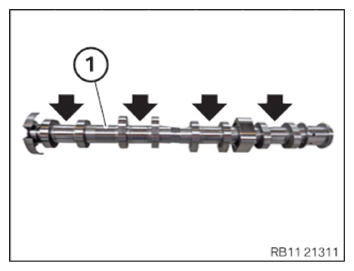
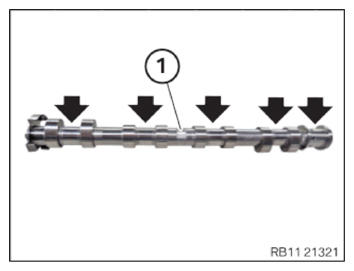
- Clean all the bearing positions (arrows) of the exhaust camshaft (1) and coat with fresh
engine oil.
- Make sure that the roller cam follower (1) is fitted correctly before installing the exhaust camshaft.
- Coat the exhaust camshaft and the exhaust camshaft bearing cap with fresh engine oil.
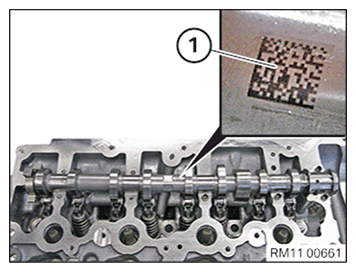
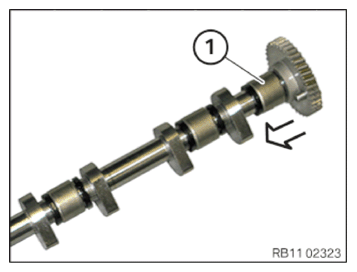
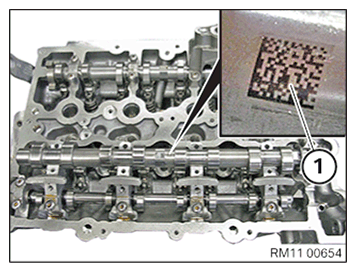
- Insert exhaust camshaft in the cylinder head, such that the mark (1) points upwards
.NOTE: TECHNICAL INFORMATION
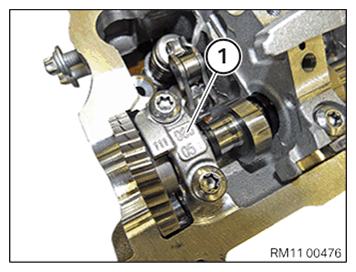
The camshaft bearing caps must not be mixed up. The camshaft bearing caps must be installed in the installation position from which they were removed. - Position the exhaust camshaft bearing cap (A1), (A2) and (A) on the cylinder head.NOTE: The exhaust camshaft bearing caps are legibly labelled from the intake side and marked with A1, A2 and A.NOTE: Exhaust camshaft bearing cap A is a thrust bearing.
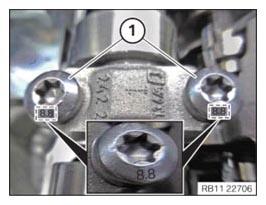
- Check the tensile strength of the screws for the bearing caps.
The figure shows screws with the tensile strength 8.8 .
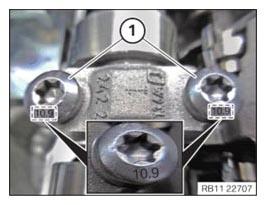
- Check the tensile strength of the screws for the bearing caps.
The figure shows screws with the tensile strength 10.9 .
NOTE: TECHNICAL INFORMATION
The camshaft is tensioned by the valve springs. Tighten or loosen each screw on the camshaft bearing caps one at a time in the specified sequence and by half a turn only. Repeat procedure. - Coat both bearing positions on the high pressure pump bracket with fresh engine oil.
- Position the high pressure pump bracket on the cylinder head.
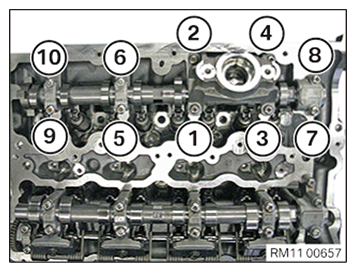
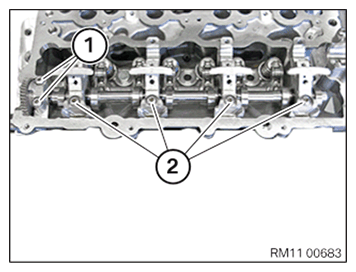
- Join all bolts of the exhaust camshaft bearing caps in sequence (1) to (10) in half turns .
- Adhere to the jointing torque.
- Tighten all bolts of the exhaust camshaft bearing caps in sequence (1) to (10).TIGHTENING TORQUES SPECIFICATION
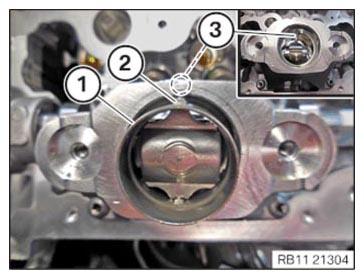
Exhaust camshaft to cylinder head M6 Tensile strength of screw 8.8 Tightening torque 9.6 Nm Tightening torque 9.6 Nm M6 Tensile strength of screw 10.9 Tightening torque 11.8 Nm Tightening torque 11.8 Nm - Guide in and position roller tappet (1).
- Ensure that pin (2) is positioned correctly in guide (3).
- Feed in and install roller tappet (1).
Install eccentric shaft
- Check the guide sleeves (1) for damage, replace if necessary.
- Check needle bearing (1) for ease of movement.NOTE: In the event of tight needle bearings, replace eccentric shaft (2).
- Coat the needle bearing (1) with new
engine oil.
- Clean the bearing positions (1) and coat with new
engine oil.
- Clean all the bearing positions (1) of the bearing supports and coat with fresh engine oil.
- Clean the bearing position (2) of the bearing cap and coat with fresh
engine oil.
- Before installing the eccentric shaft, move the needle bearing (1) in the direction of arrow up to the limit position.
- Insert eccentric shaft (1) in the cylinder head.
- Attach bearing cap (2) and bearing supports (3) on the cylinder head.
- For an engine that has been in use, make sure all bearing supports are reinstalled in the same position.
- Make sure that the bearing cap (1) is installed correctly.NOTE: The bearing cap (1) is provided with a limit position.
- Tighten down screws (1) and (2) uniformly.TIGHTENING TORQUES SPECIFICATION
Eccentric shaft to bearing support/cylinder head M6 Tightening torque 10 Nm Install the servomotor for the eccentric shaft (cylinder head removed)
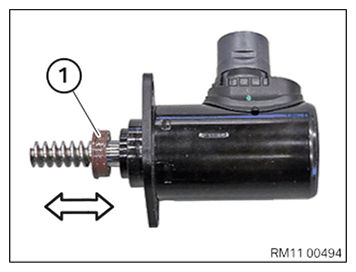
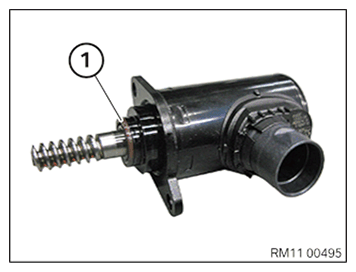
- Replace seal (1).
Parts: Gasket
- Press the seal (1) up to the limit position on the housing.
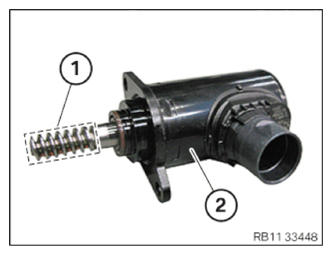
- Grease the gearing (1) of the servomotor (2) for the eccentric shaft in the marked
area.EXPENDABLE MATERIALS DESCRIPTION
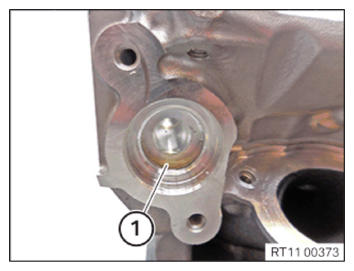
lubricating grease Longtime PD-1 400 g, Cartridge 83192160340 - Clean sealing surface (1).
- Insert the servomotor (1) for the eccentric shaft up to the limit position and install it.
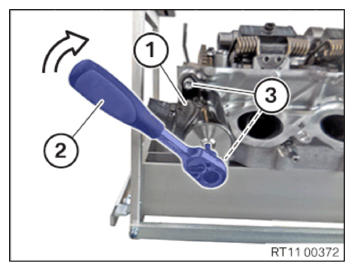
- Turn the servomotor (1) for the eccentric shaft with a standard hexagon socket wrench (2) with 4 mm in the direction of arrow until the servomotor (1) lies on the cylinder head for the eccentric shaft.
- Tighten the screws (3).TIGHTENING TORQUES SPECIFICATION
Electrical servomotor to cylinder head M6 Tightening torque 8 Nm Install intake camshaft
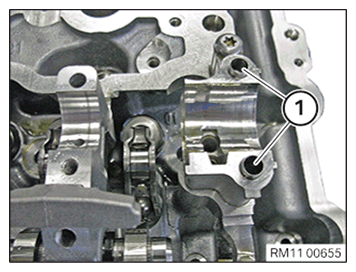
- Check the fitting sleeves for correct fit and damage and replace as needed.
- Coat all bearing positions (1) with fresh engine oil.
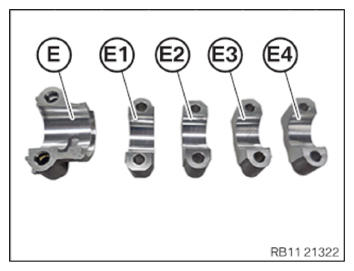
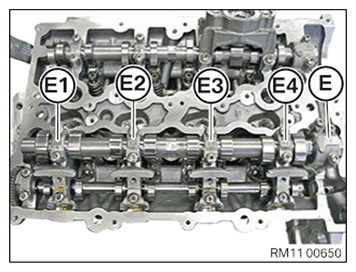
- Clean all the bearing positions of the intake camshaft bearing cap (E1) (E2) (E3), (E4) and (E) and coat with engine oil.
- Clean all bearing positions (arrows) of the intake camshaft (1) and coat with engine oil.
- Ensure the correct fit of the roller cam follower (1) before mounting the intake camshaft.
- Coat roller cam follower (1) with new engine oil.
- Insert the intake camshaft into the cylinder head in such a way that the mark (1) points up.NOTE: TECHNICAL INFORMATION
The camshaft bearing caps must not be mixed up. The camshaft bearing caps must be installed in the installation position from which they were removed. - Position the intake camshaft bearing caps (E1), (E2), (E3), (E4) and (E) on the cylinder head.NOTE: The intake camshaft bearing caps are legibly labelled from the intake side with E1, E2, E3, E4 and E.NOTE: Intake camshaft bearing cap E is a thrust bearing.
- Check the tensile strength of the screws for the bearing caps.
The figure shows the screws with the tensile strength of 8.8 .
- Check the tensile strength of the screws for the bearing caps.
The figure shows the screw with the tensile strength of 10.9 .
NOTE: TECHNICAL INFORMATION
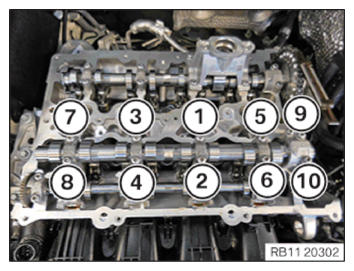
The camshaft is tensioned by the valve springs. Tighten or loosen each screw on the camshaft bearing caps one at a time in the specified sequence and by half a turn only. Repeat procedure. - Press down the intake camshaft bearing cap and hand-tighten the screws incrementally in the sequence (1) to (10).
- Join screws in sequence (1) to (10) in half turns .
- Adhere to the jointing torque.
- Tighten all screws in a sequence from (1) to (10).TIGHTENING TORQUES SPECIFICATION
Intake camshaft to cylinder head M6 Tensile strength of screw 8.8 Tightening torque 9.6 Nm Tightening torque 9.6 Nm M6 Tensile strength of screw 10.9 Tightening torque 11.8 Nm Tightening torque 11.8 Nm Checking installation position of roller cam followers
NOTE: TECHNICAL INFORMATION
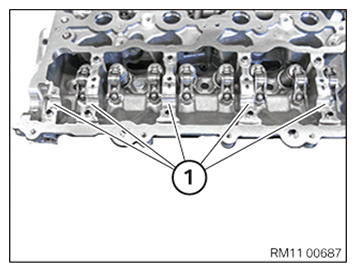
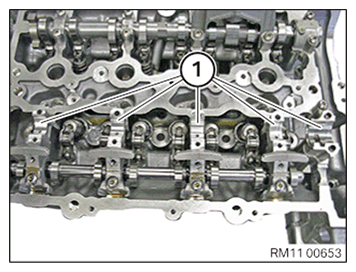
The rocker arms may slip slightly when the camshaft is positioned. Make sure rocker arms are correctly positioned on the hydraulic valve clearance compensating elements and on valves. - Make sure that the mounting orientation (arrows) of the roller cam followers (1) is correct.
Checking the intermediate lever classification
NOTE: TECHNICAL INFORMATION
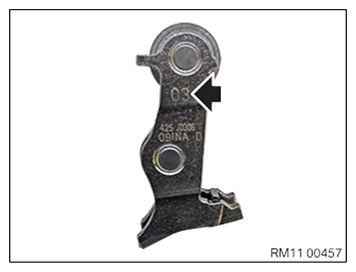
All intermediate levers are classified. Only one classification may be used per engine.All intermediate levers must be installed in the same position in an engine which has already been in use.
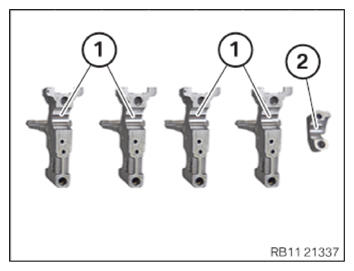
- Check classification (arrow) of intermediate lever.
Installing all intermediate levers
NOTE: TECHNICAL INFORMATION
When replacing one or more intermediate levers:
When removing the intermediate lever, it is imperative to note the part number of the intermediate lever.
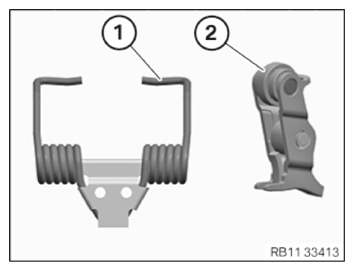
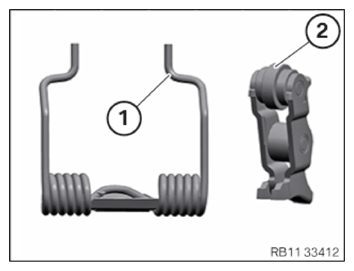
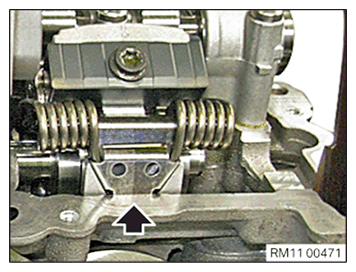
Mixed installation of the intermediate levers is only permitted in combination with the appropriate torsion spring.
For further information on possible combinations, see the applicable BMW parts catalogue. - Version with torsion spring with L-shaped contour and a suitable intermediate lever:
Use torsion spring (1) with L-shaped contour only in connection with a suitable intermediate lever (2).
- Version with torsion spring with s-shaped contour and a suitable intermediate lever:
Use torsion spring (1) with s-shaped contour only in connection with a suitable intermediate lever (2).
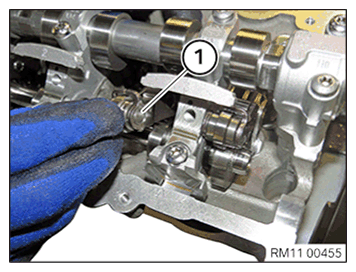
NOTE: The description is for one component only. The procedure is identical for all further components. - Install intermediate lever (1).
Installing all gates
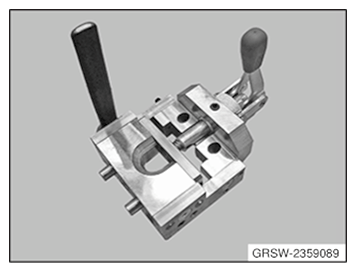
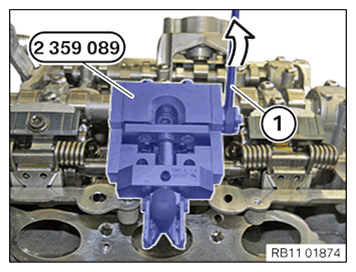
- Have the special tool 2 359 089
ready.
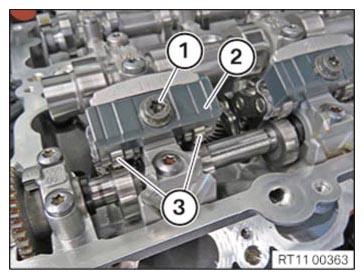
- Clean contact surfaces (1) and (2) off oil, grease and dirt.
- Position the gate (2) and hand-tighten the bolt (1).
- Check that the intermediate lever (3) is in the correct mounting orientation.
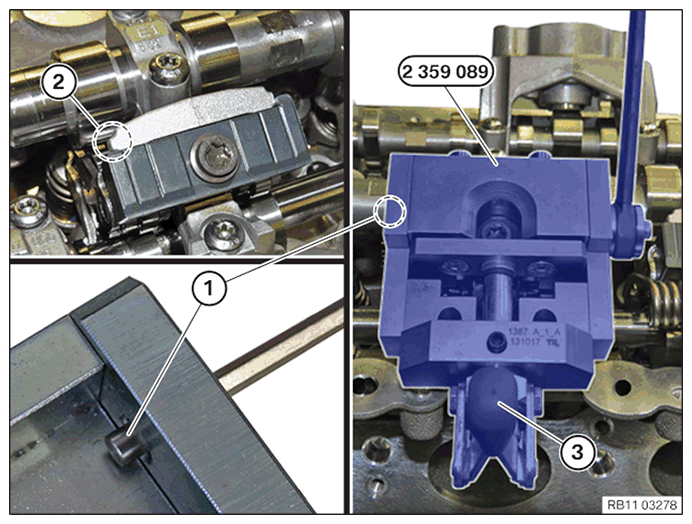
- Position the special tool 2 359 089 on the cylinder head.
- Pre-tension the gate with the lever (3).
- Abut the bolt (1) in the area (2).
- Make sure that the special tool 2 359 089
does not rotate during this process.
- Secure the gate with the lever (1) in the direction of the arrow.
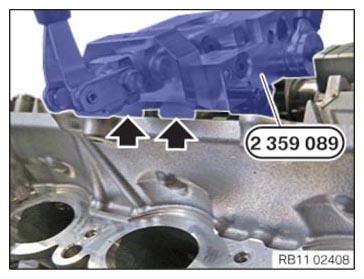
- Make sure that the special tool 2 359 089
rests flat against the cylinder head (arrows).
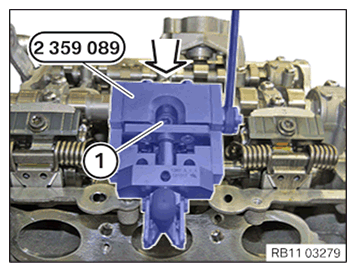
- Press the special tool 2 359 089
in the direction of arrow on to the cylinder head and tighten the screw (1) at the same time.TIGHTENING TORQUES SPECIFICATION
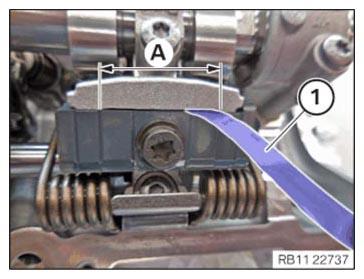
Gate to bearing bracket M7x35 Tightening torque 23 Nm - Check the conventional gauge (1) in the area (A) for the correct gap dimension.TECHNICAL DATA - GAP DIMENSION SPECIFICATION
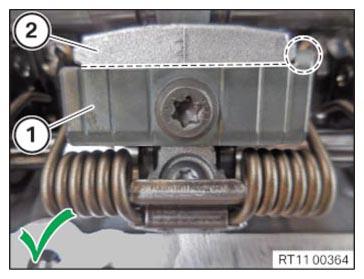
Gap between gate and bearing block Gap dimension A 0.03 mm - Make sure that gate (1) rests correctly against bearing bracket (2).
Gate (1) is installed correctly in the marked area.
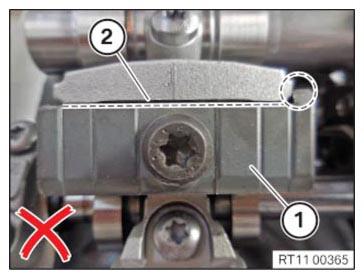
- Make sure the gate (1) is fitted correctly
at the bearing bracket (2).
Gate (1) is installed incorrectly in the marked area.
- Repeat the step for all the gates.
Checking the position of the intake camshaft (cylinder head removed)
Check
- Check position of the intake camshaft on the respective cylinders.
Result
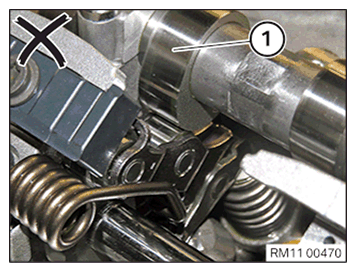
» Cam (1) of the intake camshaft runs on the intermediate lever.
Measure
- Continue to crank the intake camshaft on the mounting flats.
Installing the torsion springs
Additional information is available.
CAUTION: Spring preload.
Danger of injury!- The use of the specified special tool (tool) is mandatory.
- The described operation must be carried out properly.
NOTE: TECHNICAL INFORMATION
Wear safety goggles.NOTE: TECHNICAL INFORMATION
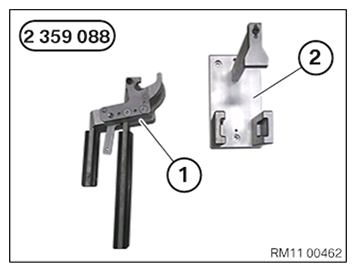
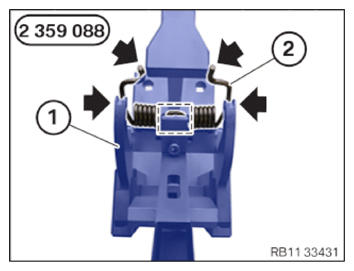
Special tool 2 359 088 is used to disassemble or install the torsion spring. Due to technical changes in the torsion spring, special tool 5 A0B 120 is mounted on existing special tool 2 359 088 .
Information on modification can be found in the further information.NOTE: TECHNICAL INFORMATION
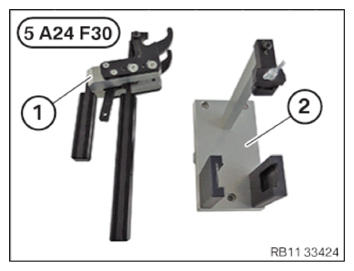
Alternative to the new special tool SWZ: 5 A24 F30 , the already known special tool SWZ: 2 359 088 can be used in modified form.
Information on modification can be found in the further information.
The modified special tool is downwards compatible.NOTE: TECHNICAL INFORMATION
When replacing one or more torsion springs:
When removing the torsion spring, it is imperative to note the part number of the torsion spring.
Mixed installation of the torsion springs is only permitted in combination with the appropriate intermediate lever.
For further information on possible combinations, see the applicable BMW parts catalogue. - Version with torsion spring with L-shaped contour and the suitable intermediate lever:
Use the torsion spring (1) with L-shaped contour only in connection with the suitable intermediate lever (2).
- Version with torsion spring with s-shaped contour and the suitable intermediate lever:
Use the torsion spring (1) with s-shaped contour only in connection with the suitable intermediate lever (2).
- Prepare the set of special tools 2 359 088
to remove the torsion spring with an s-shaped contour:
Number Description 1 Clamping lever 2 Mount for clamping lever (torsion spring with s-shaped contour) - Prepare the set of special tools 5 A24 F30
or alternatively modified special tool 2 359 088
to remove the torsion spring with an L-/s-shaped contour:
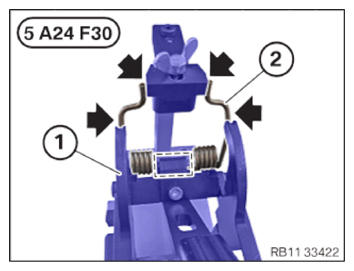
Number Description 1 Clamping lever 2 Mount for clamping lever (torsion spring with L-/s-shaped contour) - Version with torsion spring with s-shaped contour with the special tool 5 A24 F30 or the modified special tool 2 359 088:
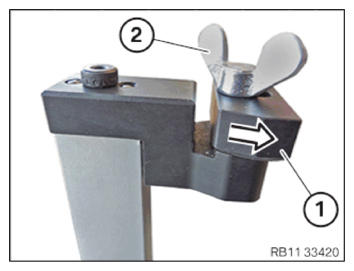
Bring the shaped element (1) in the direction of arrow on to the contact surface.
Hand-tighten the wing screw (2).
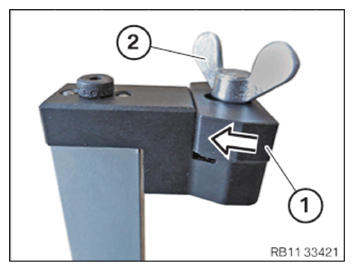
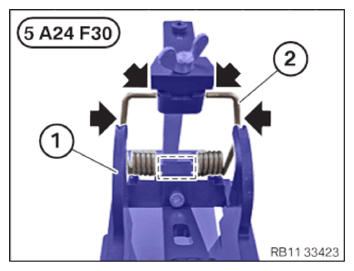
- Version with torsion spring with L-shaped contour with the special tool 5 A24 F30 or modified special tool 2 359 088:
Bring the shaped element (1) in the direction of arrow on to the contact surface.
Hand-tighten the wing screw (2).
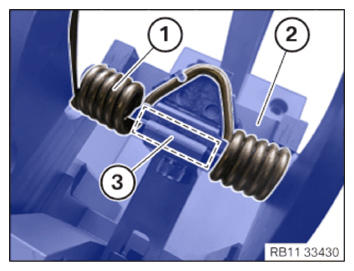
- Position the torsion spring (1) in the clamping lever (2).
The torsion spring (1) must be positioned in the marked area (3) of the clamping lever (2) correctly .
- Version with torsion spring with s-shaped contour with the special tool 2 359 088:
Close the clamping lever (1) of the special tool 2 359 088 in the associated mount carefully until the retaining hook engages audibly.
While clamping, ensure that the torsion spring (2) lies correctly in the lateral guides (arrows) and mark of the clamping lever (1).
- Version with torsion spring with s-shaped contour with the special tool 5 A24 F30 or the modified special tool 2 359 088:
Close the clamping lever (1) of the special tool 5 A24 F30 or the modified special tool 2 359 088 in the associated mount carefully until the retaining hook engages audibly.
While clamping, ensure that the torsion spring (2) lies correctly in the lateral guides (arrows) and mark of the clamping lever (1).
- Version with torsion spring with L-shaped contour with the special tool 5 A24 F30 or modified special tool 2 359 088:
- Close the clamping lever (1) of the special tool 5 A24 F30 or the modified special tool 2 359 088 in the associated mount carefully until the retaining hook engages audibly.
- While clamping, ensure that the torsion spring (2) lies correctly
in the lateral guides (arrows) and mark
of the clamping lever (1).
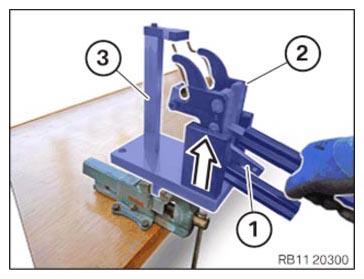
- Take the clamping lever (2) with the tensioned torsion spring carefully
in the direction of arrow from the mount (3).
- Insert the torsion spring (2) with the clamping lever (1) in the cylinder head (3).
- Version with torsion spring with s-shaped contour on the intermediate lever
- Insert the torsion spring (2) into the intermediate levers (1).
- Check all roller cam followers (3) for correct installation position.
- Lay the clamping lever (1) flat in the marked area (2).
- Press the clamping lever (1) together until the retaining hook (3) unlocks audibly.
- Carefully open the clamping lever (1) until the torsion spring is relaxed completely.
- Feed out and remove the clamping lever (1).
- Bring the torsion spring (1) with a commercially available plastic hammer (3) and a commercially available plastic wedge (2) in the direction of arrow to its correct
fit.
- Check the correct mounting orientation of the torsion spring (arrow).