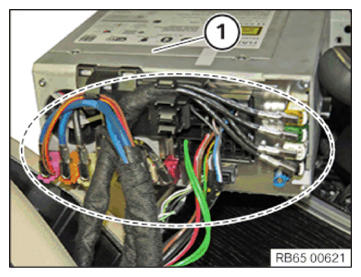
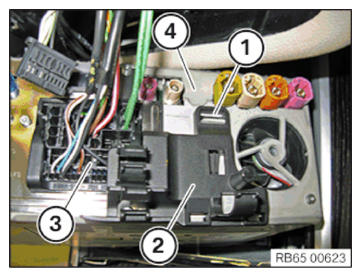
Remove Head Unit High (HU-H)
NOTE:
RISK OF DAMAGE, Damage to the head unit. The plug connections of the head unit must not be disconnected if the battery is still connected.
- Disconnect all batteries.
NOTE:
RISK OF DAMAGE, Damage to the head unit. The hard disk of the head unit can be damaged by vibration.
- Carry out mechanical work on the head unit and adjacent components with care.
NOTE:
RISK OF DAMAGE Electrostatic discharge. Damage to or destruction of electrical components.
- Leave electrical components in original packaging until just before they are installed. Use the original packaging only for any return shipments. Always package removed components straight away.
- Read and comply with user information on using the associated special tool 12 7 060.
- Only touch the housings of electrical components. Do not touch pins or multi-pin connectors directly.
- Wear electrically conductive clothing and antistatic shoes (with ESD symbol).
- For additional information see: 61 35... NOTES for ESD protection (electrostatic discharge)
Preliminary works
- Deactivate the 48 v ELECTRICAL SYSTEM .
- Disconnect all battery EARTH LEADS .
- Remove the right instrument panel SIDE PANEL .
- Remove the finisher on the right INSTRUMENT PANEL .
- Remove the radio operating unit and the air conditioning CONTROL PANEL .
NOTE:
RISK OF DAMAGE Sensitive optical fibres. Damaged optical fibres can result in operating failure of the LED.
- Do not bend optical fibres too much and do not kink, as well. The minimum permissible bending radius is 25 mm.
- Avoid pressure and tensile loads and heat influences on the optical fibre.
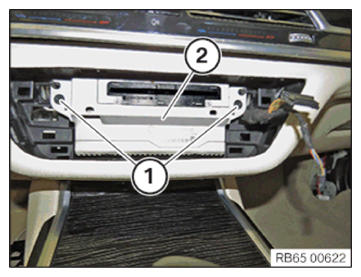
NOTE:
RISK OF DAMAGE, Damage to the instrument cluster (KOMBI) or the head unit While releasing and connecting the cable, it could lead to a ground offset. This can generate currents that render the instrument cluster (KOMBI) or the head unit unusable.
- While releasing: Release APIX data cable (blue) first.
- While connecting: Connect APIX data cable (blue) at the last.