Recycling Container, Filling With Contaminated Refrigerant Using Extractor:Vas581007
Special tools and workshop equipment required
- Minimum dimension 10 kg dry ice (as pellets or granulate) - commercially available.
- Evacuated recycling bottle for contaminated R1234yf, which is suitable for low temperatures (for example with a permitted capacity higher than 3.0 kg). Commercially available from gas supplier
- Extractor :VAS581007 . Refer to the Parts Information.
- So that contaminated refrigerant can be filled by itself without corresponding devices in an evacuated recycling container, it must be strongly cooled.
- Dry ice is solid carbon dioxide (CO2 ), that at - 78 °C (-108.4 °F) goes directly from a solid into a gas.
- The majority of gas, which can be used as a refrigerant, have a very low temperature and only have a low vapor pressure (at -50 °C (-58 °F) smaller than 0.6 bar (8.7 psi) absolute pressure). If in a deeply cooled recycling container which is connected to a refrigerant circuit, the refrigerant becomes a liquid in a cold recycling container and the refrigerant circuit pressure goes under the ambient pressure. Refer to REFRIGERANT VAPOR PRESSURE TABLE .
- The commercially available recycling containers are mostly made of universal steel, that are not designed for low temperatures (here up to -78 °C (-108.4 °F)) for this reason the only use these suitable recycling containers for this use and carefully warm the bottle to the ambient temperature (for example by placing the insulated containers with the recycling container in a secured well ventilated area on which the dry ice can safely vaporize).
- Dry ice evaporates at ambient temperature from the insulated container (depending on the ambient conditions approximately 20 to 30 % a day). For this reason only order dry ice when all other necessary tools are present and the procedure can be performed just after receiving the dry ice.
Risk of frostbite or suffocation due to dry ice.
Frostbite of the skin and other body and suffocation as a gas is possible.
- Wear safety gloves.
- Wear protective eyewear.
- Only work with the dry ice in well-ventilated areas.
- Never perform procedures in and near basement staircases or other below ground areas.
Risk of explosion due to improperly stored dry ice.
When dry ice evaporates the pressure in the container increases. Unsuitable containers can explode.
- Transport and store dry ice only in the containers designed for it.
Fill the refrigerant in a supercooled recycling bottle.
-- Remove the recycling bottle seal and remove the closure cap from the connection.
- Recycling bottles usually come from the gas supplier sealed and evacuated.
- Recycling bottles are clearly identified as such, these are in contrast to refrigerant supply bottles do not have a check valve and can therefore be filled.
-- Connect the A/C Service Station to the recycling container. To do so remove the low pressure service coupling from the A/C Service Station filler hose and connect the filler hose directly with the adapter belonging to the Extractor :VAS581007 to the adapter on the recycling bottle.
-- Carefully open the recycling bottle hand shut-off valve to check the vacuum and check the vacuum in the bottle.
- Residual pressure in the recycling bottle less than 50 mbar (0.72 psi) absolute pressure.
-- If necessary evacuate the recycling bottle using the A/C Service Station.
- If the recycling bottle has an absolute pressure larger than 100 mbar (1.45 psi) but smaller than 900 mbar (13 psi) which can be measured, evacuate the recycling bottle with a A/C Service Station (residual pressure less than 50 mbar (0.72 psi)). Refer to REFRIGERANT CIRCUIT, EVACUATING .
- If the recycling bottle has an absolute pressure greater than 900 mbar (13 psi) either the manual shut-off valve was opened and not closed correctly or the recycling bottle is leaking. Contact the gas supplier and if necessary change the recycling bottle.
-- Close the recycling bottle hand shut-off valves.
-- Switch off the ignition.
-- For good ventilation of the work space switch on the workshop ventilation equipment if equipped.
There is a risk of explosion due to overfilling refrigerant canisters.
Refrigerant can expand and the refrigerant canister can explode due to overfilling.
- Use a refrigerant canister with safety valve.
- Never exceed the permitted capacity of the refrigerant canister.
Chemical reaction due to contaminated refrigerant. When mixing gases of unknown composition different chemical reactions can occur.
Injury is possible.
- Never mix refrigerant of different origins.
-- Connect the service coupling for refrigerant R1234yf -5- to the filler hose -4-.
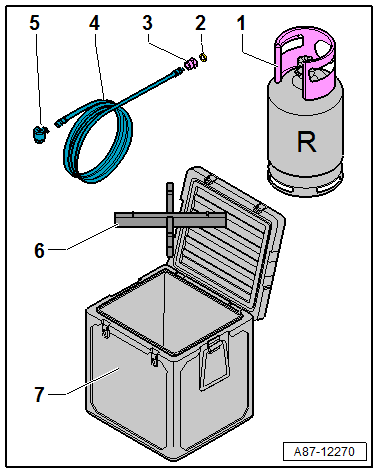
-- Connect the filler hose -4- with the connection piece -3- (and seal -2-) on the recycling bottle -1-.
-- Position the spacer -6- in the insulated container -7-.
-- Cover the bottom of the insulated container -7- with dry ice.
-- Position the recycling bottle -1- in the insulated container -7-.
-- Fill the remaining dry ice in the insulated container -7-.
-- Cool the recycling bottle -1- with dry ice (approximately 15 minutes).
-- Connect the recycling container -1- via the service coupling -5- on the vehicle refrigerant circuit.
-- Open the recycling bottle hand shut-off valve -1-.
- Recycling bottles are designed for international use, and this means that "O" on the hand wheel means "open" (for bottle vale open) and not "0" (zero for closed).
-- Connect the pressure gauge to the refrigerant circuit (or the use the A/C Service Station pressure gauge) and check the refrigerant circuit pressure.
-- Carefully open the service coupling -5- on the filler hose to the recycling bottle and let the refrigerant flow slowly in the recycling bottle -1-.
-- Wait until the refrigerant in the recycling bottle -1- is liquid (pay attention to the pressure indicator on the connected pressure gauge).
- When emptying a refrigerant circuit a pressure gauge or the A/C Service Station pressure indicator can be used.
- If the displayed pressure after approximately 60 minutes is smaller than 0.3 bar (4.35 psi) absolute pressure it can be assumed that the refrigerant in the recycling bottle is liquid.
- The complete evaporation of the contaminated refrigerant from the refrigerant circuit takes a certain period of time, after 60 min it can be assumed that the entire refrigerant is evaporated.
-- Close the service coupling -5- and the recycling bottle hand shut-off valve -1-.
-- Remove the filler hose -4- and connection piece -3- from the recycling bottle -1- and close the recycling bottle connection with the closure cap.
-- Place the insulated container -7- with the recycling bottle -1- and the dry ice in a secured, well ventilated area outside of the building.
-- Open the cover of the insulated container -7- or remove and let the dry ice completely evaporate.
Risk of damaging the recycling container due to impact.
- Remove the recycling bottle first from the insulated container, when the dry ice is evaporated and the recycling bottle has taken the ambient temperature.
-- Remove the recycling bottle -1- from the insulated container -7-.
-- Evacuate the refrigerant circuit with the A/C Service Station for at least one hour. Refer to REFRIGERANT CIRCUIT, EVACUATING .
- Then by evacuating the rest of the contaminated refrigerant, which could be attached to the refrigerant oil can be removed at an absolute pressure of less than 10 mbar (0.15 psi).
-- Fill out the supplement data sheet for the recycling bottle with contaminated refrigerant and secure on the recycling bottle.
-- Return the filled recycling bottle using the method of delivery for the recycling bottle, while paying attention to the applicable laws.