Leaks, Determining With A Pressure Test, With Nitrogen Or Compressed Air
- Determining leaks using the vacuum test with the A/C Service Station. Refer to REFRIGERANT CIRCUIT, EVACUATING . If leaks are determined but the leaking locations cannot be determined perform an additional leak test with nitrogen or compressed air. Refer to Additional Procedure, If a Leak Is Detected When Evacuating. .
Small leaks (less than 100 g (3.5 oz) of refrigerant loss per year) are not often detected with the vacuum test or with the pressure test. The incoming air or the amount of nitrogen flowing out is too small to be able to locate the faulty location based on noise.
Leaks on the refrigerant circuit that are greater than 100 g (3.5 oz) of refrigerant loss each year are also not always detectable with the vacuum test or with the pressure test, depending on the ambient conditions (ambient noise, leak location etc.). The incoming air and the quantity of nitrogen flowing out is currently too small to detect any noise and locate the faulty location.
Larger leaks on the refrigerant circuit (for example an impact from a rock on the condenser, greater than 100 g (3.5 oz) of refrigerant loss per year) can be detected for example from noise, using the vacuum test or the pressure test. Refer to REFRIGERANT CIRCUIT, EVACUATING .
A large leak can be identified if a maximum of pressure of 15 bar (217.55 psi) can be generated in the refrigerant circuit using clean, dry compressed air or nitrogen. Refer to REFRIGERANT CIRCUIT, FLUSHING WITH COMPRESSED AIR OR NITROGEN . If the leak is large enough, the sound of escaping air or gas can be heard at the location of the leak.
Tools Required:
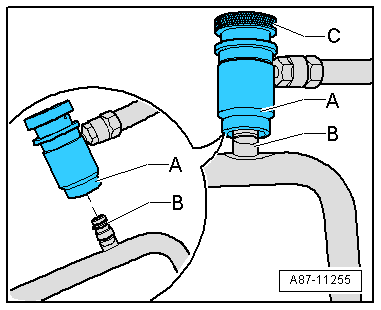
- Quick-release coupling adapter -A- (a quick-release coupling adapter can for example also be removed from the A/C Service Station and used).
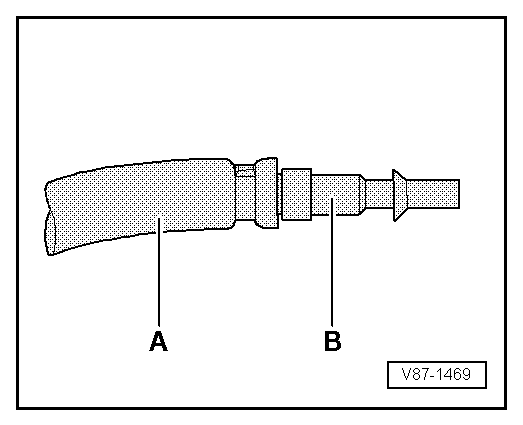
- Filler hose -A- (for example with M12 x 1.5 -6G thread according to SAE J639) depending on the threads on the quick-release coupling adapter (segmented) with the fitting adapter -B- (to connect the workshop compressed-air system or a nitrogen pressure regulator)
- Combined fine filter unit for compressed-air system with oil-dirt and water separator (so that the refrigerant circuit pressure is only generated with clean oil-free dry air) for the leak test with compressed air.
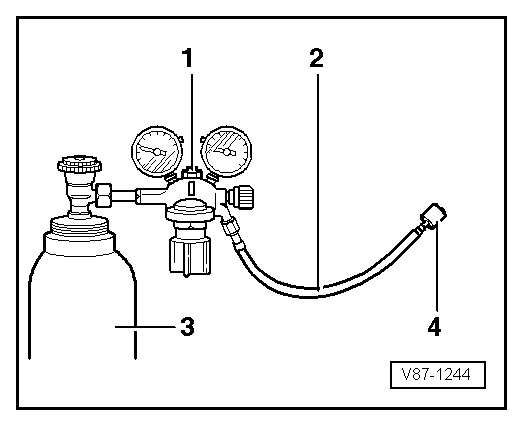
- Use the pressure gauge set with pressure reducer for nitrogen (maximum reduction pressure: 15 bar (217.55 psi)) -1- a compressed gas cylinder filled with nitrogen -3- and a filler hose -2- (connected for example a M12 x 1.5 -6G threads according to SAE J639 on a quick-release coupling adapter for the service connections) for the leak test with nitrogen.
-- Perform a pressure test. Refer to Additional Procedure, If a Leak Is Detected When Evacuating. .