COOLANT, FILLING USING Cooling System Charge Kit: VAS6096 [DMSA, DMSB]: Notes
Special tools and workshop equipment required
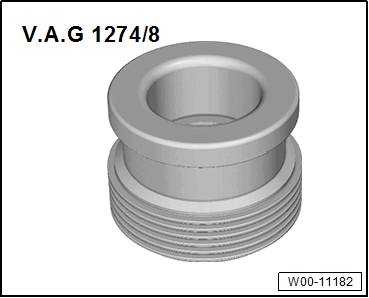
- Cooling System Tester - Adapter: VAG1274/8
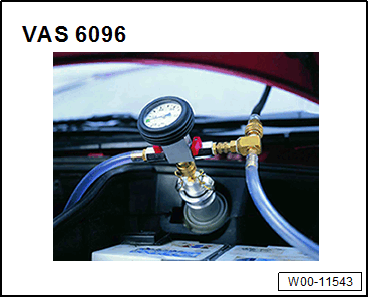
- Cooling System Charge Kit: VAS6096
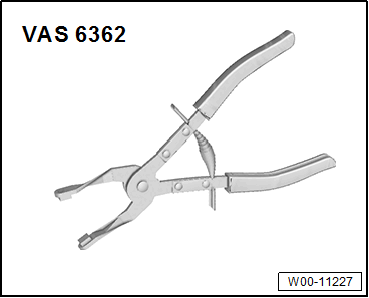
- Hose Clip Pliers: VAS6362
- Analog Refractometer: T10007B
Coolant Specification
Distilled water must be used to mix the coolant concentrate due to country and region specific differences in the contents in tap water.
Only use coolant additives approved for the vehicle. Refer to Parts Information. Other coolant additives may above all reduce the corrosion protection effect significantly. The damage resulting from this may lead to loss of coolant and consequently to severe engine damage.
Coolant with the correct mixture ratio prevents freezing and corrosion damage and calcium deposits. Additionally, the boiling temperature will be raised. For this reason the cooling system must be filled with coolant additive year-round.
Because of its high boiling point, the coolant contributes to engine reliability under heavy engine loads, particularly in countries with tropical climates.
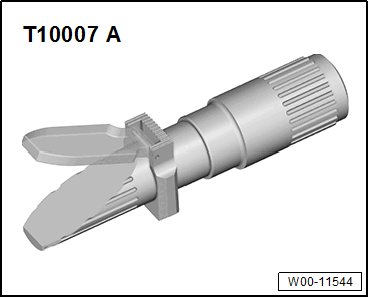
To determine the current freeze protection value, use the Refractometer: T10007A or Analog Refractometer: T10007B .
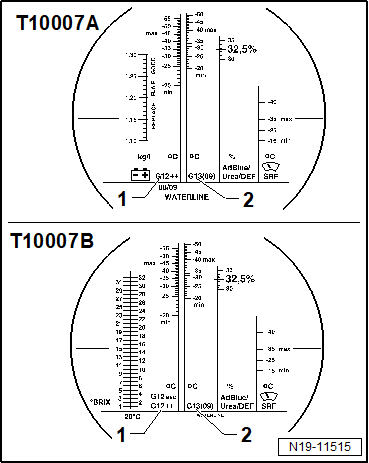
The scale -1- on the refractometer refers to the coolant additives G12++ and G12evo.
The scale -2- on the refractometer refers to the coolant additive G13.
If the type of coolant additive cannot be determined, always use the G13 scale to determine freeze protection.
Freeze protection must be assured down to minimum -25 °C (-13 °F) (in arctic climatic countries down to approximately -36 °C (-32.8 °F)). The freeze protection may only be increased, when stronger freeze protection is needed due to the climate. But only down to -48 °C (-54.4 °F), otherwise the effectiveness of the coolant decreases.
The coolant concentration must not be reduced by adding water even in warmer seasons and in warmer countries. The frost protection must be at least -25 °C (-13 °F).
The temperature on the Refractometer corresponds to the >>freezing point<<. At this temperature, ice crystals may begin to form in the coolant.
Used coolant cannot be used again.
Only use water/coolant additive to lubricate the coolant hoses.