Check for Leaks on the Refrigerant Circuit Using UV Lamp.
Risk or photokeratitis to the eyes by UV light.
- Wear protective eyewear.
- Never look into the UV lamp.
- Never point the UV lamp at another person.
-- On vehicles with a high-voltage system, switch off (deactivate) the "auxiliary climate control" function. Refer to the Owner's Manual and Infotainment/MMI Operating Manual.
-- Switch off the ignition.
A/C system must be operated for a minimum of 60 minutes so that the additive distributes itself in the entire refrigerant circuit (compressor must be running). Depending on the size of the leak, it may become visible under UV light within that time.
Depending on the size and location of the leak, it can now last up to several days until enough refrigerant oil with UV-leak detection additive flows out to clearly determine the leaking area.
With leaks on the evaporator, leak detection additive is possibly washed off with condensation and flows out via evaporator drain. Since the evaporator is not easily accessible on most vehicles, checking the evaporator drain may indicate if the evaporator is leaking. However, it is necessary for this purpose that leak detection additive has already been in the refrigerant circuit for a long period of time (for example, a few days).
The protective goggles do not only serve as eye protection but also amplify the illumination of leak detection additive under UV light.
Depending on the accessibility of the refrigerant circuit components, it may be necessary to remove some vehicle components such as the bumper or air filter.
Only a little refrigerant oil will get onto certain places on the refrigerant circuit when A/C is being used (for example, on the top cover of the receiver/dryer attached to the condenser). If there is a leak at this spot, it may take longer until enough refrigerant with refrigerant oil and additive start to leak out, which then can be viewed under UV light. It may be useful to use an electronic leak detector at these locations to find a leak. Refer to REFRIGERANT CIRCUIT, FINDING LEAKS USING ELECTRONIC LEAK DETECTOR .
-- Move vehicle into a slightly darker area of the workshop (with daylight or bright lighting the effect of the UV light is diminished).
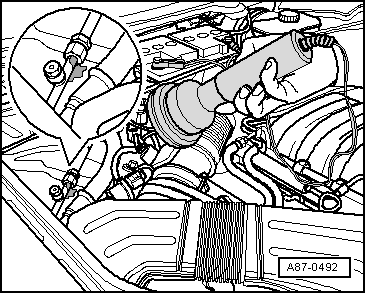
-- Check the accessibility of the various refrigerant circuit components and remove any components in the refrigerant circuit area that block access to the refrigerant circuit components (for example noise insulation and the bumper).
-- Protect the eyes by wearing protective eyewear.
-- Connect the UV lamp to a 12 V bulb (vehicle battery). At the same time make sure the polarity of the connections is correct.
-- Turn on the UV lamp and light the refrigerant circuit components. Locations where refrigerant, refrigerant oil and UV-leak detection additive has leaked out light up under fluorescent UV light.