Specified Values For The Refrigerant Circuit Pressures
Connect the Air Conditioning (A/C) service station. Refer to A/C SERVICE STATION, CONNECTING .
Observe the test requirements. Refer to PRESSURES, CHECKING .
-- With the ignition switched off, check the pressure in the refrigerant circuit (using the service station). Refer to REFRIGERANT CIRCUIT, CHECKING PRESSURE WITH SERVICE STATION .
The pressures with the ignition turned off meet the specifications.
-- Start the engine.
-- Bring the engine speed up to 2000 RPM.
-- Observe the pressure gauge of the service station.
The switch pressures for the A/C Compressor Regulator Valve -N280- and the Coolant Fan -V7- are vehicle specific.
Pressures must be measured at service connections; component locations of these connections are vehicle-specific. Refer to SYSTEM OVERVIEW - REFRIGERANT CIRCUIT .
High-Pressure Side:
Increasing from initial pressure (when connecting pressure gauges) to 20 bar (290 psi).
Low-Pressure Side:
Decreasing from initial pressure (when connecting pressure gauges) to the value in the graph.
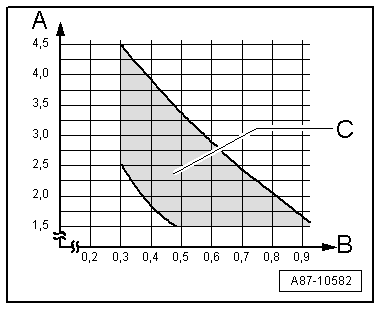
A - Low pressure (measured at service connection) in bar (psi)
B - Control current for A/C Compressor Regulator Valve -N280- in amps.
C - Permissible tolerance range
If high cooling output is needed (for example, the outside temperature is very high, the blower speed it set on high but the engine RPMs are low), then the A/C compressor will not bring the pressure on the low pressure side to the value specified in the diagram -C- (for example, for a certain time after turning on the A/C). The A/C compressor is actuated with maximum specified control current, however delivery volume is no longer sufficient at this engine speed to reduce pressure on low-pressure side to value in graph. To check the A/C compressor control under these conditions, for example, the fresh air blower is controlled only with approximately 40% of the maximum voltage, check the pressures at a lower fresh air blower speed. Use the Vehicle Diagnostic Tester ("OBD" or "Guided Fault Finding for the A/C system") and COOLING OUTPUT, CHECKING or Refrigerant Circuit .
Under unfavorable conditions (very high ambient temperatures, high humidity), pressure on high-pressure side may increase up to maximum 29 bar (421 psi).
Control current -B- is displayed in measured value block of A/C Control Head -E87- or control head, Climatronic Control Module -J255-.
The measured pressure from the High Pressure Sensor -G65- or from the A/C Pressure/Temperature Sensor -G395- is displayed in the measured value block for the Front A/C Display Control Head -E87- and the Climatronic Control Module -J255- ("OBD" or "Guided Fault Finding for the A/C System") and Refrigerant Circuit .
Low pressure settles as a function of control current for A/C Compressor Regulator Valve -N280- within compressor output range in tolerance range.
Under unfavorable conditions (very high ambient temperatures, high humidity), compressor output may not always be sufficient to attain the specified value.
If compressor capacity utilization is greater than 90%, pressure on low-pressure side may be in excess of tolerance range "C" shown in graph (compressor output no longer sufficient).
The specified operating current for the regulator valve must be greater than 0.3 A in order to ensure reliable valve activation.
At absolute pressure, "0 bar/psi" corresponds to absolute vacuum. Normal ambient pressure corresponds to 1 bar (14.5 psi) absolute pressure. 0 bar/psi pressure corresponds to an absolute pressure of 1 bar (14.5 psi) on most pressure gauges (indicated by "-1 bar (-14.5 psi)" below "0").
In "maximum cooling output" setting, control current is regulated to approximately 0.65 (vehicle-specific up to 0.85A, displayed in measured value block). Use the Vehicle Diagnostic Tester ("OBD" or "Guided Fault Finding for the A/C System") and COOLING OUTPUT, CHECKING or Component Location Overview - A/C System .
| Possible deviation from specification | Possible cause of fault | Corrective action |
|---|---|---|
|
|
-- Check the A/C Compressor Regulator Valve -N280- activation. Refer to Refrigerant Circuit .-- Localize the leak with leak detector and eliminate.-- Charge the refrigerant circuit. |
|
If no fault is found with this malfunction, clean the refrigerant circuit (flush using refrigerant R134a. Refer to REFRIGERANT CIRCUIT, CLEANING (FLUSHING) WITH REFRIGERANT R134A ; or blow through using compressed air and nitrogen. Refer to REFRIGERANT CIRCUIT, FLUSHING WITH COMPRESSED AIR AND NITROGEN ).
| Possible Deviation from Specification | Possible Cause of Fault | Corrective Action |
|---|---|---|
|
|
-- Check and service the A/C compressor activation and drive. Refer to A/C Compressor . -- Check the A/C Compressor Regulator Valve -N280- activation and functionality. |
|
-- Clean the refrigerant circuit (flush with refrigerant R134a. Refer to REFRIGERANT CIRCUIT, CLEANING (FLUSHING) WITH REFRIGERANT R134A ; or blow through with compressed air and nitrogen. Refer to REFRIGERANT CIRCUIT, FLUSHING WITH COMPRESSED AIR AND NITROGEN ).-- Replace the hose or line if kinked or constricted. | |
|
-- Check the A/C Compressor Regulator Valve -N280- functionality. If necessary, replace the valve -N280- and check for dirt. Refer to A/C Compressor Regulator Valve -N280-, REMOVING AND INSTALLING . | |
|
-- Replace the A/C compressor. |
| Possible Deviation from Specification | Possible Cause of Fault | Corrective Action |
|---|---|---|
|
|
-- Check the A/C Compressor Regulator Valve -N280- activation. Refer to Refrigerant Circuit
.-- Run hand over refrigerant circuit to check for differences in temperature
|
| Possible Deviation from Specification | Possible Cause of Fault | Corrective Action |
|---|---|---|
|
|
-- Check the A/C Compressor Regulator Valve -N280- activation. Refer to Refrigerant Circuit .-- Replace the reservoir (with dryer) and evacuate the refrigerant circuit for a minimum of three hours (see note). |
|
|
-- Check the A/C Compressor Regulator Valve -N280- functionality. If necessary, replace the valve -N280- and check for dirt. Refer to A/C Compressor Regulator Valve -N280-, REMOVING AND INSTALLING . |
|
-- Clean the refrigerant circuit (flush with refrigerant R134a. Refer to REFRIGERANT CIRCUIT, CLEANING (FLUSHING) WITH REFRIGERANT R134A ; or blow through with compressed air and nitrogen. Refer to REFRIGERANT CIRCUIT, FLUSHING WITH COMPRESSED AIR AND NITROGEN ). |
It is not initially necessary to clean the refrigerant circuit (flush using refrigerant R134a. Refer to REFRIGERANT CIRCUIT, CLEANING (FLUSHING) WITH REFRIGERANT R134A or blow through using compressed air and nitrogen. Refer to REFRIGERANT CIRCUIT, FLUSHING WITH COMPRESSED AIR AND NITROGEN .) when this problem occurs since normally there is only a small quantity of moisture in the system which can be removed by lengthy evacuation.
If problem involving moisture in refrigerant circuit only occurs after a lengthy operating period or only infrequently (low pressure drops below specification and evaporator ices up), it is sufficient to replace the dryer (adjust quantity of refrigerant oil). Refrigerant circuit is then to be evacuated for at least three hours.
Problem with Evaporator Vent Temperature Sensor -G263- can also cause icing-up of refrigerant circuit. If this problem is encountered, also pay attention to measured value of Evaporator Vent Temperature Sensor -G263-. Use the Vehicle Diagnostic Tester ("OBD" or "Guided Fault Finding" for the A/C System) and COOLING OUTPUT, CHECKING or Refrigerant Circuit .
| Possible Deviation from Specification | Possible Cause of Fault | Corrective Action |
|---|---|---|
|
|
-- Check the A/C Compressor Regulator Valve -N280- activation. Refer to Refrigerant Circuit .-- Check the A/C Compressor Regulator Valve -N280- functionality. If necessary, replace the valve -N280- and check for dirt. Refer to A/C Compressor Regulator Valve -N280-, REMOVING AND INSTALLING . |
|
-- Clean the refrigerant circuit (flush with refrigerant R134a. Refer to REFRIGERANT CIRCUIT, CLEANING (FLUSHING) WITH REFRIGERANT R134A ; or blow through with compressed air and nitrogen. Refer to REFRIGERANT CIRCUIT, FLUSHING WITH COMPRESSED AIR AND NITROGEN ).-- Replace the A/C compressor. |
For the malfunction "high pressure normal, low pressure too low", note the following: With this malfunction, evaporator may ice up although the quantity of refrigerant in circuit is OK. Check measured values of the Evaporator Vent Temperature Sensor -G263- and the actuation of the A/C Compressor Regulator Valve -N280-. If the measured value from the Evaporator Vent Temperature Sensor -G263- is incorrect, the evaporator may ice up or cooling output is not attained Vehicle Diagnostic Tester ("OBD" or "Guided Fault Finding for the A/C System") and COOLING OUTPUT, CHECKING or Refrigerant Circuit .
| Possible Deviation from Specification | Possible Cause of Fault | Corrective Action |
|---|---|---|
|
|
-- Check the A/C Compressor Regulator Valve -N280- activation. Refer to Refrigerant Circuit
.-- Extract refrigerant from the refrigerant circuit
|
|
|
-- Check the A/C Compressor Regulator Valve -N280- activation.-- Discharge the refrigerant circuit. |
|
-- Clean the refrigerant circuit (flush with refrigerant R134a. Refer to REFRIGERANT CIRCUIT, CLEANING (FLUSHING) WITH REFRIGERANT R134A ; or blow through with compressed air and nitrogen. Refer to REFRIGERANT CIRCUIT, FLUSHING WITH COMPRESSED AIR AND NITROGEN ). |
Overfilling with refrigerant oil can occur if, for example, the compressor has been replaced without adjusting the quantity of refrigerant oil.
If there is too much refrigerant oil in the circuit, the compressor must be drained and the accumulator must be replaced. After cleaning the refrigerant circuit (flushing with refrigerant R134a. Refer to REFRIGERANT CIRCUIT, CLEANING (FLUSHING) WITH REFRIGERANT R134A ; or blowing through using compressed air and nitrogen. Refer to REFRIGERANT CIRCUIT, FLUSHING WITH COMPRESSED AIR AND NITROGEN ), the correct quantity of refrigerant oil is filled into the circuit. Refer to REFRIGERANT R134A CAPACITIES, REFRIGERANT OIL AND APPROVED REFRIGERANT OILS .