Refrigerant Circuit, Cleaning (Flushing) With Refrigerant R134A: Notes
Vehicles with a High-Voltage System (Hybrid Vehicles)
High voltage is extremely dangerous.
The high-voltage system is under high voltage. Electrocution can cause death or very serious personal injury.
-- Individuals with electronic/medical life and health sustaining machines in or on their person cannot perform any work on high-voltage systems. Life and health sustaining machines are for example pain killer pumps, implanted defibrillators, pacemakers, insulin pumps, and hearing aids.
-- Have the high-voltage system de-energized by a qualified person.
There is a risk of injury due to the engine starting unexpectedly.
On electric and hybrid vehicles an active ready mode is difficult to identify. Parts of the body can be pinched or pulled.
-- Switch off the ignition.
-- Place the ignition key outside of the vehicle interior.
Risk of damaging the high-voltage cables.
Misuse can damage the insulation of high-voltage cables or high-voltage connectors.
-- Never support objects on the high-voltage cables and the high-voltage connectors.
-- Never support tools on the high-voltage cables and the high-voltage connectors.
-- Never sharply bend or kink the high-voltage cables.
-- When connecting pay attention to the coding of the high-voltage connectors.
- For all procedures on vehicles with a high-voltage system, pay attention to the additional warnings for these vehicles. Refer to WARNINGS WHEN WORKING ON VEHICLES WITH HIGH VOLTAGE SYSTEM .
- If procedures are necessary near components of the high-voltage system, "visually inspect the high-voltage components and lines for damage". Refer to PERFORMING A VISUAL INSPECTION OF DAMAGE TO HIGH VOLTAGE COMPONENTS AND CABLES .
- If work on the high-voltage system components is necessary, de-energize the high-voltage system. Refer to the appropriate service information.
-- Charge the vehicle batteries, for example, using the Battery Charger :VAS5904 in the battery support mode to minimize the number of automatic starts during the test- and measuring procedures while the ready mode is active. Refer to BATTERY, CHARGING and the appropriate service information. .
-- For testing and measurement procedures that require the ready mode to be active or the ignition to be switched on, the selector lever must be in the "P" position and the parking brake must be activated. The required tools must be placed so that they do not come into contact with any rotating components in the engine and they must also not go into the vicinity of the rotating components when the engine is running.
Also move the selector lever into position "P" and activate the parking brake for testing and measuring procedures that require the ignition to be on, but do not require the ready mode to be active.
The ready mode appears in the Instrument Cluster Control Module -J285- via the "power meter". Refer to the Owner's Manual .
Activate and deactivate the ready mode. Refer to the Owner's Manual (watch the display in the Instrument Cluster Control Module -J285- while doing this).
All Vehicles
- If it is suspected that chemicals to seal leaks (leak stop additive) were added to the refrigerant circuit that is to be flushed, do not connect the A/C service station and do not clean (flush) this refrigerant circuit.
- Chemicals that seal leaks in the refrigerant circuit (leak stop additives) form deposits that affect the function of the A/C system and lead to malfunctions in the A/C system and the A/C service station.
- Inform the customer that there are substances in the A/C system that are not approved by Audi and for this reason the A/C system cannot be cleaned (flushed) and serviced.
Audi does not approve the use of chemicals (stop leak additives) to seal leaks in the refrigerant circuit.
Chemical materials (leak stop additives) to seal leaks in the refrigerant circuit react with air or the moisture in the surrounding air and form deposits in the refrigerant circuit (and in the A/C service station) that lead to malfunctions in the valves and other components that come into contact with such chemicals. These deposits cannot be removed completely from the components, even by cleaning/flushing. It is only possible to service the refrigerant circuit by replacing all the components that have come into contact with this material.
It is generally not possible to externally recognize chemical substances to seal leaks in the refrigerant circuit (leak stop additive), and the stickers that are supposed to come with them are usually not there. Therefore be careful when working with a vehicle if its service history is unknown.
- The refrigerant circuit must be cleaned by flushing with refrigerant R134a in order to remove moisture, contaminants (such as abraded material from a faulty A/C compressor) as well as old refrigerant oil as cleanly and efficiently as possible, without wasting refrigerant, without the need for extensive assembly work and without endangering the environment.
Flush the Refrigerant Circuit:
-- If dirt or other contaminants are in the circuit.
-- If the vacuum reading is not maintained when evacuating a leak-free refrigerant circuit (pressure build-up due to moisture in the refrigerant circuit).
-- The refrigerant circuit has been left open for longer than normal (for example, after a collision).
-- Pressure and temperature measurements in the circuit indicate that there is moisture in the refrigerant circuit.
-- If there is any uncertainty as to how much refrigerant oil is in the refrigerant circuit.
-- The A/C compressor had to be replaced due to internal damage (for example, noise or no output).
For vehicles with an electrically-driven A/C compressor, pay attention to the notes for replacing the Electrical A/C Compressor -V470- (the refrigerant circuit does not always have to be cleaned if there is damage to the A/C compressor electronics). Refer to COMPRESSOR, REPLACING WITHOUT THE NEED FOR FLUSHING REFRIGERANT CIRCUIT .
If a faulty A/C compressor is replaced with an A/C compressor from another manufacturer, check if the same refrigerant oil is approved for the A/C compressor to be installed as the one that is already in the refrigerant circuit (from the removed A/C compressor). If a different refrigerant oil is approved for the A/C compressor to be installed than the one in the removed A/C compressor, the refrigerant circuit must be flushed. Refer to APPROVED REFRIGERANT OILS .
-- If it is stipulated by the vehicle-specific Service Information following the replacement of certain components.
Required Tools
- A/C Service Station with Flushing Device (these A/C service stations have the additional "flush refrigerant circuit" function and are equipped with the refrigerant circuit flushing device required for it). Refer to the Parts Information (Tools; Special Tools and Equipment: A/C and Heating).
- Refrigerant Circuits Adapter Set 1 :VAS6338/1 . Refer to ADAPTER FOR ASSEMBLING FLUSHING CIRCUIT and the Parts Information (Tools; Special Tools and Equipment: A/C and Heating).
If an A/C Service Station with Flushing Device is not available (refer to the Parts Information (Tools; Special Tools and Equipment: A/C and Heating)), a Refrigerant Circuit Flushing Device (refer to the Parts Information (Tools; Special Tools and Equipment: A/C and Heating)) may also be attached to the refrigerant circuit to flush with refrigerant R134a, depending on the A/C service station version. The procedure must however be performed manually. Refer to Sequence of flushing procedure (sequence occurs automatically according to the A/C service station program) .
For vehicles with threaded connections on the refrigerant circuit, the A/C Adapter Set - Adapter 7 :VAG1785/7 and A/C Adapter Set - Adapter 8 :VAG1785/8 from the Refrigerant Circuits Adapter Set 1 :VAS6338/1 can be used; for vehicles with threaded connections on the A/C compressor and reservoir, two A/C Adapter Set - Adapter 8 :VAG1785/8 are required.
In the Refrigerant Circuits Adapter Set 1 :VAS6338/1 , there is also a Hose :VAS6338/31 with 5/8" 18 UNF connections and a large inner diameter in the short version (commercially available).
Preliminary Work
-- Discharge the refrigerant circuit. Refer to REFRIGERANT CIRCUIT, DISCHARGING WITH A/C SERVICE STATION .
-- Remove the A/C compressor. Refer to A/C Compressor .
Vehicle with Restrictor and Reservoir
-- Remove the restrictor (vehicle-specific) and reconnect the lines to each other. Refer to Refrigerant Circuit .
-- Remove the reservoir (vehicle-specific) and reconnect the lines to each other (use adapters and the Hose :VAS6338/31 from the Refrigerant Circuits Adapter Set 1 :VAS6338/1 ). Refer to ADAPTER FOR ASSEMBLING FLUSHING CIRCUIT and Refrigerant Circuit .
Depending on the version, the reservoir could be potentially flushed but it will take too much refrigerant because of its large internal volume; the reservoir would ice-up too much when extracting the refrigerant, the refrigerant would evaporate too slowly and the extraction process would take too long.
Depending on the version, the receiver/dryer can be potentially flushed (see vehicle-specific description) but it will take too much refrigerant because of its large internal volume; the receiver/dryer would ice-up too much when extracting the refrigerant, the refrigerant would evaporate too slowly and the extraction process would take too long.
Vehicle with expansion valve and receiver/dryer
-- Remove the receiver/dryer (vehicle-specific; not necessary on all vehicles) and reconnect the lines to each other (use adapters and the Hose :VAS6338/31 from the Refrigerant Circuits Adapter Set 1 :VAS6338/1 ). Refer to ADAPTER FOR ASSEMBLING FLUSHING CIRCUIT and Refrigerant Circuit .
The receiver/dryer can be flushed depending on the version (remove the dryer cartridge installed inside of it if necessary). Refer to ADAPTER FOR ASSEMBLING FLUSHING CIRCUIT and Refrigerant Circuit .
The receiver/dryer attached to the condenser (on the Audi A3 from MY 2004, for example) remains installed during flushing (it can be flushed due to its design and is only replaced after flushing). Refer to ADAPTER FOR ASSEMBLING FLUSHING CIRCUIT and Refrigerant Circuit .
If the receiver/dryer or dryer cartridge is integrated in the condenser, then they cannot be replaced separately or are not available as a single part, and the condenser must be replaced after flushing. In this case, replace the condenser with the receiver/dryer on these vehicles. Refer to Refrigerant Circuit and the Parts Information.
Depending on the version, there may be an additional filter element on receiver/dryers where the dryer cartridge can be replaced separately. This filter element must be replaced with the dryer cartridge if necessary.
-- Remove the dryer cartridge on vehicles with a dryer cartridge in the receiver/dryer attached to the condenser (vehicle-specific) and seal off the opening on the receiver/dryer. Refer to Refrigerant Circuit .
-- Remove the expansion valve (vehicle-specific) and install an adapter from the Refrigerant Circuits Adapter Set 1 :VAS6338/1 in its place. Refer to ADAPTER FOR ASSEMBLING FLUSHING CIRCUIT and Refrigerant Circuit .
-- For vehicles with one or multiple shut-off valves and check valves, remove them and install suitable adapters (or manual shut-off valves) from the Refrigerant Circuits Adapter Set 1 :VAS6338/1 in their place. Refer to ADAPTER FOR ASSEMBLING FLUSHING CIRCUIT and Refrigerant Circuit .
If there is no adapter suitable for the expansion valve in the Refrigerant Circuits Adapter Set 1 :VAS6338/1 , the removed expansion valve can also be drilled open (the old expansion valve must also be replaced in most cases and is therefore no longer required).
- Make sure the sealing surfaces on the expansion valve are not damaged when drilling open.
- Refrigerant will otherwise escape if the sealing surface is damaged.
Drill a hole for the expansion valve.
Before drilling open, remove the regulating element and drill open the expansion valve using a suitable drill, for example (drill bit diameter 6.0 mm, for example).
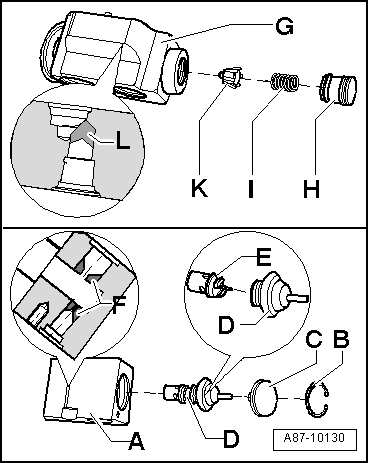
Several components are to be removed from the expansion valve before drilling open.
Expansion valves are available in various versions and with different constructions. For version -A-, parts -B-, -C- and -D- must be removed, for example. Separate the part -E- (regulating element) from component -D-. Then drill open the expansion valve in area -F- using a suitable drill bit.
For version -G-, for example, parts -H-, -I- and -K- must be removed and then drill open the area -L- using a suitable drill bit.
-- Clean the drilled open expansion valve of residue from the work (shavings).
-- Install the parts -B-, -C- and -D- for version -A-, or the part -H- for version -G-.
For vehicles with two evaporators, the circuit to the second evaporator must be disconnected from the circuit of the first evaporator and must be flushed in a separate work procedure. Refer to ADAPTER FOR ASSEMBLING FLUSHING CIRCUIT and Refrigerant Circuit .
Flushing
-- Check the refrigerant quantity in the A/C service station. There must be at least 6 kg of refrigerant R134a.
If necessary, turn on the heating installed in the A/C service station for the refrigerant cylinder before the first flushing procedure (to increase the pressure in the refrigerant cylinder) and turn it off before the first extraction during the flushing procedure.
-- Drain the used oil container of the A/C service station.
-- Connect the supply hose (high pressure side) of A/C service station to the low pressure line leading to the A/C compressor (line with larger diameter) using an adapter. Refer to ADAPTER FOR ASSEMBLING FLUSHING CIRCUIT .
-- Connect the return hose (low pressure or intake side) of the A/C service station to the output of the refrigerant circuit flushing device.
-- Connect the input on the refrigerant circuit flushing device to the high pressure line leading to the A/C compressor (line with smaller diameter) using an adapter. Refer to ADAPTER FOR ASSEMBLING FLUSHING CIRCUIT .
Components are always (with the exception of the electric A/C compressor) flushed in the opposite direction of refrigerant flow when the A/C system is operating. Refer to FLUSHING CIRCUIT BLOCK DIAGRAMS .
While flushing, contaminants from the refrigerant circuit enter the refrigerant circuit flushing device and the A/C service station and are absorbed by the filters and dryers installed there. Depending on the contaminant, these components are to be replaced in shorter intervals in line with operating instructions for A/C service station or refrigerant circuit flushing device.
Depending on the type and degree of contamination in the flushed refrigerant circuit, the filter in the refrigerant circuit flushing device must be changed after five to ten flushing cycles (flushed vehicles) at the latest. If a heavily contaminated refrigerant circuit is flushed (the refrigerant oil from the circuit is black and viscous or there are many shavings in the refrigerant circuit), the filter should be replaced after flushing this refrigerant circuit. With a refrigerant circuit heavily contaminated in this way, it is wise to flush the refrigerant circuit again after changing the filter.
Depending on the type of contamination, dirt (old refrigerant oil and abraded material from A/C compressor) accumulates on the viewing glass of the refrigerant circuit flushing device. Clean the viewing glass after flushing if necessary, and flush the refrigerant circuit once more with one flushing procedure as a check (one cycle is sufficient).
Liquid refrigerant cannot be channeled through the expansion valve, restrictor and desiccant bag of certain receiver/dryers at the necessary speed, therefore these components must be removed and replaced by adapters if necessary. Refer to Refrigerant Circuit .
Adapters for connecting the A/C service station and for bridging certain refrigerant circuit components. Refer to ADAPTER FOR ASSEMBLING FLUSHING CIRCUIT .
-- Depending on the refrigerant circuit, assemble the flushing circuit in the vehicle. Refer to ADAPTER FOR ASSEMBLING FLUSHING CIRCUIT .
Vehicles with Two Evaporators in Refrigerant Circuit:
The refrigerant circuit is cleaned in two flushing cycles (first the section with the evaporator in the front heater and A/C unit and then the section with the evaporator in the rear heater and A/C unit. Refer to ADAPTER FOR ASSEMBLING FLUSHING CIRCUIT .
For vehicles with two evaporators, the circuit to the second evaporator must be disconnected from the circuit of the first evaporator and must be flushed in a separate work procedure. Refer to ADAPTER FOR ASSEMBLING FLUSHING CIRCUIT and Refrigerant Circuit .
Vehicles with High-Voltage System (without Additional A/C System Functions, for Example the Audi A3 e-tron, Audi Q5 hybrid etc.)
The refrigerant circuit is cleaned in two flushing cycles (first the section with the evaporator in the front heater and A/C unit and then the section with the high-voltage battery heat exchanger or the evaporator in the battery cooling module). Refer to ADAPTER FOR ASSEMBLING FLUSHING CIRCUIT .
For vehicles with two evaporators or an evaporator with a heat exchanger, disconnect the circuit to the second evaporator or to the heat exchanger from the circuit for the first evaporator using the manual shut-off valves and flush it in a separate work procedure. Refer to ADAPTER FOR ASSEMBLING FLUSHING CIRCUIT and Refrigerant Circuit .
A flushing cycle currently consists of three flushing procedures one after the other (depending on the program in the respective A/C service station). Refer to Sequence of flushing procedure (sequence occurs automatically according to the A/C service station program) .
-- If necessary, close or open the installed manual shut-off valves depending on which section of the refrigerant circuit should be flushed during this flushing cycle.
-- Close or open the installed power-operated valves using the designated routine in the corresponding vehicle control module depending on which section of the refrigerant circuit is to be flushed in this flushing cycle.
Vehicles with High-Voltage System (with Additional A/C System Functions, such as Heat Pump Operation on Audi Q7 e-tron, for Example)
The refrigerant circuit is cleaned in multiple flushing cycles. Refer to ADAPTER FOR ASSEMBLING FLUSHING CIRCUIT and Refrigerant Circuit (Cleaning the A/C system refrigerant circuit).
To flush, the circuit is divided into multiple sections and then cleaned during one flushing cycle at a time. It is divided by activating the installed electrically activated valves and using the installed manual shut-off valves. Refer to Refrigerant Circuit (Cleaning the A/C system refrigerant circuit).
A flushing cycle currently consists of three flushing procedures one after the other (depending on the program in the respective A/C service station). Refer to Sequence of flushing procedure (sequence occurs automatically according to the A/C service station program) .
The design of the different flushing circuits for these vehicles is described in the respective vehicle-specific Service Information. Refer to Refrigerant Circuit (Cleaning the A/C system refrigerant circuit).
-- Close or open the installed manual shut-off valves depending on which section of the refrigerant circuit should be flushed during this flushing cycle. Refer to Refrigerant Circuit (Cleaning the A/C system refrigerant circuit).
-- Close or open the installed power-operated valves using the designated routine in the corresponding vehicle control module depending on which section of the refrigerant circuit is to be flushed in this flushing cycle. Use the Vehicle Diagnostic Tester in the "Guided Fault Finding" function and refer to Refrigerant Circuit (Cleaning the A/C system refrigerant circuit).
All Vehicles
-- Turn on the A/C service station and flush the refrigerant circuit (duration approximately one to one and a half hours for one flushing cycle with three flushing operations).
Perform the flushing procedure according to operating instructions of the A/C service station. Refer to the A/C Service Station Operating Instructions.
Depending on version of A/C service station, the used oil container only holds approximately 125 cm 3 of refrigerant oil. If a system with a larger quantity of refrigerant oil must be flushed, it may be necessary to drain the used oil container after the first flushing procedure of one flushing cycle.
Observe the refrigerant that flows back into the A/C service station from the refrigerant circuit. Only when the refrigerant streams clear and completely colorless through the viewing glass on the refrigerant circuit flushing device into the A/C service station is the refrigerant circuit cleaned.
All the refrigerant oil is washed out of the refrigerant circuit during flushing (except for a very small amount in the evaporator, however this can be disregarded).
If heavily contaminated, it may be necessary to perform the flushing procedure twice (two flushing cycles with three flushing operations each).