Specified Values For The Refrigerant Circuit Pressures
High-Pressure Side:
Increasing from initial pressure (when connecting the pressure gauges) to a maximum of 20 bar (290 psi).
Low-Pressure Side:
Decreasing from initial pressure (when connecting pressure gauges) to the value in the graph.
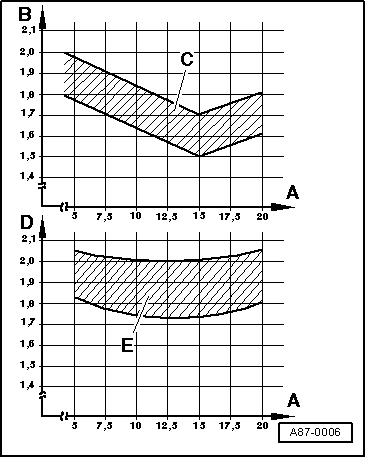
A - High pressure (measured at service connection) in bar (psi)
B - Low pressure (measured at connection with valve at compressor or accumulator) in bar
C - Permissible tolerance range
D - Low pressure (measured at connection with valve for low-pressure switch or at service connection) in bar (psi)
E - Permissible tolerance range
| Possible Deviation from Specification | Possible Cause of Fault | Corrective Action |
|---|---|---|
|
Not enough refrigerant in refrigerant circuit | -- Localize leak with leak detector and eliminate.-- Charge the refrigerant circuit. |
|
||
|
If no fault is found with this malfunction, clean the refrigerant circuit (flush using refrigerant R134a. Refer to REFRIGERANT CIRCUIT, CLEANING (FLUSHING) WITH REFRIGERANT R134A ; or blow through using compressed air and nitrogen. Refer to REFRIGERANT CIRCUIT, FLUSHING WITH COMPRESSED AIR AND NITROGEN ).
| Possible Deviation from Specification | Possible Cause of Fault | Corrective Action |
|---|---|---|
|
|
-- Check and service the A/C compressor activation and drive. Refer to A/C Compressor . |
|
-- Clean the refrigerant circuit (flush with refrigerant R134a. Refer to REFRIGERANT CIRCUIT, CLEANING (FLUSHING) WITH REFRIGERANT R134A ; or blow through with compressed air and nitrogen. Refer to REFRIGERANT CIRCUIT, FLUSHING WITH COMPRESSED AIR AND NITROGEN ).-- Replace the hose or line if kinked or constricted. | |
|
-- Replace the A/C compressor. |
| Possible Deviation from Specification | Possible Cause of Fault | Corrective Action |
|---|---|---|
|
Constriction or obstruction in refrigerant circuit | -- Run hand over refrigerant circuit to check for differences in temperature. Refer to Refrigerant Circuit
.
|
|
Moisture in refrigerant circuit | -- Check the reservoir (with dryer) and restrictor and replace if necessary. Then evacuate the refrigerant circuit for a minimum of three hours (see note).-- Clean the refrigerant circuit (flush with refrigerant R134a. Refer to REFRIGERANT CIRCUIT, CLEANING (FLUSHING) WITH REFRIGERANT R134A ; or blow through with compressed air and nitrogen. Refer to REFRIGERANT CIRCUIT, FLUSHING WITH COMPRESSED AIR AND NITROGEN ). |
|
If problem involving moisture in refrigerant circuit only occurs after a lengthy operating period or only infrequently (low pressure drops below specification and evaporator ices up), it is sufficient to replace the dryer (adjust quantity of refrigerant oil). Refrigerant circuit is then to be evacuated for at least three hours.
It is not initially necessary to clean the refrigerant circuit (flush using refrigerant R134a. Refer to REFRIGERANT CIRCUIT, CLEANING (FLUSHING) WITH REFRIGERANT R134A . Or blow through using compressed air and nitrogen. Refer to REFRIGERANT CIRCUIT, FLUSHING WITH COMPRESSED AIR AND NITROGEN when this problem occurs since normally there is only a small quantity of moisture in the system which can be removed by lengthy evacuation.
| Possible Deviation from Specification | Possible Cause of Fault | Corrective Action |
|---|---|---|
|
A/C compressor faulty. | -- Clean the refrigerant circuit (flush with refrigerant R134a. Refer to REFRIGERANT CIRCUIT, CLEANING (FLUSHING) WITH REFRIGERANT R134A ; or blow through with compressed air and nitrogen. Refer to REFRIGERANT CIRCUIT, FLUSHING WITH COMPRESSED AIR AND NITROGEN ).-- Replace the A/C compressor. |
For the malfunction "high pressure normal, low pressure too low", note the following: This fault may cause the evaporator to ice up or the A/C Refrigerant Low Pressure Switch -F73- to shut off the compressor although the amount of refrigerant in the circuit is OK.
On the Audi 100, Audi A6 (through MY1997) and Audi V8, this fault may result in compressor being shut off by the control head (if the temperature at fresh-air blower drops below -3 °C (27 °F)). Refer to Refrigerant Circuit or Component Location Overview - A/C System .
| Possible Deviation from Specification | Possible Cause of Fault | Corrective Action |
|---|---|---|
|
Too much refrigerant in the circuit. | -- Extract refrigerant from the refrigerant circuit
|
| Possible Deviation from Specification | Possible Cause of Fault | Corrective Action |
|---|---|---|
|
Too much refrigerant oil in the circuit. | -- Discharge the refrigerant circuit.-- Clean the refrigerant circuit (flush with refrigerant R134a. Refer to REFRIGERANT CIRCUIT, CLEANING (FLUSHING) WITH REFRIGERANT R134A ; or blow through with compressed air and nitrogen. Refer to REFRIGERANT CIRCUIT, FLUSHING WITH COMPRESSED AIR AND NITROGEN ). |
|
Overfilling with refrigerant oil can occur if, for example, the compressor has been replaced without adjusting the quantity of refrigerant oil.
If there is too much refrigerant oil in the circuit, the compressor must be drained and the accumulator must be replaced. After cleaning the refrigerant circuit (flushing with refrigerant R134a. Refer to REFRIGERANT CIRCUIT, CLEANING (FLUSHING) WITH REFRIGERANT R134A ; or blowing through using compressed air and nitrogen. Refer to REFRIGERANT CIRCUIT, FLUSHING WITH COMPRESSED AIR AND NITROGEN ), the correct quantity of refrigerant oil is filled into the circuit. Refer to REFRIGERANT R134A CAPACITIES, REFRIGERANT OIL AND APPROVED REFRIGERANT OILS .