Hydraulic System, Bleeding Without Brake Charger/Bleeding Unit
Special tools and workshop equipment required
- Brake Bleeding Tool Set :VAS6564
- Container
- The brake system is divided by the axle on this vehicle.
- Right and left front axle
- Right and left rear axle
Procedure
- Wheels are removed. Refer to Wheels And Tires .
TIP:
Make sure that the brake fluid reservoir is always filled.
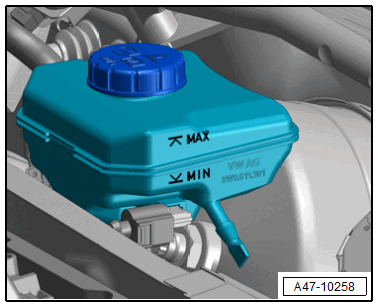
-- Fill the brake fluid reservoir up to the "MAX" mark.
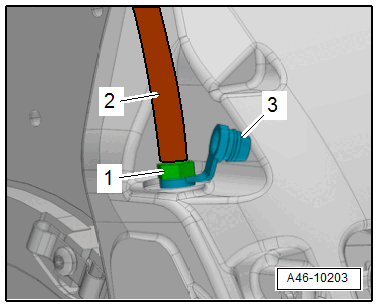
-- Remove the protective cap -3- from the bleed screw -1- on the respective brake caliper.
 Courtesy of AUDI OF AMERICA, LLC
-- Connect the bleeder bottle hose -2-.
TIP:
Use a suitable bleeder hose. It must be seated tightly on the bleed screw so that no air can enter the brake system.
The front brake calipers each have two bleed screws.
Bleed the brake caliper at each bleed screw.
Bleeding Sequence
- Left front outer brake caliper (not steel brakes 1LA/1LB)
- Left front inner brake caliper
- Right front outer brake caliper (not steel brakes 1LA/1LB)
- Right front inner brake caliper
- Left Rear Brake Caliper
- Right Rear Brake Caliper
-- Build pressure up in brake system by pumping brake pedal.
TIP:
Press the brake pedal slowly to prevent bubbles from building up.
-- As soon as pressure is built up, hold the brake pedal in depressed position.
-- Open the bleeder screw with bleeder bottle hose connected, until the pressure is reduced (pedal drops).
-- Hold the pedal in the depressed position and close the bleed screw.
-- Release brake pedal and wait approximately two seconds so that brake fluid can flow out of the brake fluid reservoir.
-- Repeat the procedure until the brake fluid flows out clear and without bubbles.
-- Tighten the bleed screw, remove the bleeder hose and place the protective cap on the bleed screw.
-- Repeat the bleeding procedure in the specified sequence for the remaining brake calipers.
-- Fill the brake fluid reservoir under consideration of brake pad wear up to the "MAX" mark and screw on the fuel cap.
- Do not add brake fluid above the "MAX" mark otherwise it will leak out of the reservoir.
-- Start the engine and check the brake pedal travel and pressure.
-- If the pedal travel is too long, check the brake system for leaks or repeat the bleeding procedure.
Faulty brakes increase the risk of an accident.
- Make sure the brakes are working correctly before driving the vehicle for the first time.
Brake Fluid, Changing. Refer to BRAKE FLUID, CHANGING .
Tightening Specifications
- Refer to OVERVIEW - FRONT BRAKES
- Refer to OVERVIEW - REAR BRAKES