Assembly Instructions
If brake pads are ceramics, wheel must not fall on the brake rotor, otherwise it will be irreparably damaged. To remove/mount a wheel, install the long assembly pin instead of wheel bolts at the top position (12 o'clock position) and insert the short assembly pin in the wheel bolt mounts for support. In this way, the wheel can glide on the assembly aids when removing/installing.
Special Tools And Workshop Equipment Required
- Torque Wrench, 40-200 Nm:VAG1332A
- Wax Spray:D 322 000 A2
Vehicles with tire pressure monitoring sensor.
If wheels are changed (for example, change from summer to winter tires), wheel electronics send data as soon as speed of new wheels exceeds 25 km/h. The control module automatically recognizes the identification numbers of the new wheel electronics.
An acceleration data check also occurs with vehicle speed. This process takes about 7 minutes.
Tire Pressure Monitoring Control Module -J502- must first be in learning mode before it can automatically learn wheel electronics.
Vehicle must stand for 20 minutes for this. This takes five minutes after a recognized tire puncture.
If the standing time is not followed, control module is not in learning mode so system recognizes a malfunction and can only automatically learn wheel electronics after standing 20 minutes.
When changing wheels, be sure to install only vehicle manufacturer approved wheel/tires combinations with tire pressures listed on the tank flap.
If unapproved wheel/tire combinations are installed, they must have a certificate from a technical testing organization for the particular vehicle and a second wheel set must be programmed using the Vehicle Diagnostic Tester.
An adaptation is also needed if tire pressure deviates from pressures given on fuel filler flap.
Wheel sets with other specified tire pressures
If a vehicle is equipped with tires which have specified pressures different from those listed on fuel filler flap, these tires (second wheel set) can also be monitored by the Tire Pressure Monitoring System (TPMS).
Specified tire pressures for a second wheel set must be entered into the system using the Vehicle Diagnostic Tester.
Wheel electronics on wheels from second set are not automatically recognized and learned by the tire pressure monitoring system (as wheel electronics on vehicle manufacturer approved wheel/tire combination set are).
To change to a second wheel set, the following steps must be carried out:
- Read the wheel electronic (tire pressure sensors) identification numbers (IDs) before installing.
- Switch the TPMS to wheel set 2.
- Enter needed specified tire pressures and wheel electronic IDs in system.
Continuation for All Vehicles
The wrench size of the included wheel bolt adapter can be vary from the wrench size of the respective master set.
-- Switch off the ignition.
Corrosion, dirt, oil and grease can cause the wheel bolts and wheels to become loose.
- Clean the affected parts and areas.
After removing or installing one or multiple tires, the tire pressure monitoring system must be recalibrated for vehicles with tire pressure monitoring system. Refer to Vehicle Diagnostic Tester.
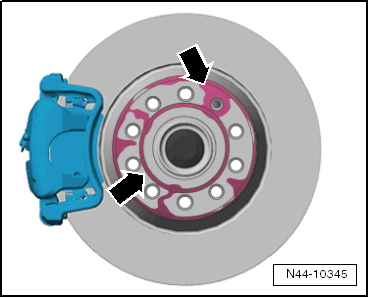
-- Make sure the contact surfaces -arrows- on the brake rotor are free of corrosion and dirt.
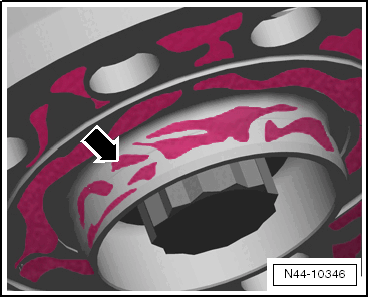
-- Make sure the contact surfaces -arrow- on the wheel hub center seat are free of corrosion and dirt.
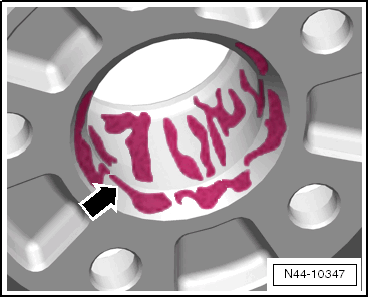
-- Make sure the contact surface -arrow- on the wheel inner side (rim) as well as the central seat in the rim is free of corrosion and dirt.
 Courtesy of AUDI OF AMERICA, LLC
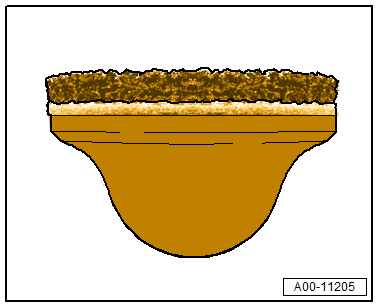
-- Remove rust and dirt with the Wheel Hub Cleaner: VAS294 009
Wear protective eyewear when cleaning with the Wheel Hub Cleaner: VAS294 009 .
-- Always wear protective eyewear when cleaning with the Wheel Hub Cleaner: VAS294 009 .
-- Remove rust and dirt on all contact surfaces of the wheel hub and rim using the Wheel Hub Cleaner: VAS294 009 .
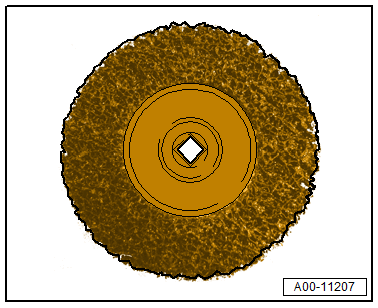
-- If necessary, remove oil, grease, grease and corrosion.
-- The spherical caps * in the wheel bolt openings and the wheel bolt threads must likewise be free of corrosion, dirt, oil or grease.
* The spherical cap is the curved surface of a section of a sphere.
-- Check whether the wheel bolts can be easily screwed in by hand. The threads of the wheel bolts must not touch the holes in the brake rotor -arrow-.
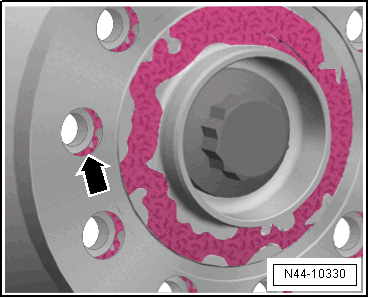
If the thread of the wheel bolt touches the hole -arrow-, turn the brake rotor accordingly.
Remove any dirt or corrosion if necessary:
- Oil or grease from the contact surfaces
- Oil or grease from the threads on the wheel hub
- Oil or grease from the threads on the wheel bolts
Heavily corroded, difficult to turn and/or damaged wheel bolts can become loose.
- Wheel bolts must be replaced.
Applies to light-alloy and steel wheels
When a wheel is changed, the wheel centering seat should be sprayed with Wax Spray to prevent corrosion between the wheel centering seat and the rim. Refer to Parts Information. WHEEL CENTERING SEAT, PROTECTING AGAINST CORROSION