Wheels, Requirements
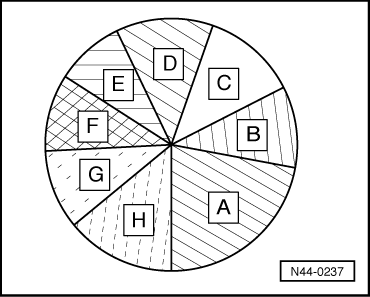
A - Wet braking performance
B - Driving comfort
C - Steering precision
D - Driving stability
E - Tire weight
F - Service life expectancy
G - Rolling resistance
H - Hydroplaning
The circular area represents the performance of the tire. It shows how the proportions of requirements A through H can be distributed in the tire structure and in the rubber compound.
Improving one requirement will cause an impairment in another requirement.
Example:
Improving the wet braking performance -A- will cause a reduction in driving comfort -B-, roll resistance -G- and the service life expectancy -F-.
The service life expectancy of passenger car tires is not only dependent on the rubber compound and type. The operating conditions, the vehicle-specific conditions and the driving style have a strong influence on the tire service performance.
A considerably mild, economical as well as an extreme, sporty driving style is possible with modern vehicles and the applicable engine. Tire service performance from 5, 000 to 40, 000 km and also more is possible.
The driving style is the main influencing factor on the service life of a tire.