Run-Flat Tire, General Information
Run-flat tires have a reinforced sidewall in comparison to standard tires. This reduces the tendency for the sidewall to roll when there is a loss of pressure and prevents the sides of the tire from being pinched. This allows the vehicle to be driven while still maintaining close to normal driving behavior. It also eliminates the need to install the spare tire in dangerous situations such as on the highway or in poor weather conditions.
Assessing a damaged tire may only be done by a trained technician.
Run-flat tires must be replaced after they have gone flat.
Pay close attention to the installation instructions.
When there is a flat tire, the vehicle can still be driven to the nearest workshop (within approximately 50 km) as long as the vehicle speed (maximum 80 km/h) and driving style are adapted accordingly. Refer to Owner's Manual.
If there is a flat tire, the driver is ultimately responsible for checking the affected tire and deciding if it is possible to continue driving.
-I - Tires with normal pressure
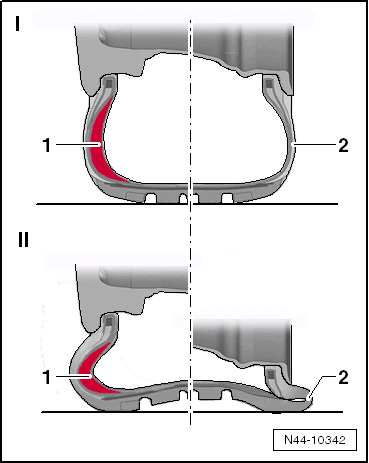
1 - Run-flat tires (reinforced sidewall -red-)
2 - Standard tires
-II - Tires without air pressure
If the standard tire -2- loses pressure, the rim pushes the side wall together. When the tire is flat, the sidewall becomes extremely hot from the rolling motion and or is pinched. This destroys the tire.
In run-flat tires -1-, the reinforced sidewall (-red-) supports the tire. Because of a special rubber compound and the reduced flexing of the reinforced sidewall, the tires does not become as hot and the vehicle can still be steered.
Read and follow the special requirements for using run-flat tires. Refer to RUN-FLAT TIRE, RETROFITTING/CONDITIONS FOR USE OF RUN-FLAT TIRES .