Heel And Toe Wear
Heel-and-toe wear is step-like wear of individual tread blocks, due to which an increased rolling noise can develop. The heel-and-toe wear is caused by the uneven distortion of the tread blocks in the contact patch. Heel-and-toe wear appears in more extreme forms on non-tractive wheels than on tractive wheels.
New tires have a stronger tendency to heel-and-toe wear, because the high tread blocks have greater elasticity. As tread depth decreases, the rigidity of the tread blocks increases and the tendency to heel-and-toe wear decreases.
Appearance of heel-and-toe wear
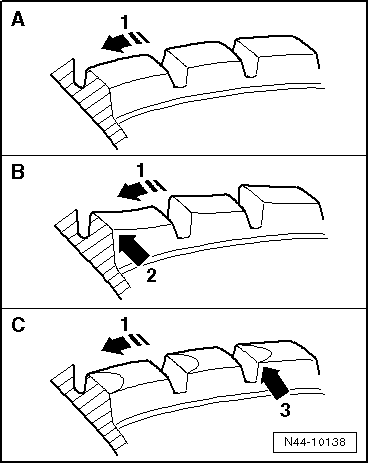
A -
Tread blocks of a new tire; viewed in direction of travel -arrow 1-, tread blocks have the same height in front and rear.
B -
Heel-and-toe wear; viewed in direction of travel -arrow 1-, the tread blocks are higher in front than in rear -arrow 2-.
C -
Viewed in direction of travel -arrow 1-, tread blocks exhibit significant wear in forward area of "heel-and-toe wear" -arrow 3-.
Extreme heel-and-toe wear may lead to customer complaints about noise.
Increased heel-and-toe wear occurs with:
- Toe values too great
- Incorrect air pressure
- Deep, open treads
- Tires which are not mounted on the driven axle
- Extreme driving style around curves.
Non-directional tires
When heel-and-toe wear occurs, the direction of travel of the tire must be reversed. If increased heel-and-toe wear and rolling noise develop, the tires should be rotated diagonally. This leads to a reduction of heel-and-toe wear.
On vehicles with FWD, this effect is increased by increased wear on front axle.
The rolling noise is somewhat louder immediately after rotating the wheels, but the normal noise level will be reached after traveling approximately 500 to 1, 000 km.
Directional tires
In the event of increased heel-and-toe wear of the tires on the rear axle - most common with FWD - rotate the wheels from back to front. In the event of increased heel-and-toe wear on the outer edges on one axle, reverse both tires on their rims. Then the left wheel must be mounted on the right side and the right wheel on the left side.