Diagonal Flattening
Diagonal flattening on tires
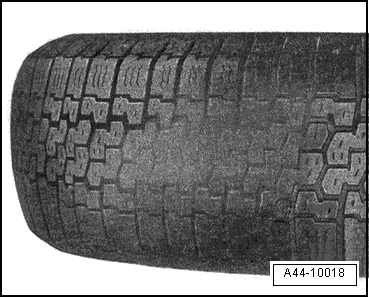
Diagonal flattening runs at an angle of approximately 45° with respect to the plane of circumference.
They usually occur once, but may also occur several times along the tire circumference.
Wear spots appear almost exclusively on the non-tractive tires, especially the rear left tire. There are vehicle models where wear spots appear rounded, which are not a problem. The effect is increased by high toe values. Toe values at the lower tolerance limit of the specified value improve the wear pattern.
The tire component integration is often found in the area with the most pronounced diagonal flattening.
Wheels with toe-in roll with a slip angle even when the vehicle is traveling straight ahead. This leads to diagonal tension in the contact zone between tires/road surface.
Driving with reduced tire pressure will improve the wear pattern. To prevent such wear patterns, the toe values of both rear wheels should be the same and the specified tire pressure should be maintained.
If wear spots are detected, mount the wheels on the tractive axle if the wear spots are still in the initial stage. Deeper wear spots are irreparable.
Faulty adjustment
When a customer complains of "diagonal flattening", the toe adjustment must be checked. If it is OK, the cause for the diagonal wear spots is most likely in the tires.
Tires with diagonal wear spots which developed due to faulty adjustment of the axle geometry are excluded from the warranty.