Coolant, Filling
Special tools and workshop equipment required
- Cooling System Tester - Adapter: VAG1274/8
- Cooling System Charge Kit: VAS6096
- Hose Clip Pliers: VAS6362
- Analog Refractometer: T10007B
Coolant Specification
The mixture of the water used greatly influences the effectiveness of the coolant. The water quality to be used is based on the contents, which can be specific to a country or even a region. Distilled water fulfills all requirements. For this reason, distilled water must be used when adding coolant or filling coolant for the first time.
Use only coolant additives listed. Refer to the Parts Information. Other coolant additives may above all reduce the corrosion protection effect significantly. The damage resulting from this may lead to loss of coolant and consequently to severe engine damage.
Coolant with the correct mixture ratio prevents freezing and corrosion damage and calcium deposits. Additionally, the boiling temperature will be raised. For this reason the cooling system must be filled with coolant additive year-round.
Because of its high boiling point, the coolant contributes to engine reliability under heavy engine loads, particularly in countries with tropical climates.
To determine the current freeze protection value, use the : T10007A or : T10007B .
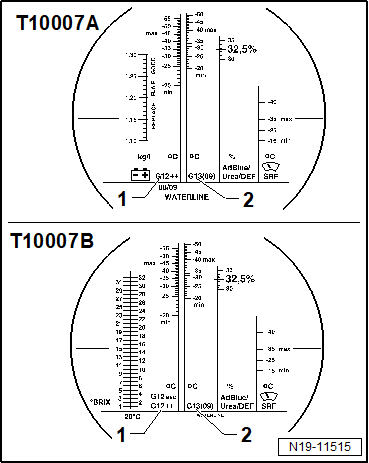
The scale -1- on the refractometer refers to the coolant additives G12++ and G12evo.
The scale -2- on the refractometer refers to the coolant additive G13.
If the type of coolant additive cannot be determined, always use the G13 scale to determine freeze protection.
Freeze protection must be set at minimum -25 °C (-13 °F) (in arctic climate countries: at approximately -36 °C (-32.8 °F)). The freeze protection may only be increased when stronger freeze protection is required for the climate. But only down to -48 °C (-54 °F), otherwise the effectiveness of the coolant decreases.
The coolant concentration must not be reduced by adding water even in warmer seasons and in warmer countries. The frost protection must be at least -25 °C (-13 °F).
The temperature on the Refractometer corresponds to the >>freezing point<<. At this temperature, ice crystals may begin to form in the coolant.
Used coolant cannot be used again.
Only use water/coolant additive to lubricate the coolant hoses.
Coolant Mixture Ratio
There is a risk of corrosion damage from an unsuitable mixture of water and coolant additive.
- For optimal corrosion protection distilled water must be used.
- Coolant (40%) and distilled water (60%) for freeze protection down to -25 °C (-13 °F)
- Coolant (50%) and distilled water (50%) for freeze protection down to -36 °C (-32.8 °F)
- Coolant. Refer to the Parts Information.
Procedure
- Used coolant cannot be used again.
-- Fill with coolant reservoir from the : VAS6096 with 10 liters (2.6 gallons) of coolant with the correct mixture ratio. Refer to Coolant Mixture Ratio above for the mixture ratio.
-- To make the filling procedure easier, position the coolant reservoir as high up as possible, for example on a workshop cart or the engine and gearbox jack.
-- Install the : VAG1274/8 on the coolant expansion tank -1-.
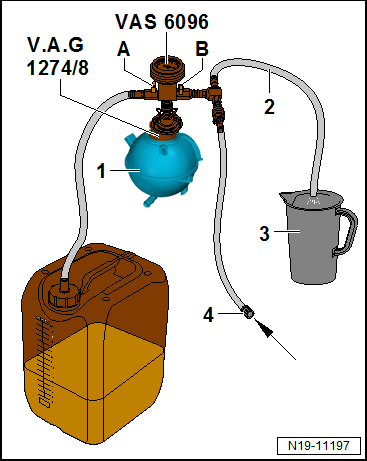
-- Attach the : VAS6096 on the : VAG1274/8 .
-- Place the drain hose -2- in a small container -3-.
TIP:
A small amount of coolant which should be collected is drawn off with the discharged air.
-- Close the valves -A and B- by turning lever at a right angle to the flow direction.
-- Connect the hose -4- to compressed air.
- Pressure: 7 to 10 bar (101.52 to 145.03 psi) positive pressure.
-- Open the coolant circuit valves. Refer to Vehicle Diagnostic Tester 0001 - Engine Electronics Functions , 0001 - Coolant Circuit Bleeding Procedure .
-- Open the valve -B- by turning the lever in the flow direction.
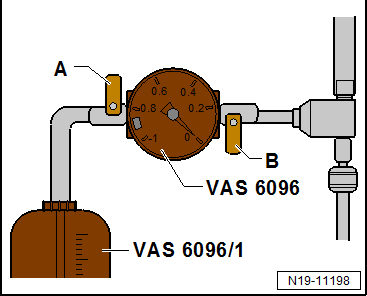
- The suction jet pump generates vacuum in the coolant system; indicator on display instrument must move into green area.
-- Briefly open the valve -A- by turning the lever in the flow direction so that the hose on the : VAS6096 coolant reservoir fills with coolant.
-- Close the valve -A- again.
-- Leave the valve -B- open another two minutes.
- More pressure is generated in the coolant system by the suction jet pump; indicator on display instrument must stay in the green area.
-- Close the valve -B-.
- Needle in the display instrument must remain in the green region, then the sufficient vacuum in the cooling system is obtained for the upcoming filling.
- Repeat the procedure if the needle goes below the green range.
- Check the cooling system for leaks if the pressure drops.
-- Remove the pressure hose.
-- Open the valve -A-.
- Coolant is extracted from the : VAS6096 coolant reservoir by pressure in the coolant system and the system is filled.
-- Remove the : VAS6096 and the : VAG1274/8 from the coolant expansion tank.
Continuation of the Filling Procedure:
-- Bleed the cooling system. Refer to BLEED COOLING SYSTEM .