94 Exterior Lights Have Moisture Accumulation (GROUP 94, NO. 25-85)
Reference number: GROUP 94, NO. 25-85
Supersedes refnos: 2012749, 2012749/1, 2012749/10, 2012749/11, 2012749/12, 2012749/13, 2012749/14, 2012749/15, 2012749/16, 2012749/17, 2012749/18, 2012749/2, 2012749/3, 2012749/4, 2012749/5, 2012749/6, 2012749/7, 2012749/8, 2012749/9, GROUP 94, NO. 06-07, GROUP 94, NO. 07-03, GROUP 94, NO. 08-01, GROUP 94, NO. 08-03, GROUP 94, NO. 08-48, GROUP 94, NO. 11-44, GROUP 94, NO. 11-48, GROUP 94, NO. 11-52, GROUP 94, NO. 12-92, GROUP 94, NO. 15-65, GROUP 94, NO. 17-91, GROUP 94, NO. 19-18, GROUP 94, NO. 21-34, GROUP 94, NO. 23-64, GROUP 94, NO. 24-73
94 EXTERIOR LIGHTS HAVE MOISTURE ACCUMULATION
TECHNICAL SERVICE BULLETIN
| AUDI: | 2016-2025 All Audi vehicles |
| GROUP: | 94 - Lights - Exterior |
SERVICE INFORMATION
94 25 85 2012749/18 April 10, 2025. Supersedes Technical Service Bulletin Group 94 number 24-73 dated March 9, 2024, for reasons listed below.
| Model(s) | Year | VIN Range | Vehicle-Specific Equipment |
|---|---|---|---|
| All Audi vehicles | 2016 - 2025 | All | Not applicable |
CONDITION
| Revision | Date | Purpose |
|---|---|---|
| 18 | - | Revised Condition
(Updated verbiage) Revised Service (Update verbiage) |
| 17 | 03/09/2024 | Revised Header
(Added MY25) Revised attachment (Added checklist and flow chart) Revised Service (updated verbiage and steps) |
| 16 | 05/09/2023 | Revised Header
(Added MY23,24) Revised Technical Background (Updated information) |
This TSB describes the procedure for moisture in the headlights and taillights. There are two separate issues:
Situation 1: There is condensation on the inside of the lenses (physical condensation - Not a fault which is covered under warranty).
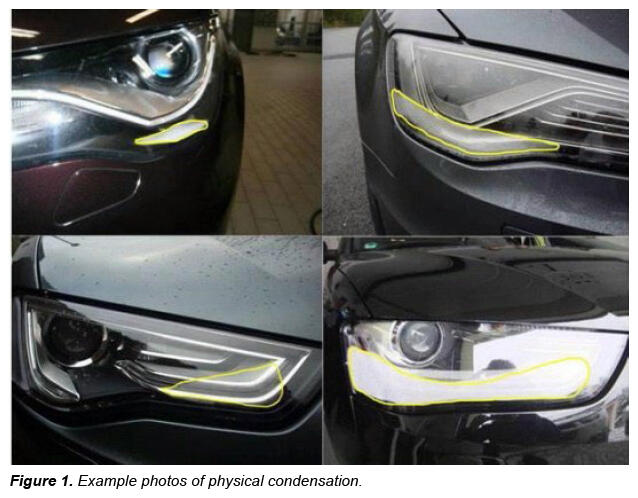
Situation 2: Water marks/large droplets on the lenses or inside the headlights or taillights despite the vehicle being driven in such a way as to ensure sufficient ventilation.
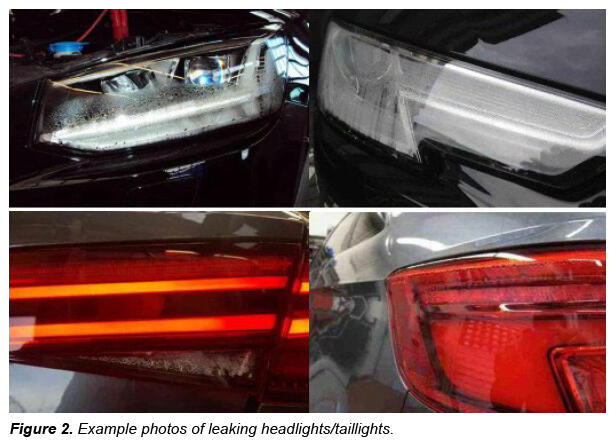
TECHNICAL BACKGROUND 1
Situation 1.
Process of physical condensation on the headlights and taillights
- The physical process of condensation:
- Is an optical phenomenon which does not affect the performance of the headlights or taillights.
- Does not cause corrosion inside the component
- Can occur on any headlamp, fog lamp or taillight.
Is NOT a fault which is covered under warranty.
Headlights and taillights are normally open systems. Air from outside circulates through the component. This type of design is necessary to ensure pressure equalization.
Background:
The humidity inside the headlight or taillight rises in wet weather.
When the vehicle is parked after use, the back of the headlight is heated up by residual heat from the engine, for example while at the same time the lens is cooled down by the colder outside air. This creates a temperature difference which causes humidity in the air to condense on the inside of the lens.
In winter and/or wet weather, the complaint "condensation on lens" can occur on the headlights and other exterior lights.
Driving through a car wash or using a steam cleaner on the engine compartment or at the front/rear of the vehicle amplifies phenomenon by increasing the air humidity in the component. This phenomenon can also occur in summer when the vehicle has heated up in the sun and is then parked in a cold underground garage or in winter when the vehicle has heated up in a warm garage and is then driven in cold outside conditions.
LED headlights and taillights:
The lens does not warm up even when the lights are switched on because none of the light emitted is in the infrared spectrum. In this case, only the pressure difference at the vents occurring while driving provides the needed airflow to clear up the condensation. The vents are arranged and designed in such a way that the lens will be cleared after driving with sufficient ventilation.
If the customer concern relates to Situation 1, please explain the information above to the customer. Do not replace parts.
Situation 2
Leak on the light due to open covers, a damaged cap seal or similar.
PRODUCTION SOLUTION
Situation 1: Not affected.
Situation 2: Continuous fixing of defect causes.
SERVICE
- In the event of a customer complaint about moisture in a light, please use the checklist, the test plan flowchart and the reference photos to determine the cause.
- Document this repair following the instructions in TSB 2061922: 94 How to properly document optical concerns for headlights and taillights.
- The "Checklist " and the "Flowchart " are found in the "Attachments" tab at the bottom border of this TSB.
- Photos of the moisture are required to be submitted to DOC-IT if a warranty claim is made.
Situation 1: If there is a physical condensation in the headlights, the light emission surface of the lens must be clear after the vehicle is driven in such a way as to provide sufficient ventilation (on a major roadway at an average speed of 50mph for approximately 10-30 minutes) with the low beam lamp switched on.
The remaining inside surfaces may still have condensation on them after the drive; this is not a problem.
However, the amount of time required for the condensation to clear depends on the outside temperature, relative humidity and the vehicle speed (higher speed provides more ventilation).
Explain the process of physical condensation to the customer using the description under "customer information" in this TSB.
Replacing the headlight or taillight will not solve the issue.
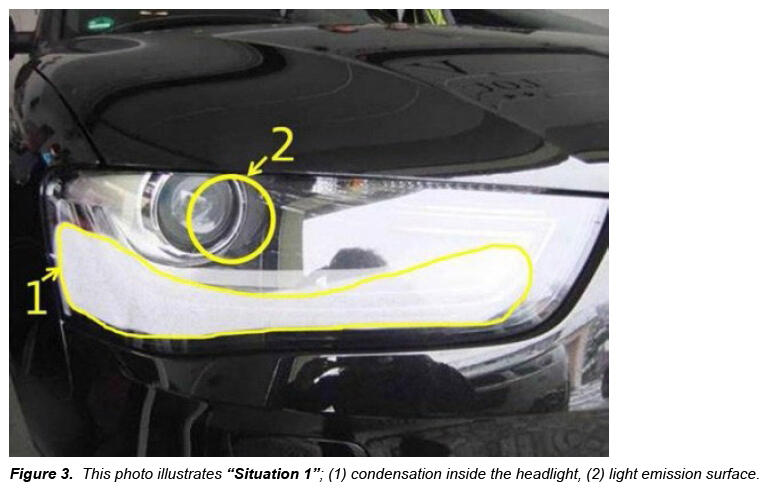
Situation 2: If it is apparent that there is water ingress/a leak (droplets on the lens), use the test plan to establish the cause.
Dry the headlight/taillight afterwards with filtered, oil-free compressed air. Then replace the component which caused the complaint and check whether the connectors or connections of any control units fitted are damaged by corrosion.
If, despite the above repair, the customer complains again about leaking headlight/taillight and water ingress or large droplets are still present after the checks (see test plan), replace the headlight/taillight.
The decision whether to replace parts is yours. You should not submit a technical repair query regarding billing under warranty.
Further information on the physical process of condensation can be found in a video on the Audi Knowledge Tank.
WARRANTY
This TSB is informational only and not applicable to any Audi Warranty. If a warranty is going to be submitted to warranty, the complaint must be documented with a complete checklist, the test plan and photos showing the concern. All must be submitted to DOC-IT.
If headlights/taillights are submitted for a warranty claim but are determined to be OK according to the manufacturer's testing requirements, the costs may be charged back.
ADDITIONAL INFORMATION
The following Technical Service Bulletin(s) will be necessary to complete this procedure:
- TSB 2061922, 94 How to properly document optical concerns for headlights and taillights.
All part and service references provided in this TSB (2012749) are subject to change and/or removal. Always check with your Parts Department and/or ETKA for the latest information and parts bulletins. Please check the Repair Manual for fasteners, bolts, nuts, and screws that require replacement during the repair.
©2025 Audi of America, Inc. All rights reserved. The information contained in this document is based on the latest information available at the time of printing and is subject to the copyright and other intellectual property rights of Audi of America, Inc., its affiliated companies, and its licensors. All rights are reserved to make changes at any time without notice. No part of this document may be reproduced, stored in a retrieval system, or transmitted in any form or by any means, electronic, mechanical, photocopying, recording, or otherwise, nor may these materials be modified or reposted to other sites, without the prior expressed written permission of the publisher.