46 Brake Noise Analysis And Handling (GROUP 46, NO. 23-48)
Reference number: GROUP 46, NO. 23-48
Supersedes refnos: 2034181, 2034181/1, 2034181/10, 2034181/11, 2034181/12, 2034181/13, 2034181/14, 2034181/15, 2034181/16, 2034181/17, 2034181/18, 2034181/19, 2034181/2, 2034181/20, 2034181/21, 2034181/22, 2034181/23, 2034181/24, 2034181/3, 2034181/4, 2034181/5, 2034181/6, 2034181/7, 2034181/8, 2034181/9, GROUP 46, NO. 13-53, GROUP 46, NO. 13-56, GROUP 46, NO. 13-63, GROUP 46, NO. 14-64, GROUP 46, NO. 14-67, GROUP 46, NO. 14-68, GROUP 46, NO. 14-76, GROUP 46, NO. 14-91, GROUP 46, NO. 15-00, GROUP 46, NO. 15-02, GROUP 46, NO. 15-23, GROUP 46, NO. 15-99, GROUP 46, NO. 16-46, GROUP 46, NO. 16-48, GROUP 46, NO. 16-50, GROUP 46, NO. 19-03, GROUP 46, NO. 19-08, GROUP 46, NO. 21-24, GROUP 46, NO. 22-27, GROUP 46, NO. 22-30, GROUP 46, NO. 22-34, GROUP 46, NO. 23-41
46 BRAKE NOISE ANALYSIS AND HANDLING
TECHNICAL SERVICE BULLETIN
| AUDI: | 2015-2025 All Audi Vehicles |
| GROUP: | 46 - Brake - Mechanical Components |
SERVICE INFORMATION
46 23 48 2034181/24 September 14, 2023. Supersedes Technical Service Bulletin Group 46 number 23-41 dated February 7, 2023, for reasons listed below.
| Model(s) | Year | VIN Range | Vehicle-Specific Equipment |
|---|---|---|---|
| All Audi Vehicles | 2015 - 2025 | All | Not Applicable |
CONDITION
| Revision | Date | Purpose |
|---|---|---|
| 24 | - | Revised header (Added Model Years) |
| 23 | 02/07/2023 | Revised Warranty (Updated Labor Operations) |
| 22 | 08/11/2022 | Revised Warranty (Updated Labor Operations) |
Customer states:
- They hear a brake noise from the front or rear brakes. The customer may describe these noises as squealing, squeaking, grinding, groaning, thumping, or creaking.NOTE: DO NOT use this TSB if there is another brake noise TSB applicable to the VIN. For additional information, refer to the Audi Brake systems brochure.
TECHNICAL BACKGROUND
Brake noise can be attributed to many causes. The most common causes are:
- Brake discs or brake pads are close to or below their wear limit.
- New brake pads and/or discs have not been properly embedded after installation.
- Aftermarket pads or discs are installed.
- There is debris (such as small stones, grit, road salt, or sand) between the brake disc and brake pad.
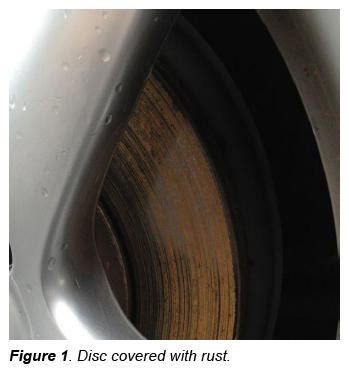
- Discs are covered with rust. Rust can form when the vehicle has not been driven for a long period of time (Figure 1).
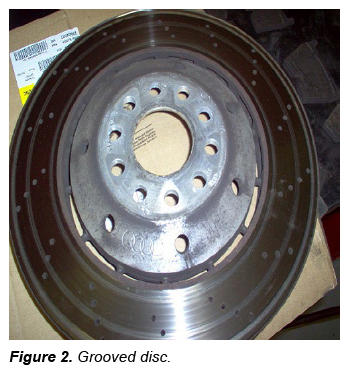
- Discs are grooved (Figure 2).
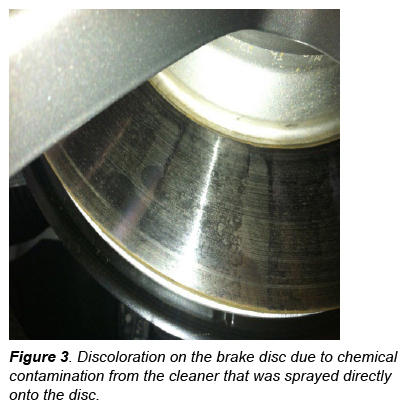
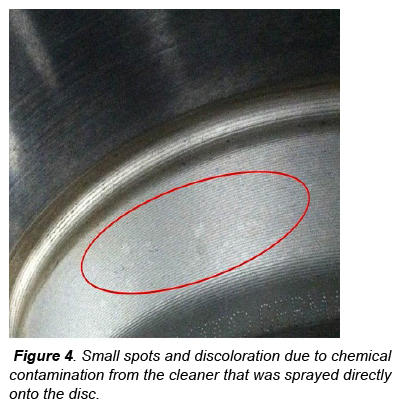
- There is chemical contamination on the braking surface of the brake disc due to wheel or tire cleaner being sprayed directly onto the brake disc (Figure 3 and Figure 4).
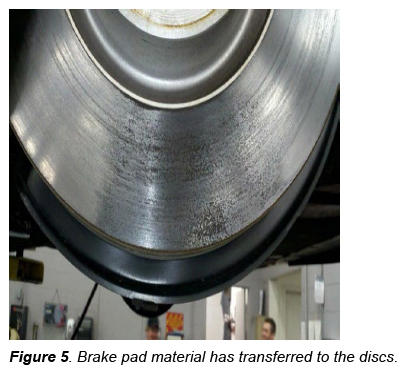
- There are "pad marks" on the brake disc as a result of brake pad material transferring to the discs (Figure 5). Pad marks can occur when a vehicle has been parked for long periods of time in a wet or snowy environment.NOTE: For specific pulsation concerns, refer to TSB 2022584: 46 Brake pulsation diagnostic guidelines. For specific frequency analysis, refer to TSB 2051095: 46 Audi frequency analysis.
PRODUCTION SOLUTION
Not applicable.
SERVICE
Proceed as follows:
- Check the overall condition of the brakes to determine if the brake noise is caused by one of the causes listed in the Technical Background section of this bulletin. If the noise is not a result of one of these causes, proceed with the following steps 2- 4.
- Determine the location of the brake noise
(e.g., left front, front axle, rear axle, etc.):
- Knowing the location of the noise on the vehicle is critical to properly addressing the concern.
- It may be necessary to have an assistant listening from inside or outside of the vehicle to accurately determine the location.
- Obtain a sound or video recording and fill out the questionnaire:
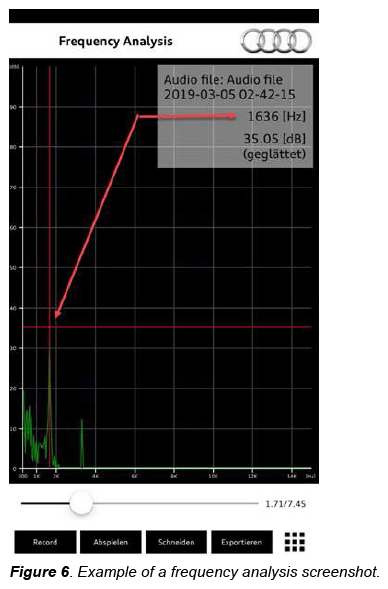
- The sound recording should be from a cell phone using the Audi analysis app (TSB 2051095: 46 Audi frequency analysis ) and the noise should be clearly identified.
- Recordings submitted by customers are also acceptable.
- In order to minimize file size, only sound recordings are necessary. Videos should only be sent if it is critical to understanding the conditions under which the noise occurs.
- Fill out as much information as possible in the questionnaire. Some fields are mandatory.
- Clean the brake pads and discs:
- With careful consideration of the traffic situation, perform up to 5 ABS stops from speeds above 50 mph. Between each ABS stop, allow the brake components to cool by driving the vehicle for more than one minute at speeds greater than 50 mph.
- Let the vehicle sit for two hours to cool down.
- Manually clean all the brake components. Remove all brake dust from components (springs, retaining clips, pistons, caliper, pins, etc.).
Clean all contact points between pads/clips/caliper and add the correct lubrication paste to the contact areas (review ELSA for the correct paste for each application).
- Test drive again.
If the noise was not eliminated after completing steps A, B and C, open a Technical Assistance Center (TAC) ticket and include the following information with the TAC ticket:
- Completed Brakes Acoustic Questionnaire.
- Sound or video recording (sound recording preferred from Audi frequency app, see TSB 2051095: Audi frequency analysis ).
- Frequency analysis (screenshot preferred showing peak frequency, see figure 6).
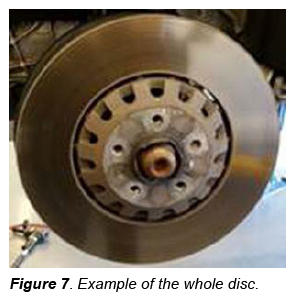
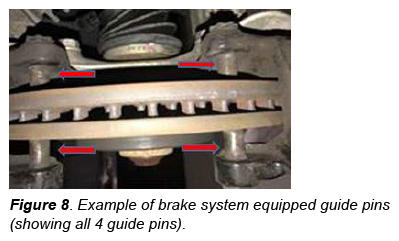
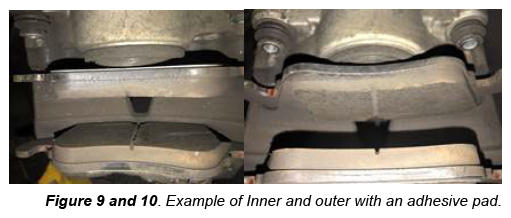
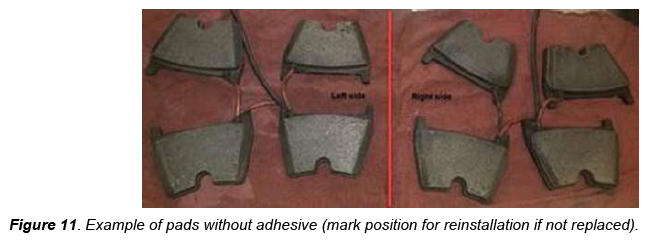
- Photos of the affected brake discs and pads that clearly show the condition of the braking surface (see Figures 7 through 11).
-
NOTE: Do not alter the brake pads when performing the cleaning procedure.
- Known brake noise frequency and repair suggestions: NOTE: The information below is only a reference for vehicles with a similar brake system, always review the specific VIN for applicable TSBs. Review ELSA Repair Manual for specific brake system repair information.
Brake system ATE-TEVES with PR codes: 1LF/1 LG/1 LL/1 ZK/1 LJ/1 LP:
- 1.6 KHz from front brakes. Inspect front pads.
- 3.2 KHz/11 KHz from front brakes. Inspect front discs and pads.
Brake system TRW with PR codes: 1LA/1LB/1LD/1LT/1ZT/1LJ:
- 1.6 KHz to 1.7 KHz from front brakes. Inspect front discs.
- 3.2 KHz from front brakes. Inspect and if needed, suggest to clean and lube the guide pins in the caliper carrier using anti-seize paste G052560A2.
- 7.8 KHz from front brakes. Inspect front pads.
WARRANTY
| Claim Type: |
|
||
| Service Number: | 4617 | ||
| Damage Code: | 0020 | ||
| Labor Operations: | Clean brake pads and discs Includes: Road tests, submission of an audio file, and questionnaire |
4617 8099 | 70 TU |
| Diagnostic Time: | GFF | No allowance | 0 TU |
| Road test prior to the service procedure | No allowance | 0 TU | |
| Road test after the service procedure | No allowance | 0 TU | |
| Claim Comment: | As per TSB 2034181/24 | ||
All warranty claims submitted for payment must be in accordance with the Audi Warranty Policies and Procedures Manual. Claims are subject to review or audit by Audi Warranty.
ADDITIONAL INFORMATION
The following Technical Service Bulletin(s) may be necessary to complete this procedure:
- TSB 2022584: 46 Brake pulsation diagnostic guidelines.
- TSB 2051095: 46 Audi frequency analysis.
All parts and service references provided in this TSB (2034181 ) are subject to change and/or removal. Always check with your Parts Department and/or ETKA for the latest information and parts bulletins. Please check the Repair Manual for fasteners, bolts, nuts, and screws that require replacement during the repair.
©2023 Audi of America, Inc. All rights reserved. The information contained in this document is based on the latest information available at the time of printing and is subject to the copyright and other intellectual property rights of Audi of America, Inc., its affiliated companies, and its licensors. All rights are reserved to make changes at any time without notice. No part of this document may be reproduced, stored in a retrieval system, or transmitted in any form or by any means, electronic, mechanical, photocopying, recording, or otherwise, nor may these materials be modified or reposted to other sites without the prior expressed written permission of the publisher.