Refrigerant Pressure And Boiling Point
The boiling point given in tables for a liquid is always referenced to an atmospheric pressure (1 bar (14.5 psi) absolute pressure). If the pressure acting on a fluid changes, its boiling point also changes.
Pressure is measured in different units: 1 MPa (mega Pascal) corresponds to 10 bar (145 psi) positive pressure. 1 bar (14.5 psi) absolute pressure corresponds to 0 bar (0 psi) positive pressure and thus to the ambient pressure (atmospheric pressure).
It is known that, for example, water boils at a lower temperature when the pressure is lower.
The vapor pressure curves for water and refrigerant R123yf show that, at constant pressure, reducing the temperature changes vapor to liquid (in the condenser) or that reducing the pressure causes the refrigerant to change from liquid to vapor (inside the evaporator).
Vapor pressure curve of water
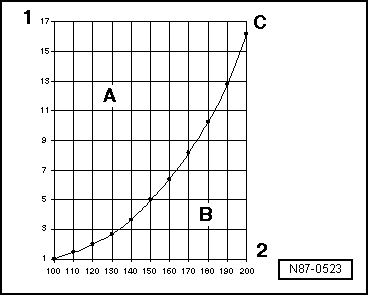
A - Liquid
B - Gaseous
C - Vapor pressure curve of water
1 - Pressure acting on liquid in bar (absolute)
2 - Temperature in °C
Refrigerant R1234yf vapor pressure
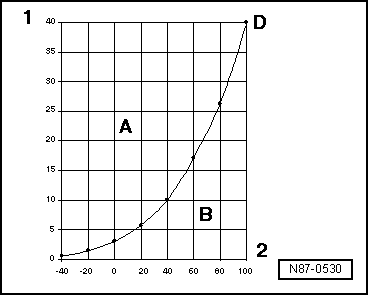
A - Liquid
B - Gaseous
D - Refrigerant R1234yf vapor pressure
1 - Pressure acting on liquid in bar (absolute)
2 - Temperature in °C
The vapor pressure curves of both refrigerant R1234yf and R134a is similar across a large temperature range. The pressure difference between both refrigerants in the temperature range of 0 to 50 °C (32 to 122 °F) if for example only approximately 0.2 bar (3 psi) for this reason distinguishing the two refrigerants is not possible. Refer to REFRIGERANT VAPOR PRESSURE TABLE and A/C System, General Information (Refrigerant R134a Servicing, A/C System, General Information). Distinguishing is only possible by suitable sensors which can analyze the chemical characteristics of the refrigerant. Refer to REFRIGERANT R1234YF ANALYSIS .