A/C Compressor Regulator Valve -N280-, REMOVING AND INSTALLING: Removing
-- Discharge the refrigerant circuit. Refer to USING SERVICE STATION .
There is a risk of damaging the A/C compressor if the refrigerant circuit is empty.
Do not start the motor if the refrigerant circuit is empty.
- Depending on the version of the A/C Service Station, the pressure of the refrigerant circuit may be less than 1 bar (14.5 psi) absolute pressure after it has been discharged.
- Depending on the version of the A/C compressor, it may be damaged if the pressure in the refrigerant circuit is too low.
- Do not start the engine while the refrigerant circuit pressure is less than the ambient pressure.
-- Depending on the vehicle and installed location of the A/C compressor, remove the components that prevent access to the A/C Compressor Regulator Valve -N280-. Refer to Refrigerant Circuit .
On vehicles where at least one of the two refrigerant lines and the A/C Compressor Regulator Valve -N280- cannot be disconnected and removed while the A/C compressor is attached to the engine.
-- Remove the A/C compressor. Refer to A/C Compressor .
A refrigerant line must be removed on an installed A/C compressor so that it is assured, that the pressure in the A/C compressor is the same as the ambient pressure.
On a vehicle, where at least one of the two refrigerant lines and the A/C Compressor Regulator Valve -N280- can be disconnected and removed while the A/C compressor is attached to the engine (the A/C compressor is not removed).
There is a danger of ice-up.
- Before removing the A/C Compressor Regulator Valve -N280-, connect the service station and extract the refrigerant. Refrigerant circuit must be empty to avoid possible injury.
- Refrigerant and refrigerant oil will leak out if the refrigerant circuit is not discharged.
- The refrigerant is extracted before removing the A/C Compressor Regulator Valve -N280-. If the A/C Compressor Regulator Valve -N280- is not removed within 10 minutes after extraction, pressure may build up in the refrigerant circuit by renewed evaporation. Extract the refrigerant once more.
-- Check the pressure in the refrigerant circuit once more via the A/C service station pressure gauge.
- If the displayed pressure is larger than the ambient pressure (larger than approximately 1 bar (14.5 psi) absolute pressure), turn on the A/C service station and extract the refrigerant that is building up the pressure.
-- Disconnect one of the two refrigerant lines from the A/C compressor. Refer to Refrigerant Circuit .
A refrigerant line must be removed on an installed A/C compressor so that it is assured, that the pressure in the A/C compressor is the same as the ambient pressure.
All Vehicles
-- Before removing the A/C Compressor Regulator Valve -N280- check again if the A/C compressor is actually being driven by the belt pulley/drive unit. If the belt pulley or the drive unit overload protection has triggered, the cause for the fault is not the regulator valve but rather the A/C compressor (for example does not move easily).
This illustration shows the A/C Compressor Regulator Valve -N280- -B- on a A/C compressor manufactured by "Sanden" type "PXE 14". On these A/C compressors the connector to the vehicle wiring harness connection is mounted directly on the A/C Compressor Regulator Valve -N280- -B-. The removal and installation of the A/C Compressor Regulator Valve -N280- -B- on other A/C compressors (other type and manufacturer, for example "Denso", the A/C Compressor Regulator Valve -N280- with a short wiring harness, for example) can differ. The procedure for removal and installation is however the same, as described in the following for the A/C compressor manufactured by "Sanden" type "PXE 14".
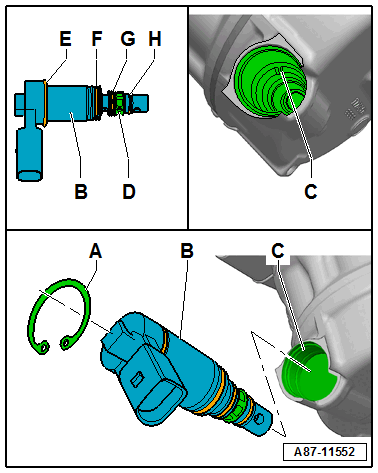
This illustration shows an A/C Compressor Regulator Valve -N280- -B- with an O-ring -E- (not available on all versions).
On a A/C Compressor Regulator Valve -N280- -B- without an O-ring -E-, dirt can penetrate into the A/C Compressor Regulator Valve -N280- -C- mount up to the O-ring -F-.
-- If applicable, loosen the wire connection from the A/C Compressor Regulator Valve -N280- -B- to the connection to the vehicle wire harness from the A/C compressor.
On an A/C compressor with an A/C Clutch -N25- where the A/C Clutch -N25- is activated via the same connector as the A/C Compressor Regulator Valve -N280- -B-, remove the applicable wires from the connector (for example, using an extractor from the Wiring Harness Repair Set :VAS1978B ). Refer to Refrigerant Circuit .
If a connector should be installed on an A/C compressor with an A/C Clutch -N25- where the wires cannot be removed, cut the wires to the A/C Compressor Regulator Valve -N280- (or to the A/C Clutch -N25-) at a suitable location and reattach using wire connectors from the Wiring Harness Repair Set :VAS1978B (or replace the connector itself. Refer to the Parts Information). Refer to WIRING HARNESSES AND CONNECTORS, REPAIRING .
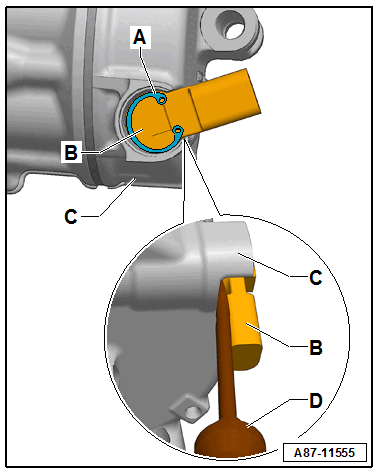
-- Clean the A/C compressor near the circlip -A- and the A/C Compressor Regulator Valve -N280- -B- thoroughly.
The pressure in the A/C compressor must be equal to the ambient pressure.
- Refrigerant and refrigerant oil can leak out if there is excess pressure in the A/C compressor.
- Dirt can be absorbed into the A/C compressor if there is a vacuum in the A/C compressor.
- Make sure there is pressure equalization before removing the A/C Compressor Regulator Valve -N280- -B-.
-- Remove the circlip -A-.
-- Carefully remove the A/C Compressor Regulator Valve -N280- -B- from the A/C compressor mount -C-, using a suitable screwdriver -D-, for example.
-- Check the removed A/C Compressor Regulator Valve -N280- -B- and A/C compressor mount -C- for dirt.
If the strainer -D-, A/C Compressor Regulator Valve -N280- -B- up to the O-ring -F- or the A/C compressor mount -C- are heavily contaminated in this area (with shavings or dark, sticky abraded material, for example), this indicates damage on the A/C compressor. In this case, the refrigerant circuit is to be cleaned and the A/C compressor is to be replaced. Refer to COMPRESSOR, REPLACING ON ACCOUNT OF LEAKAGE OR INTERNAL DAMAGE and REFRIGERANT CIRCUIT, CLEANING (FLUSHING) WITH REFRIGERANT R134A .
If the strainer -D- on the A/C Compressor Regulator Valve -N280- -B- and the A/C compressor mount -C- up to the O-ring sealing surface -F- are only lightly contaminated in this area (with gray deposits from normal A/C compressor operation, for example), a malfunction at the A/C Compressor Regulator Valve -N280- -B- can cause the A/C compressor malfunctioning.
On an A/C Compressor Regulator Valve -N280- -B- without an O-ring -E-, dirt can penetrate into the mount -C- up to the O-ring -E- during operation. Remove the dirt carefully and completely using, for example, a lint-free cloth (do not work with compressed air).