General Description - Refrigerant Circuit Components: Evaporator
The evaporator is available in different versions. Depending on the design and the function, the heat energy of the flowing air needed (for example, an evaporator in the heater and A/C Unit or in the battery cooling module) or flowing coolant needed (for example near the high-voltage battery heat exchanger) is extracted for refrigerant evaporation. Refer to Refrigerant Circuit .
Two versions of the evaporator are described.
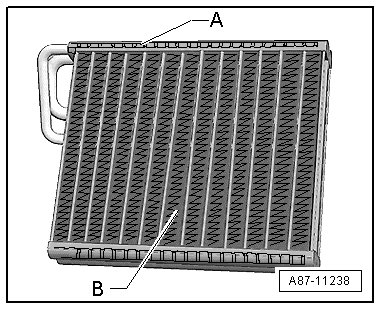
Evaporator in the Heater and A/C Unit (or in the Battery Cooling Module)
- The liquid refrigerant evaporates in the evaporator pipe -A-. The heat required for this is extracted from the air flowing on the evaporator ribbing -B-. The air cools off. Refrigerant evaporates and is extracted with the absorbed heat by the A/C compressor
- A definite quantity or refrigerant is supplied to the evaporator through an expansion valve (a restrictor). In systems with an expansion valve, the flow rate is regulated so that only gaseous refrigerant escapes the evaporator outlet.
- With the introduction of the refrigerant R1234yf the evaporator is adapted to the refrigerant, for this reason pay attention to the version. Refer to the Parts Information.
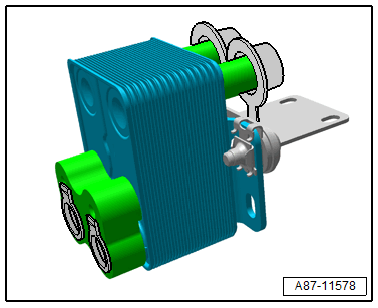
Evaporator/High-Voltage Battery Heat Exchanger (Chiller)
The liquid refrigerant evaporates in the evaporator (heat exchanger). The heat required for this is extracted from the flowing coolant in the evaporator. The coolant cools, the refrigerant evaporates and is extracted with the absorbed heat by the A/C compressor.
 Courtesy of AUDI OF AMERICA, LLC
A defined amount of refrigerant is supplied to the evaporator by a restrictor (or expansion valve) and a shut off valve. The flow rate of the refrigerant (or the coolant) is regulated so that only gaseous refrigerant escapes the evaporator outlet. Refer to Refrigerant Circuit .