A/C Pressure/Temperature Sensor
Danger or frostbite due to refrigerant coming out under pressure.
Frostbite on the skin and other parts of the body is possible.
- Wear safety gloves.
- Wear protective eyewear.
- Extract refrigerant and open the refrigerant circuit immediately.
- If more than 10 minutes have elapsed since evacuating the refrigerant and the refrigerant circuit was not opened, evacuate the refrigerant again. Evaporation can cause pressure to develop in the refrigerant circuit.
Sensor for a Connection with the Valve on the Refrigerant Circuit
Switching pressures, removing and installing switches as well as switch arrangement and version. Refer to Refrigerant Circuit .
There are different versions of this sensor with different functions and with different names. For example, the following illustrated A/C Pressure/Temperature Sensor -G395- is installed on a Golf GTE Audi A4, Audi Q5, and Audi Q5 hybrid. Refer to Refrigerant Circuit .
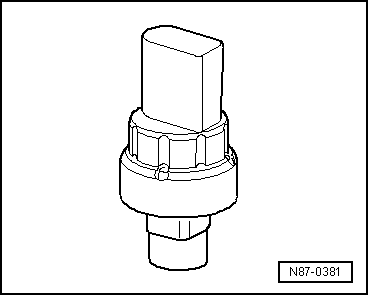
Before loosening the sensor threaded connection, check the version. Refer to Refrigerant Circuit .
On a sensor for the connection on the refrigerant circuit without a valve. The refrigerant must be extracted before loosening the threaded connection. If sensor is not removed within 10 minutes after extraction, pressure may build up in refrigerant circuit by renewed evaporation. Extract the refrigerant again.
There are various designations, depending on the function and the vehicle. Refer to Refrigerant Circuit .
- The A/C pressure/temperature sensor is installed for example instead of the high pressure sensor or the refrigerant circuit pressure sensor. Refer to Refrigerant Circuit .
- The A/C pressure/temperature sensor, the refrigerant circuit pressure sensor and the high pressure sensor are available in different versions. currently the sensor's only exterior difference is the parts number. Therefore, make sure that the part numbers are correctly allocated when replacing them (part number Parts Information). Reason: These sensors produce different signals that can only be evaluated by the respective control modules. Use the Vehicle Diagnostic Tester"Guided Fault Finding" function for the A/C system. Refer to Refrigerant Circuit .
- When voltage is applied, the a/c pressure/temperature sensor (and the refrigerant circuit pressure sensor exchange information via the data Bus (for example via the "LIN Bus") with the corresponding control module. The relevant control module uses this information to calculate the pressure (and temperature) in the refrigerant circuit and any faults detected are signaled to the control module. Use the Vehicle Diagnostic Tester in the"Guided Fault Finding" function.
- The A/C pressure/temperature sensor transmits the measured value for the refrigerant circuit pressure and the measured temperature to the connected control module. The refrigerant circuit pressure sensor only transmits the measured value for the refrigerant circuit pressure to the connected control module. Even if only the pressure signal is evaluated on most vehicles, no other pressure sensor is or will be installed on a vehicle in which a A/C pressure/temperature sensor is designed. Refer to the Parts Information.
- The temperature measured by the A/C pressure/temperature sensor differs from the actual refrigerant temperature in the refrigerant circuit because of the sensor version and its component location. Therefore it is not currently evaluated by all control modules and is not used to regulate the A/C system. Refer to Refrigerant Circuit .
- With this information the corresponding control modules calculate the refrigerant circuit pressure and activates the downstream control modules (radiator fan control module, engine control module etc.) via the data Bus. These control modules then active for example the A/C Clutch -N25-, the radiator fan and the engine. Use the Vehicle Diagnostic Tester in the"Guided Fault Finding" for the A/C system. Refer to Refrigerant Circuit .
Sensor for a Connection without the Valve on the Refrigerant Circuit
There are different versions of this sensor with different functions and with different names. For example, the following illustrated A/C pressure/temperature sensor is installed on an Audi Q7 e-tron. Refer to Refrigerant Circuit .
There are various designations, depending on the function and the vehicle. Refer to Refrigerant Circuit .
Possible Names for this Sensor
- A/C Pressure/Temperature Sensor -G395- (for example on e-Golf and Audi Q7 e-tron)
- A/C Pressure/Temperature Sensor 2 -G826- (for example on Audi Q7 e-tron)
- A/C Pressure/Temperature Sensor 3 -G827- (for example on Audi Q7 e-tron)
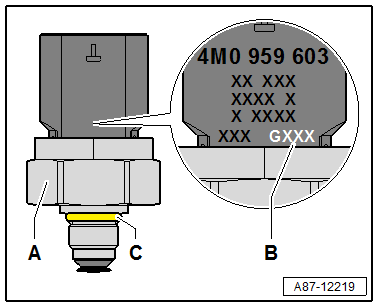
There are different versions of this sensor -A-. Depending on the version, their exterior currently only differs in part number, or in imprinted designation with the same part number -B-. Therefore pay attention to the correct allocation, part number and designation when replacing. Refer to the Parts Information and Refrigerant Circuit .
This sensor exchanges the information with the respective control module via the data Bus (for example via the "LIN Bus") when creating tension. The relevant control module uses this information to calculate the pressure (and temperature) in the refrigerant circuit and any faults detected are signaled to the control module. Use the Vehicle Diagnostic Tester in the"Guided Fault Finding" function.
The respective control module uses this information to calculate the refrigerant circuit pressure and to activate the control modules or components downstream (radiator fan control module, pumps, valves etc.) via the data Bus according to the specifications. Use the Vehicle Diagnostic Tester in the"Guided Fault Finding" function. Refer to Refrigerant Circuit .