Additional Procedure, If a Leak Is Detected When Evacuating.
- If there is a leak that allowed enough air to enter during evacuation that the A/C service station cannot generate a sufficient vacuum or that the vacuum is lost immediately after switching the A/C service station off:
-- Determine leaks on the refrigerant circuit as follows:
A large leak can be identified if a maximum of pressure of 15 bar (217.56 psi) can be generated in the refrigerant circuit using clean, dry compressed air or nitrogen. Refer to REFRIGERANT CIRCUIT, FLUSHING WITH COMPRESSED AIR OR NITROGEN . If the leak is large enough, the sound of escaping air or gas can be heard at the location of the leak.
Add the compressed air or nitrogen to the closed empty refrigerant circuit through the service connection -B- after fitting it with a quick-release connector adapter -A-.
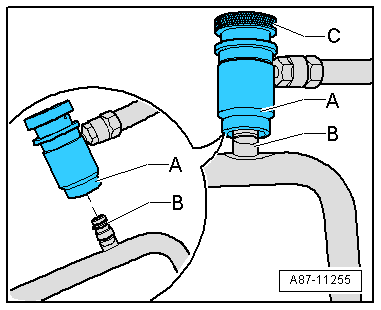
Install the hand wheel -C- in the quick-release coupling connection -A- until the valve in the service connection -B- is securely opened, do not put too much pressure on the valve.
The quick-release coupling adapter for service connections can be connected to the air compressor using a modified filler hose -A- (for example, M12 x 1.5-6G thread according to SAE J63 depending on the threads on the quick-release coupling adapter) and a suitable adapter -B-. Refer to IMPROVISED TOOLS . This keeps humidity, oil and dirt coming out of the workshop compressed air system from getting into the A/C refrigerant circuit. Also use a combination fine-gauge filter for compressed air systems with oil, dirt and water separator such as those that are standard in paint shops. Install it between the compressed air system and the filler hose -A-. Refer to the Parts Information.
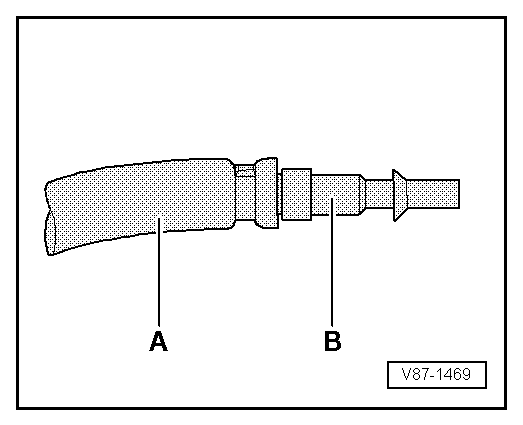 Courtesy of AUDI OF AMERICA, LLC
A compressed gas cylinder filled with nitrogen -3- can be connected to the closed empty refrigerant circuit using a pressure gauge battery with a pressure reducer for nitrogen (maximum reduction pressure: 15 bar (217.56 psi)) -1- and a filler hose -2- (for example, with M12 x 1.5 -6G threads according to SAE J639) connected to the service connection. A quick-release coupling adapter must also be connected to the service connection. Refer to COMMERCIALLY AVAILABLE TOOLS AND MATERIALS .
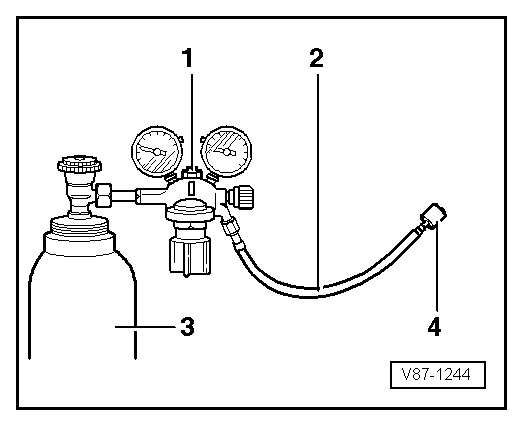
-- Rain the refrigerant circuit pressure slowly to a maximum of 15 bar (217.56 psi).
Risk of injury due to nitrogen flowing under high pressure.
- Use a pressure reducer for the nitrogen container.
-- Find the location of the leak by listening for the sound of venting gas.
-- Eliminate the leak.
-- Evacuate and check the vacuum display again over several hours. Only when the vacuum is maintained can the refrigerant circuit be charged.
- If there is a leak that is small enough that no air or very little air vents through it when evacuating the refrigerant circuit and the A/C service station can generate a sufficient vacuum. The vacuum indicator does not increase after switching off the A/C service station or only increases slowly, indicating that air is only entering through a small leak.
-- Add 100 grams (3.5 oz) of refrigerant to the circuit, find the location of the leak using an electronic leak detector and repair it or add UV contrast dye to the refrigerant and find the location of the leak with the leak detection system. Refer to REFRIGERANT CIRCUIT, FINDING LEAKS USING ELECTRONIC LEAK DETECTOR and LEAKS, FINDING WITH UV LEAK DETECTION SYSTEM .
-- Empty the refrigerant circuit, if necessary. Refer to REFRIGERANT CIRCUIT, DISCHARGING .
-- Service the refrigerant circuit. Refer to Refrigerant Circuit .
-- Evacuate the refrigerant circuit and observe the vacuum reading again over a longer period of time. Only when the vacuum is maintained can the refrigerant circuit be charged. Refer to REFRIGERANT CIRCUIT, EVACUATING .
Should work be performed on the vehicle after evacuating which does not require using the A/C service station.
-- Disconnect and the A/C service station from the refrigerant circuit and turn it off. Refer to A/C SERVICE STATION, SWITCHING OFF AND DISCONNECTING FROM REFRIGERANT CIRCUIT .
Risk of damaging the A/C compressor by the refrigerant circuit vacuum.
- Never start the engine with vacuum in the refrigerant circuit.
-- Make sure that when charging the refrigerant circuit the engine cannot be started.
If after discharging and evacuating the refrigerant circuit cannot be refilled. Refer to REFRIGERANT CIRCUIT, CHARGING .