Brake Pads, Removing And Installing: Installing
Install in reverse order of removal and note the following:
- Always replace brake pads on the same axle at the same time.
- When installing new brake pads use the repair kit and new brake pad wear indicator wire.
- Clean the bolts and nuts before reusing.
- Replace damaged bolts and nuts.
- Replace the self-locking bolts and nuts after removal.
TIP:
- Coat the brake pad backing plate with grease.
- Coat the guide pin with lithium grease.
- Do "not" coat the rubber components, seals and adhesive surfaces for the brake pad backing plate with grease or paste.
-- If the brake pads are being replaced, check the brake rotors for wear and damage.
- Brake rotor wear limit. Refer to TECHNICAL DATA .
Health risk due to toxic dust from the brake system.
Irreversible deposit of dust particles in the lungs. Breathing may become impaired.
- Never blow out the brake system with compressed air.
- Use only mineral spirits to clean the brake caliper.
- Check the brake caliper piston protective caps for damage and install the complete repair kit, if necessary. Refer to BRAKE CALIPER PISTON, REMOVING AND INSTALLING .
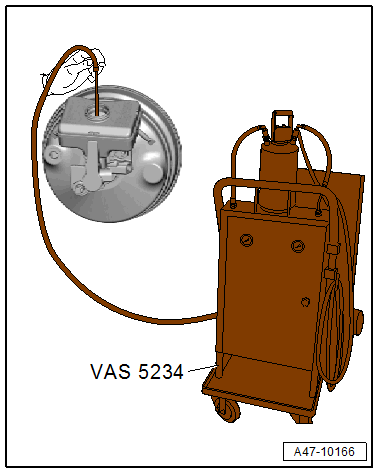
There is a risk of contamination and paint damage from leaking brake fluid.
- Check the brake fluid level before pushing the brake caliper piston back into the brake cylinders.
-- If the brake fluid is up to the "MAX" marking on used brake pads, it must be extracted.
- Use the Brake Charger/Bleeder Unit :VAS5234 to extract brake fluid from the brake fluid reservoir.
-- Use the Piston Resetting Tool :T10145 to completely press back the brake caliper piston.
-- Clean the brake carrier -1- at the brake pad spring contact surfaces -arrow- and thinly coat them with lithium grease.
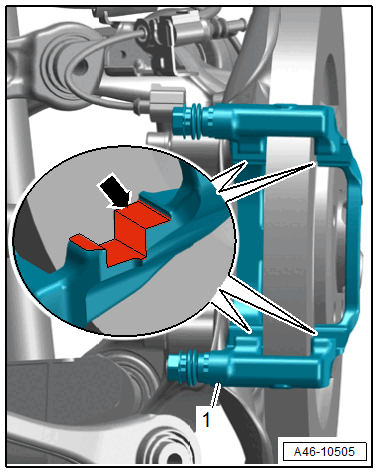
-- If reusing, install the marked brake pads in the same location.
-- Insert brake pads in brake carrier.
-- Push the brake caliper over the installed brake pads.
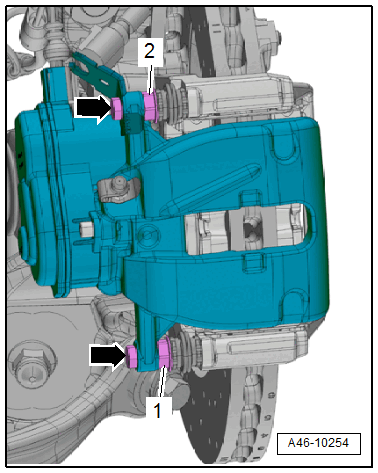
- Make sure the brake hose is routed correctly.
- Make sure the brake hose is not blocked, bent, twisted or rubbing against the vehicle.
-- Tighten the brake caliper bolts -arrows- by counterholding the guide pins -1 and 2-.
- Check the brake pad wear indicator contact for damage and replace if necessary.
- Make sure that the brake pad wear indicator contact fits correctly in the brake pad.
- If the clips go missing, the brake pad wear indicator wire must be replaced.
-- Free up the wire by removing the protective cap -3- from the bleed screw and the clip -4-.
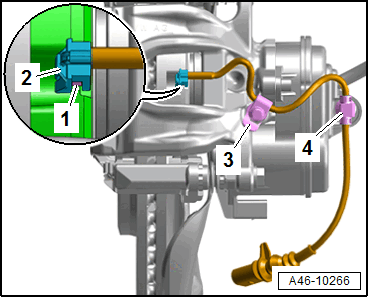
-- Carefully remove the contact -1- for the brake pad wear indicator using pliers while paying attention to the clip -2-.
-- Drive the parking brake motors up using the Vehicle Diagnostic Tester by following the instructions in the display.
Faulty brakes increase the risk of an accident.
- Make sure the brakes are working correctly before driving the vehicle for the first time.
-- With the vehicle stationary, firmly press the brake pedal several times so that the brake pads in the operating condition properly sit in their respective position.