Rear Brake Pads, Removing And Installing: Installing
Install in reverse order of removal and note the following:
-- When the brake pads are replaced, check the brake rotors for wear and damage:
- Brake rotor wear limit. Refer to TECHNICAL DATA .
Always replace brake pads on the same axle at the same time.
When installing new brake pads use the repair kit and new brake pad wear indicator sensor wire.
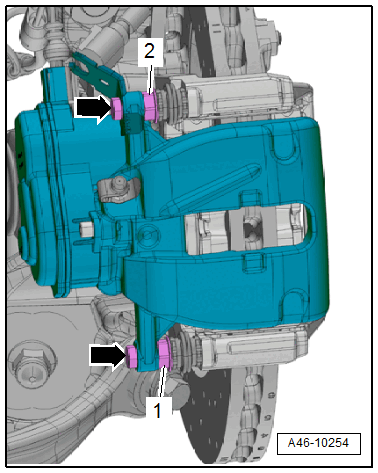
Replace the brake caliper bolts after removing.
Health Risk.
- Do not blow out brake system with compressed air.
Use only mineral spirits to clean the brake caliper.
Check the brake caliper piston protective caps for damage and install the complete repair kit, if necessary. Refer to BRAKE CALIPER PISTON, REMOVING AND INSTALLING, REAR BRAKES .
There is a risk of contamination and paint damage from escaping brake fluid.
- If the brake pads are worn out and unnecessary brake fluid was filled, the brake fluid may overflow, when the brake caliper pistons in the brake cylinders are pressed back.
- Check the brake fluid level before pressing back the brake caliper pistons. If there is brake fluid up to the "MAX" mark, some brake fluid will need to be extracted.
- Use the :VAS5234 to extract brake fluid from the brake fluid reservoir.
-- Use the :T10145 to completely press back the brake caliper piston.
-- Clean the brake carrier on the retaining clip contact surfaces and thinly coat them with lithium grease.
-- If reusing, install the marked brake pads in the same location.
-- Insert brake pads in brake carrier.
Make sure the brake pads are installed at the correct location.
The brake pad clips -A- must sit correctly in the contact surfaces in the brake carrier.
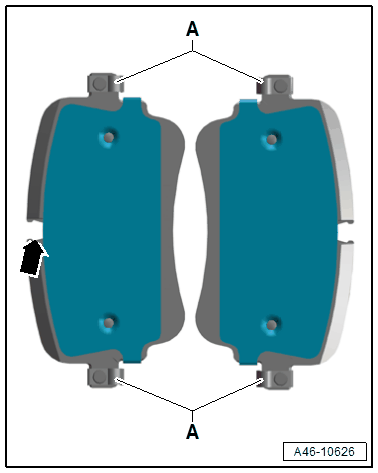
Brake pad wear indicator sensor mount -arrow-, only installed on the right rear side
-- Push the brake caliper over the installed brake pads.
Make sure that the wire and brake hose are routed correctly.
Make sure the brake hose is not blocked, bent, twisted or rubbing against the vehicle.
-- Tighten the new brake caliper bolts -arrows- by counterholding the guide pins -1 and 2-.
Check the brake pad wear indicator sensor contact for damage and replace if necessary.
Make sure that the brake pad wear indicator sensor contact fits correctly in the brake pad.
If the clips go missing, the brake pad wear indicator sensor wire must be replaced.
Insert the contact -4- for the brake pad wear indicator sensor with the clip -3- until it engages in the inner brake pad.
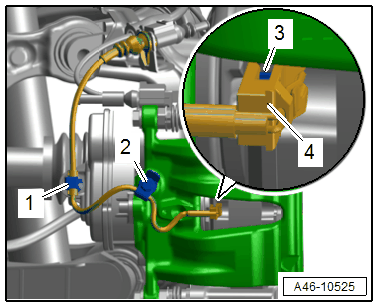
-- Secure the brake pad wear indicator sensor wire with the protective cap -2- and the clip -1-.
-- With the vehicle stationary, firmly press the brake pedal several times so that the brake pads in the operating condition properly sit in their respective position.
-- Drive the parking brake motors up using the Vehicle Diagnostic Tester by following the instructions in the display.
Risk of accident!
- With the vehicle stationary, firmly press the brake pedal several times so that the brake pads in the operating condition properly sit in their respective position.
- Make sure the brakes are working correctly before driving the vehicle for the first time.