Installing the rail with injectors
NOTE:
TECHNICAL INFORMATION
When assembling, it is essential to observe screwing sequences and tightening torques.
Failure to comply with the regulations can lead to leaks and damage.
When assembling, it is essential to observe screwing sequences and tightening torques.
Failure to comply with the regulations can lead to leaks and damage.
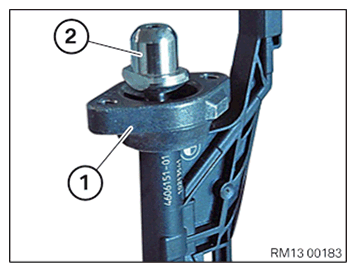
- Mount the holder (1) above the bayonet fitting (2) on the injector.
- If the holder (1) has a cast lug:
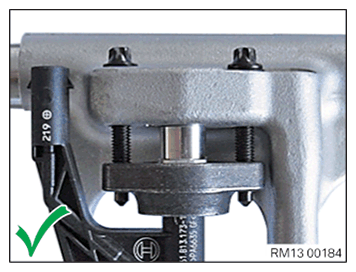
Ensure that the installation position of the holder is correct.
- If necessary, note the position of the cast lug:
The holder is mounted correctly when the cast lug lies in the rear.
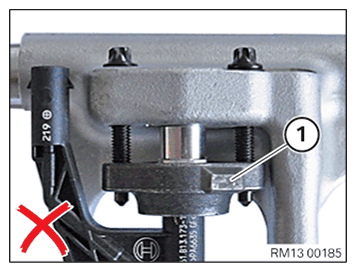
- If necessary, note the position of the cast lug:
The holder is mounted incorrectly when cast lug (1) lies in the front.
NOTE:
RISK OF DAMAGE
Damage to injectors.
Weld seams on the injector may tear due to incorrect distances between the rail and injector so that the injector must be replaceed.
Damage to injectors.
Weld seams on the injector may tear due to incorrect distances between the rail and injector so that the injector must be replaceed.
- Insertion of the distance gauge is compulsory.
- Replace distance gauge, if a thickness of 8.5 mm is no longer given in the distance gauge.
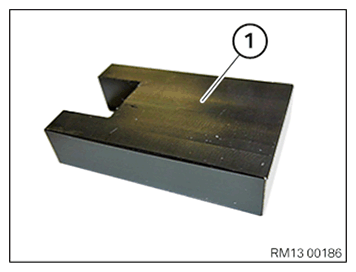
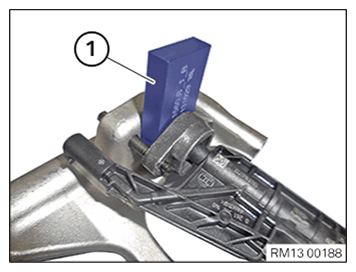
- Use the special tool (distance gauge) 2 358 022 (1).
- Mount the injectors with holders and the new screws (M5x30) to the rail.
Parts: Screws (M5x30)
- Place the rail on a clean table that the openings on the rail for the injectors point upwards.
The electrical injector connections must point towards the fuel pressure sensor.
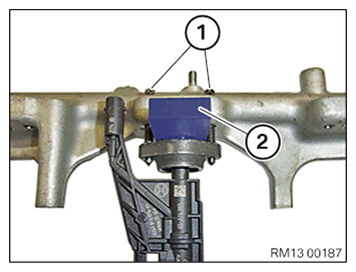
- Slide the special tool (distance gauge) 2 358 022 (2) between the holders and the rail onto the injector head.
- Make sure that the special tool (distance gauge) 2 358 022
(2) rests flat on the retaining bridge.
- Hand-tighten both screws (M5x30) (1) uniformly until special tool (distance gauge) 2 358 022 (2) rests flat against the rail and the holder.
- Remove the special tool (distance gauge) 2 358 022 (1) .
- Repeat this operation for all injectors.
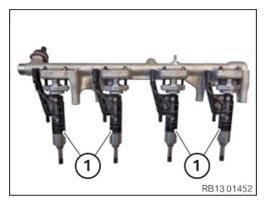
- Check injectors (1) for loose fit at the rail.
- Align the electrical injector connections parallel to the rail.
Injectors (1) must be able to move freely.
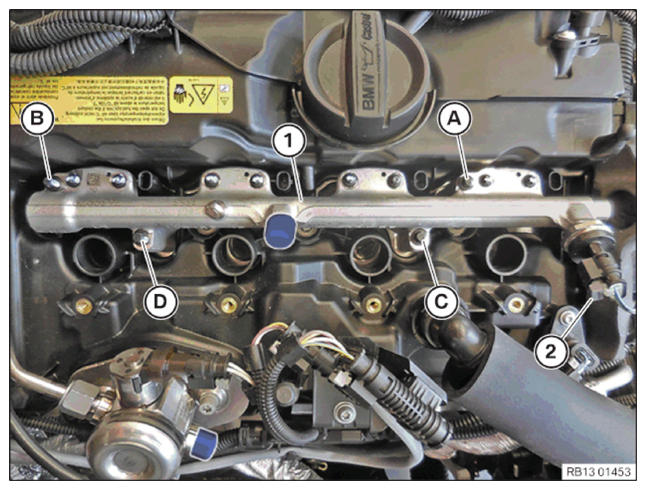
- Attach the rail (1) with the injectors to the cylinder head from the top.
- Ensure that the injector tips hit the bores provided in the cylinder head for the injection in the cylinder head.
- Ensure that the guides on the injector are slid correctly into the guide bore holes in the cylinder head.
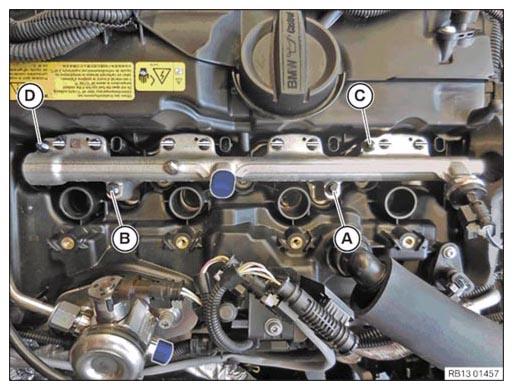
- Press down until resistance can be felt, position screws (M6x70) (A), (B), (C) and (D), and turn them until hand-tight.
- Set torque wrench to 2 Nm.
- Tighten the screws (A,) (D), (B) and (C) in alternating order by 90° each with the torque wrench until the rail is positioned flush on the cylinder head.
The illustration shows the rail lying flat on the cylinder head.
- If tightening torque (2 Nm) is achieved before the rail rests on the cylinder head: Disassemble the rail and restart the installation procedure.
NOTE:
TECHNICAL INFORMATION
When assembling, it is essential to observe screwing sequences and tightening torques.
Failure to comply with the regulations can lead to leaks and damage.
When assembling, it is essential to observe screwing sequences and tightening torques.
Failure to comply with the regulations can lead to leaks and damage.
- Tighten screw (A) by 5 Nm.
- Tighten screw (D) by 5 Nm.
- Tighten screw (B) by 5 Nm.
- Tighten screw (C) by 5 Nm.
- Connect connectors (2) and lock.
The connector (2) must engage audibly.
- Make sure that the rail (1) rests flat against the cylinder head.
- Insert a wrench socket set into an extension.
Do not use a reversible ratchet or torque wrench.
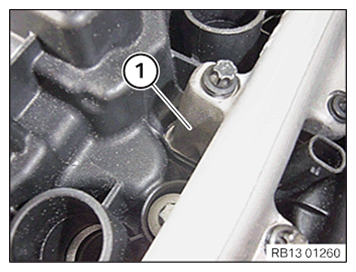
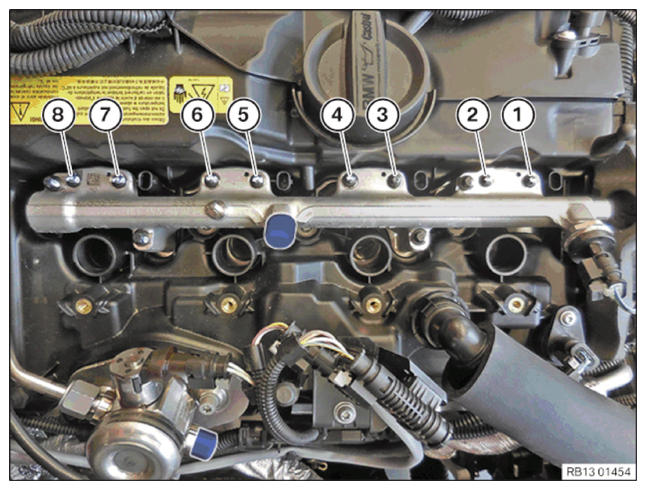
- Hand-tighten the screws (M5x30) respectively in pairs (1) with (2), (3) with (4), (5) with (6), (7) with (8) alternatively with 90°.
- Set torque wrench to 5 Nm.
NOTE:
TECHNICAL INFORMATION
When assembling, it is essential to observe screwing sequences and tightening torques.
Failure to comply with the regulations can lead to leaks and damage.
When assembling, it is essential to observe screwing sequences and tightening torques.
Failure to comply with the regulations can lead to leaks and damage.
- Screw the M5x30 screws according to the following pattern:
- Fuel injector 1:
- Tighten the bolt (1) at an angle of rotation of 90° with the torque wrench.
- Tighten the bolt (2) at an angle of rotation of 90° with the torque wrench.
- Repeat the steps for screws (1) and (2) until 5 Nm is achieved for the two screws.
- Fuel injector 2:
- Tighten the bolt (3) at an angle of rotation of 90° with the torque wrench.
- Tighten the bolt (4) at an angle of rotation of 90° with the torque wrench.
- Repeat the steps for screws (3) and (4) until 5 Nm is achieved for the two screws.
- Fuel injector 3:
- Tighten the bolt (5) at an angle of rotation of 90° with the torque wrench.
- Tighten the bolt (6) at an angle of rotation of 90° with the torque wrench.
- Repeat the steps for screws (5) and (6) until 5 Nm is reached for both screws.
- Fuel injector 4:
- Tighten the bolt (7) at an angle of rotation of 90° with the torque wrench.
- Tighten the bolt (8) at an angle of rotation of 90° with the torque wrench.
- Repeat the steps for screws (7) and (8) until 5 Nm is reached for both screws.
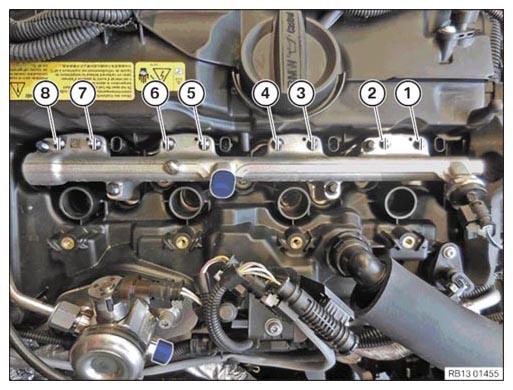
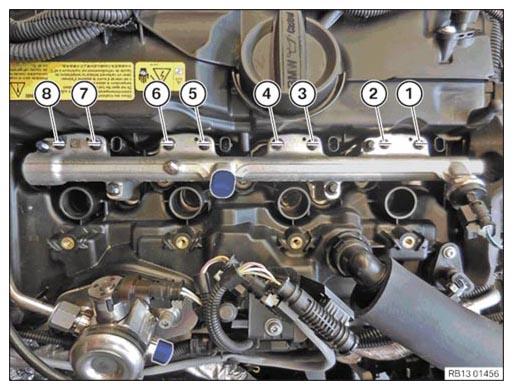
- Mark all bolts (1) to (8) with a vertical line (see figure).
- Tighten screws using an angle of rotation.
- Tighten the bolt (1) with an angle of rotation of 90°.
- Tighten the bolt (2) with an angle of rotation of 90°.
- Tighten the bolt (3) with an angle of rotation of 90°.
- Tighten the bolt (4) with an angle of rotation of 90°.
- Tighten the bolt (5) with an angle of rotation of 90°.
- Tighten the bolt (6) with an angle of rotation of 90°.
- Tighten the bolt (7) with an angle of rotation of 90°.
- Tighten the bolt (8) with an angle of rotation of 90°.
- Check if all bolts (1) to (8) were tightened with an angle of rotation of 90°.
Marks (lines) must be horizontal (see illustration).
- Release bolts (M6x70) (A) to (D).
The screws must be released.
NOTE:
TECHNICAL INFORMATION
When assembling, it is essential to observe screwing sequences and tightening torques.
Failure to comply with the regulations can lead to leaks and damage.
When assembling, it is essential to observe screwing sequences and tightening torques.
Failure to comply with the regulations can lead to leaks and damage.
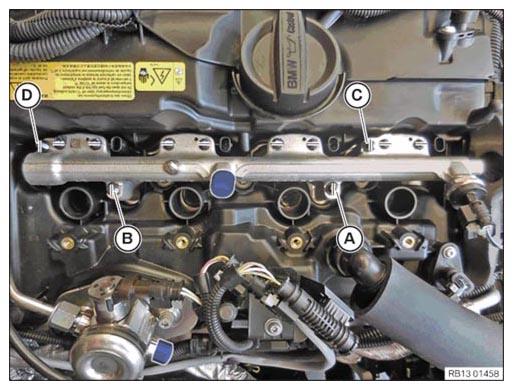
- Tighten screw (A) at 5 Nm.
- Tighten screw (D) at 5 Nm.
- Tighten screw (B) at 5 Nm.
- Tighten screw (C) at 5 Nm.
- Mark screws (A) to (D) with a vertical line (see figure).
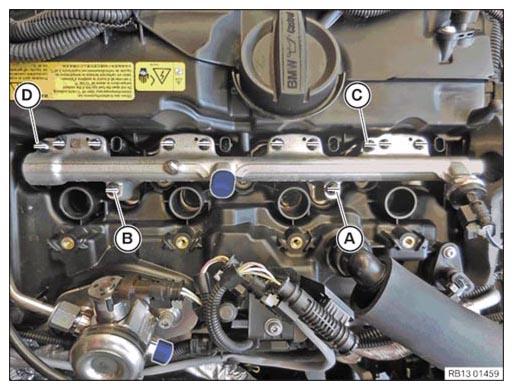
- Tighten the screws (M6x70) (A) to (D) at an angle of rotation of 90°.
- Check if screws (A) to (D) were tightened with an angle of rotation of 90°.
All the marks (lines) must be horizontal (see illustration).
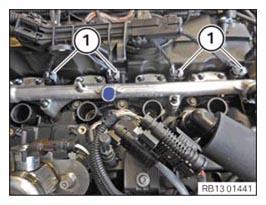
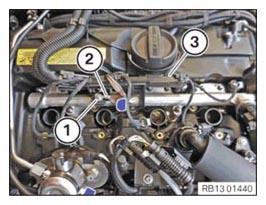
- Connect and lock all the connectors (1) to the injectors.
All connectors (1) must engage audibly.
- Thread the cable channel (3) in and install.
- Thread in ground cable (2) and install.
- Tighten nut (1).
TIGHTENING TORQUES SPECIFICATION
| Ground cable to rail | ||
| M6 | Tightening torque | 5 Nm |
Follow-up work
- Refer to INSTALLING THE HIGH-PRESSURE LINE BETWEEN THE HIGH-PRESSURE PUMP AND THE HIGH-PRESSURE RAIL .
- Refer to INSTALL IGNITION COIL .
- Refer to INSTALL THE CYLINDER HEAD COVER ACOUSTIC COVER .
- Refer to DISCONNECTING ALL BATTERY GROUND LEADS .
- Refer to ACTIVATING THE 48 V ELECTRICAL SYSTEM .
- Refer to INSTALLING ACOUSTIC COVER AT REAR .
- Refer to INSTALL ACOUSTIC COVER .
- Refer to INSTALL THE FRONT HOOD SEAL AT THE REAR .