Installing the retaining bridge in vehicles with a gasoline particulate filter
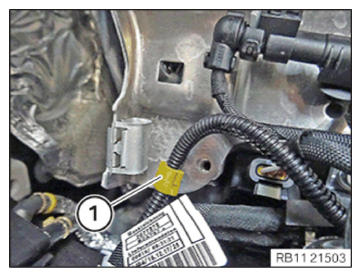
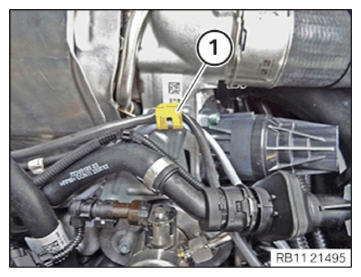
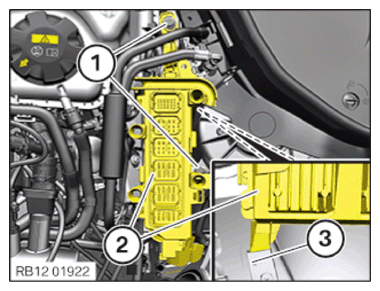
- Clip in the wiring harness mounting (1) on the retaining bridge.
- Clip in the wiring harness mounting (1) on the retaining bridge.
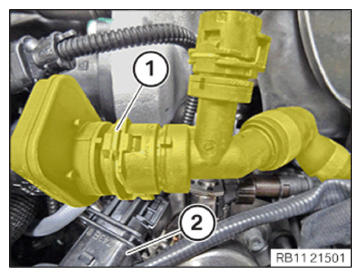
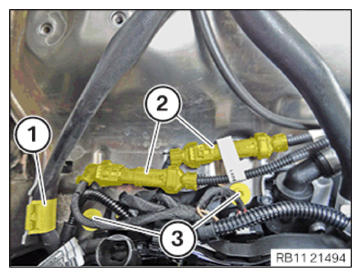
- Feed the connector (2) of the Lambda oxygen sensor through.
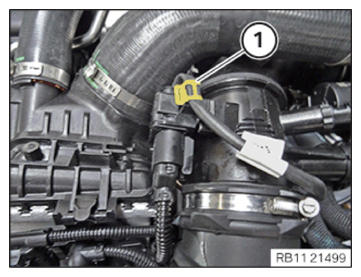
- Connect and lock the engine ventilation line to the retaining clip in the region of (1).
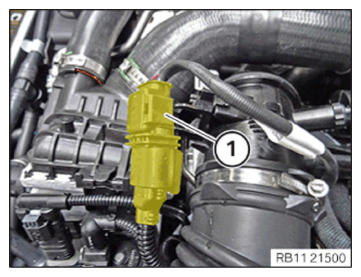
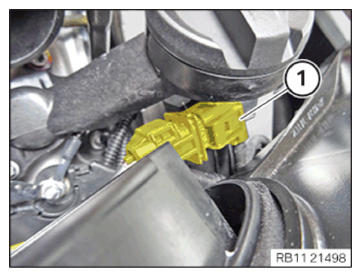
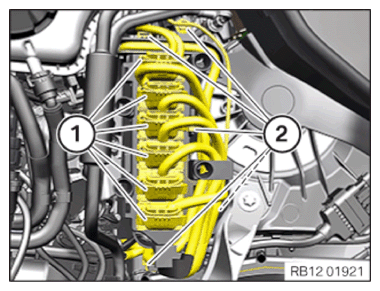
- Connect connectors (1) and lock.
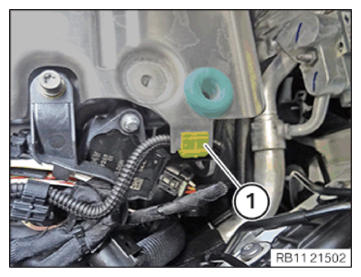
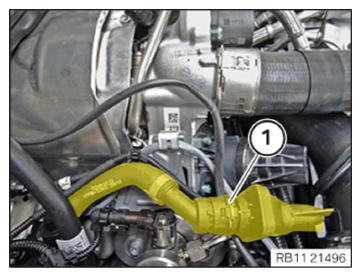
- Clip In the cable from the Lambda oxygen sensor on the holder (1).
- Feed the connector (2) of the Lambda oxygen sensor through.
- Connect and lock the engine ventilation line to the retaining clip in the region of (1).
- Connect connectors (1) and lock.
- Connect connectors (1) and lock.
- Clip In the cable from the Lambda oxygen sensor on the holder (1).
- Connect connectors (1) and lock.
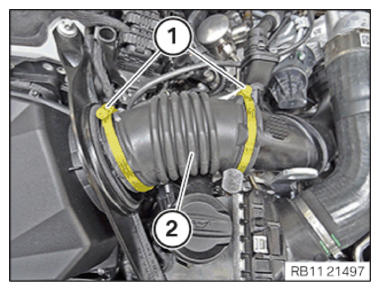
- Install bellows (2).
- Tighten hose clamp (1).TIGHTENING TORQUES SPECIFICATION
Hose clamp Hose clamp Tightening torque 3 Nm - Connect and lock the engine ventilation line to the retaining clip in the region of (1).
- Clip in the cable from the Lambda oxygen sensor on the holder (1).
- Clip in all plug connections (2) downwards into the retaining bridge.
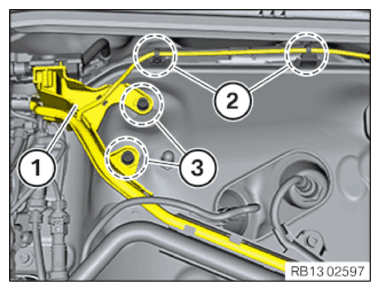
- Clip the transmission wiring harness on to the bracket (1).
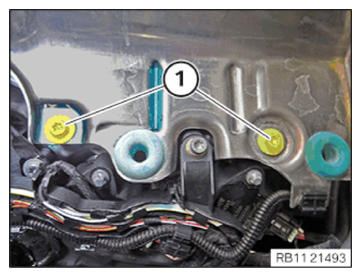
- Tighten down screws (1).TIGHTENING TORQUES SPECIFICATION
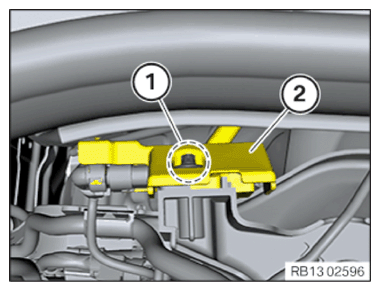
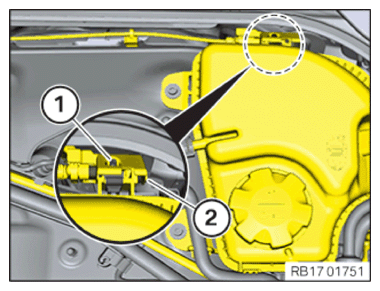
Support bridge M6x16 screw Tightening torque 10 Nm - Position the holder (2) of the gasoline particulate sensor with the gasoline particulate sensor.
- Tighten down screw (1).TIGHTENING TORQUES SPECIFICATION
Gasoline particulate sensor to holder of cylinder bank 1 Plastic screw 6x18 Tightening torque 5.5 Nm - Position the holder (1) of the gasoline particulate sensor.
- Tighten the screws (3).TIGHTENING TORQUES SPECIFICATION
Engine wiring harness of transmission module to holder for expansion tank M6x16 screw Tightening torque 10 Nm - Fix wiring harness mountings (2).
- Position the holder (2) of the gasoline particulate sensor with the gasoline particulate sensor.
- Tighten down screw (1).TIGHTENING TORQUES SPECIFICATION
Gasoline particulate sensor to coolant expansion tank M 6x20 screw Tightening torque 8 Nm - Version with a gasoline particulate filter:
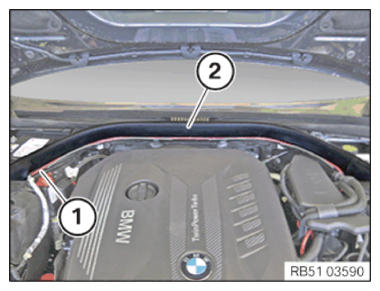
Press the rear hood seal (2) Into the guide.
Guide cable (1) into the holders.
Check if the rear hood seal (2) and cable (1) fit correctly.
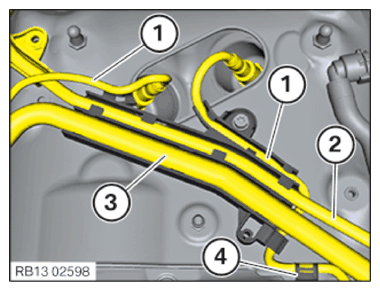
- Clip the cable (1) of the lambda oxygen sensor into the holder.
- Clip in the wiring harness (2).
- Clip in the intake pipe (3).
- Clip the cable (1) of the Lambda oxygen sensor into the holder (4).
Check
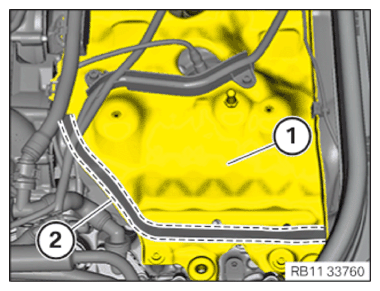
- In area (2), check if the foam on the holder of coolant expansion tank (1) is damaged, porous, loose, or present.
Result
» The foam is damaged or porous or loose.
Measure
- Replace the foam.
Parts: foam
Measure
- Clean the bonding surface in the area (2) from foam residues or adhesive residues.
Measure
- Bond the foam with an adhesive.
Result
» The foam is not installed.
Measure
- Retrofit the foam.
Parts: foam
Measure
- Clean the bonding surface in area (2).
Measure
- Bond the foam with an adhesive.
NOTE: RISK OF DAMAGE
Injectors contaminated with coolant.
Damage to and failure of injectors that were coated with coolant for an extended period.- Covering injectors with suitable auxiliary materials before testing or topping up the coolant is mandatory.
- Covering injectors with suitable auxiliary materials before working on the cooling system in the area of the injectors is mandatory.
- If necessary, draw off all of the coolant from the coolant expansion tank.
- Always clean injectors or injector shafts contaminated with coolant (e.g. with compressed air).
CAUTION: Swirling dirt particles caused by compressed air.
Injury hazard!- Collect dirt particles, e.g. when blowing out, use cloth to do so.
- Wear safety goggles.
CAUTION: Materials harmful to health.
Contact with fluids harmful to health!- Note and follow safety instructions on containers.
- Conduct all work in appropriate personal protective equipment only.
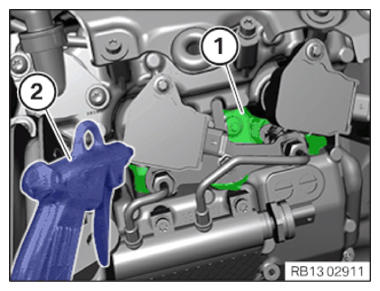
- Check the injector shafts for coolant residues (1).
- If there are coolant residues (1) in the injector shaft: Clean the injector shafts with an air gun (2).NOTE: Schematic diagram is for example purposes. Some parts may differ in certain details.
- Position the coolant expansion tank (2).
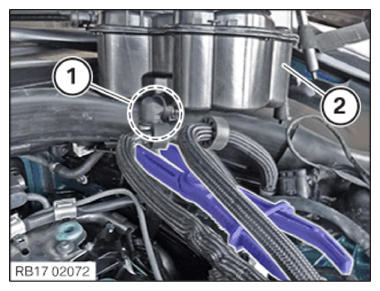
- Connect and lock coolant hose In area (1).NOTE: Schematic diagram is for example purposes. Some parts may differ in certain details.
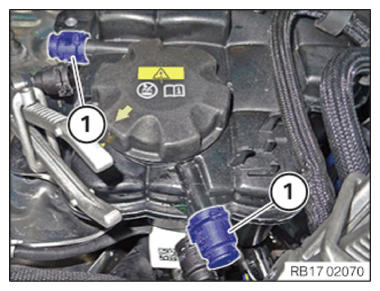
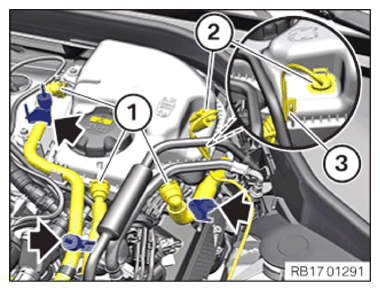
- Remove all the seal plugs (1).
- Secure clamps (3).
- Connect connectors (2) and lock.
The connector (2) must engage audibly.
- Connect and lock the coolant lines (1).
Coolant lines (1) must engage audibly.
- Remove the standard disconnection tools (arrows).NOTE: Schematic diagram is for example purposes. Some parts may differ in certain details.
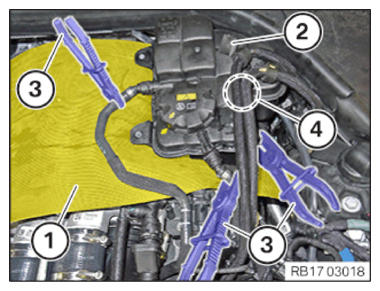
- Position the coolant expansion tank (2).
- Clip in the fuel lines in the area (4) at the coolant expansion tank (2).
- Remove clamping pliers (3).
- Remove the rubber mat (1).
- Connect the holder (4) and lock.
The holder (4) must engage audibly.
- Secure the coolant hose (3) on the coolant expansion tank (2).
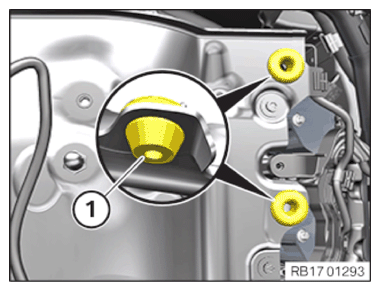
- Check the rubber mount (1) for correct fit.
- Version with a gasoline particulate filter:
Feed in the holder (2) of the gasoline particulate sensor downwards in the guide.
Tighten down screw (1).
TIGHTENING TORQUES SPECIFICATIONGasoline particulate sensor to coolant expansion tank M6x20 screw Tightening torque 8 Nm - version with a gasoline particulate filter:
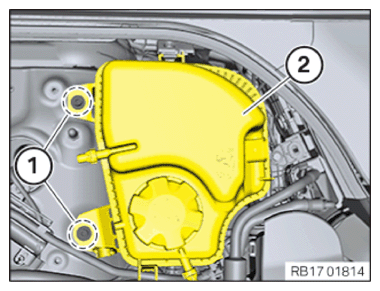
Position the coolant expansion tank (2).
Tighten the screws (1).
TIGHTENING TORQUES SPECIFICATIONCoolant reservoir M6x20 screw Tightening torque 11 Nm - Version with a gasoline particulate filter:
Press the rear hood seal (2) into the guide.
Guide cable (1) into the holders.
Check if the rear hood seal (2) and cable (1) fit correctly.
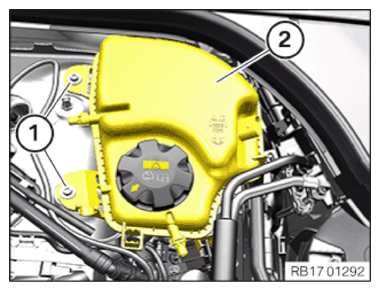
- Feed in and install coolant expansion tank (2).
- Tighten down screws (1).TIGHTENING TORQUES SPECIFICATION
Coolant reservoir M6x20 screw Tightening torque 11 Nm NOTE: TECHNICAL INFORMATION
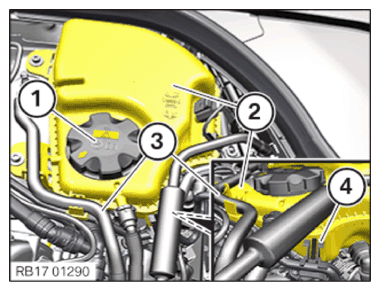
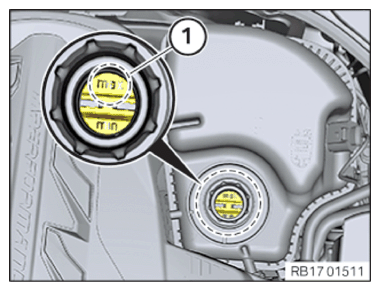
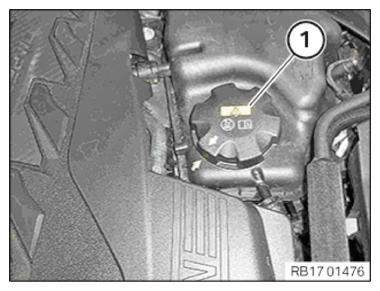
Follow notes for REPAIR WORK ON THE COOLING SYSTEM . - Top up the coolant expansion tank (1) with coolant up to the maximum mark.
- Close the sealing cap (1) until the arrows align.
Installing the control unit bracket for cylinders 5 to 8:
NOTE: RISK OF DAMAGE
Electrostatic discharge.
Damage to or destruction of electrical components.- Leave the electrical components in their original packaging until they are being installed. Only use the original packaging for returning the product. Always package removed components straight away.
- Read and comply with user information on using the associated special tool 12 7 060.
- Only tap the housings of electrical components. Do not tap pins or multi-pin connectors directly.
- Wear electrically conductive clothing and antistatic shoes (with ESD symbol).
- For additional information see: 61 35... NOTES ON ESD (ELECTROSTATIC DISCHARGE) PROTECTION .
NOTE: TECHNICAL INFORMATION
Follow instructions for REMOVING AND INSTALLING CONTROL UNITS .NOTE: TECHNICAL INFORMATION
Disconnecting control units may cause fault code entries and functional limitations. Fault code entries must be read out and deleted if necessary. - Guide and install control unit bracket (2) with the DME control unit into holder (3).
- Tighten down screws (1).TIGHTENING TORQUES SPECIFICATION
Control unit holder Hexagon screw Tightening torque 8 Nm - Fasten all the clamps (2).
- Connect all connectors (1) and lock.
The connectors (1) must engage audibly.
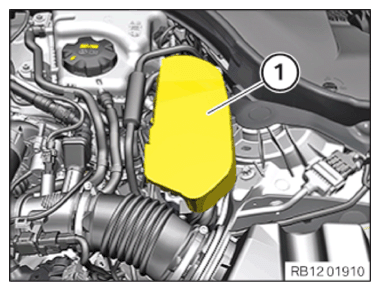
Installing the cover of the left DME control unit
- Feed In the cover (1) In the guides and Install It.
Installing acoustic cover
NOTE: RISK OF DAMAGE
Damage to the acoustic cover/design cover.
Jerky movements during disassembly and application of excessive force during installation may result in breakage of the acoustic cover/design cover.- Disassemble or mount the acoustic cover/design cover carefully.
- Disassemble or mount snap-lock couplings of the ball pivots one after the other.
- Disassemble or mount the acoustic cover/design cover only at temperatures > 20°C.
- Use only distilled water as an auxiliary material during installation, no lubricants.
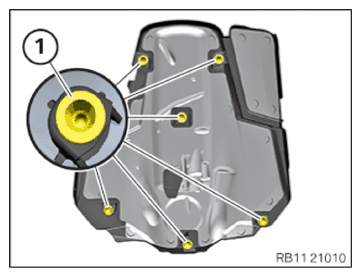
- Check the rubber mount (1) for a correct seat of the acoustic cover.
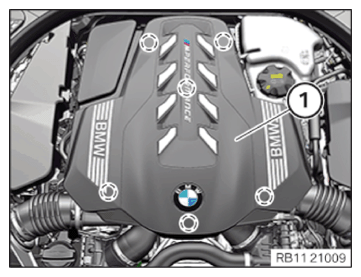
- Install the acoustic cover (1) and fasten it in the rubber mounts (marks).
- Version with clip:
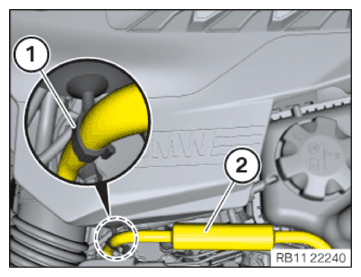
Clip in the tank vent line (2) into the clamp (1).
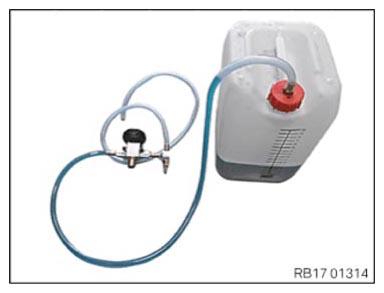
Fill and vent the high-temperature coolant circuit:
NOTE: TECHNICAL INFORMATION
It is mandatory to fill the cooling system before bleeding.
Fill both the circuits for high and low-temperature coolant circuits.