Prepare for the installation of the exhaust turbocharger
WARNING:
Hot surfaces.
Risk of burning!
Risk of burning!
- Perform all work only on components that have cooled down.
NOTE:
RISK OF DAMAGE
Electrostatic discharge.
Damage to or destruction of electrical components.
Electrostatic discharge.
Damage to or destruction of electrical components.
- Leave the electrical components in their original packaging until they are being installed. Only use the original packaging for returning the product. Always package removed components straight away.
- Read and comply with user information on using the associated special tool 12 7 060.
- Only tap the housings of electrical components. Do not tap pins or multi-pin connectors directly.
- Wear electrically conductive clothing and antistatic shoes (with ESD symbol).
- For additional information see: NOTES ON ESD (ELECTROSTATIC DISCHARGE) PROTECTION .
NOTE:
TECHNICAL INFORMATION
Prior to replacing the exhaust turbocharger: Observe the notes on troubleshooting on the exhaust turbocharger.
Prior to replacing the exhaust turbocharger: Observe the notes on troubleshooting on the exhaust turbocharger.
NOTE:
TECHNICAL INFORMATION
For exhaust turbocharger damage: Check the pressure pipes, charge air cooler and intake plenum for foreign matter, damage and correct functionality.
If the oil return line is exchanged, then the connecting pipe to the oil sump must ALWAYS be cleaned, as the connecting pipe can coke.
For exhaust turbocharger damage: Check the pressure pipes, charge air cooler and intake plenum for foreign matter, damage and correct functionality.
If the oil return line is exchanged, then the connecting pipe to the oil sump must ALWAYS be cleaned, as the connecting pipe can coke.
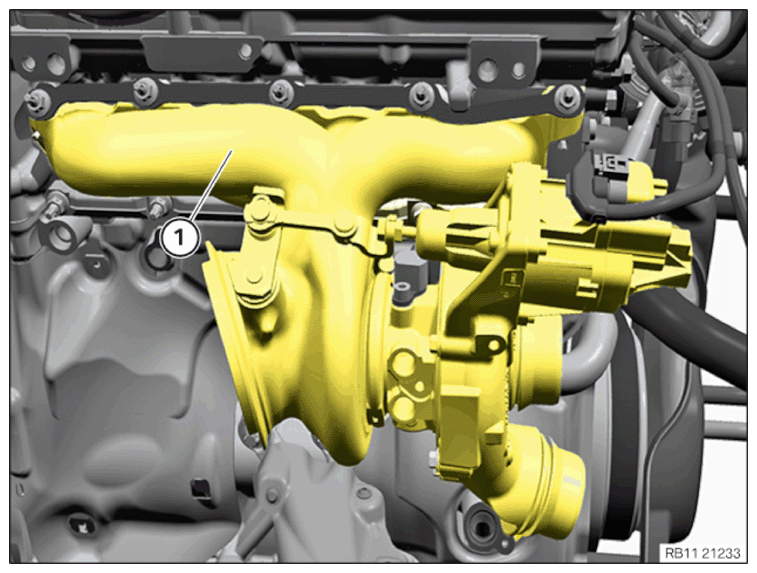
Preliminary work
- Refer to BRINGING FRONT COMPARTMENT LID IN THE SERVICE POSITION .
- Refer to REMOVING THE ACOUSTIC COVER .
- Refer to REMOVING THE SEAL FOR THE HOOD REAR .
- Refer to REMOVING ACOUSTIC COVER AT REAR .
- Refer to REMOVING RESONATOR .
- Refer to REMOVING CLEAN AIR PIPE .
- Refer to REMOVING CHARGE AIR LINE .
- Refer to REMOVING THE ACOUSTIC COVER FOR THE ENGINE AT THE FRONT .
- Refer to REMOVING THE LAMBDA OXYGEN SENSOR .
- Refer to REMOVING THE CENTER UNDERBODY PROTECTION .
- Refer to REMOVING THE UNDERBODY PROTECTION OF THE STEERING GEAR AND THRUST FIELD RESPECTIVELY .
- Refer to REMOVING THE CONNECTING SUPPORT FROM THE TUNNEL .
- Refer to REMOVING COMPLETE EXHAUST SYSTEM .
- Refer to REMOVING CATALYTIC CONVERTER .
- Refer to DRAINING THE COOLANT FROM THE HIGH-TEMPERATURE COOLING SYSTEM .
- Refer to CONNECTING THE COOLANT LINES FOR THE HIGH-TEMPERATURE COOLANT CIRCUIT .
- Refer to REMOVING THE COOLANT FEED LINE FOR THE EXHAUST GAS TURBOCHARGER .
- Refer to REMOVING THE COOLANT RETURN LINE FOR THE EXHAUST TURBOCHARGER .
- Refer to REMOVING THE OIL RETURN LINE FOR THE EXHAUST TURBOCHARGER .
- Check the oil feed and oil return lines for contamination or obstruction and clean or replace as needed.
- If the oil feed and/or oil return lines are heavily contaminated, we recommend changing the motor oil and the oil filter.
- If installed: Check the coolant feed and coolant return lines for the exhaust turbocharger for contamination or obstruction and clean or replace as needed.
- Check the screw connections and plug connections of all lines for accuracy.
- Check air filter for contamination and clean or replace as needed.
- Check correct functioning of crankcase ventilation.
- Replace all gaskets.
Parts: Seals