Remove exhaust turbocharger
WARNING:
Hot surfaces.
Risk of burning!
Risk of burning!
- Perform all work only on components that have cooled down.
NOTE:
RISK OF DAMAGE
Electrostatic discharge.
Damage to or destruction of electrical components.
Electrostatic discharge.
Damage to or destruction of electrical components.
- Leave the electrical components in their original packaging until they are being installed. Only use the original packaging for returning the product. Always package removed components straight away.
- Read and comply with user information on using the associated special tool 12 7 060.
- Only tap the housings of electrical components. Do not tap pins or multi-pin connectors directly.
- Wear electrically conductive clothing and antistatic shoes (with ESD symbol).
- For additional information see: NOTES ON ESD (ELECTROSTATIC DISCHARGE) PROTECTION
NOTE:
Prior to replacing the exhaust turbocharger: Observe the notes on troubleshooting on the exhaust turbocharger.
NOTE:
For exhaust turbocharger damage: Check the pressure pipes, charge air cooler and intake plenum for foreign matter, damage and correct functionality.
NOTE:
If the oil return line is exchanged, then the connecting pipe to the oil sump must ALWAYS be cleaned, as the connecting pipe can coke.
Preliminary work
- Refer to REMOVING THE FRONT UNDERBODY PROTECTION OR FRONT THRUST FIELD .
- Refer to REMOVING THE FRONT THRUST FIELD .
- Refer to REMOVING THE STIFFENING PLATE .
- Refer to REMOVING THE CONNECTING SUPPORT FROM THE TUNNEL .
- Refer to REMOVING COMPLETE EXHAUST SYSTEM .
- Refer to REMOVING THE ACOUSTIC COVER .
- Refer to REMOVING THE COVER ON LEFT AND RIGHT IN THE ENGINE COMPARTMENT AT THE TOP .
- Refer to REMOVING THE LEFT AND RIGHT FRONT-END STRUT .
- Refer to REMOVING INTAKE SILENCER HOUSING .
- Refer to REMOVING THE RESONATOR WITH THE TOP CLEAN AIR PIPE .
- Refer to REMOVING BOTTOM CLEAN AIR PIPE .
- Refer to REMOVING CHARGE AIR LINE .
- Refer to REMOVING FRONT CROSS CONNECTION .
- Refer to REMOVING THE REAR TOP CROSS CONNECTION .
- Refer to REMOVING THE FAN COWL .
- Refer to DRAINING THE COOLANT FROM THE HIGH-TEMPERATURE COOLING SYSTEM .
- Refer to REMOVING THE LAMBDA OXYGEN SENSOR .
- Refer to REPLACING THE OXYGEN MONITOR SENSOR .
- Refer to REMOVING CATALYTIC CONVERTER .
- Refer to REMOVING THE OIL RETURNING LINE FOR THE EXHAUST TURBOCHARGER .
- Refer to REMOVING THE FRONT SECTION OF THE COOLANT RETURN LINE .
- Refer to REMOVING THE COOLANT FEED LINE (COOLANT RETURN LINE IS REMOVED) .
- Refer to REMOVING HEAT SHIELD FOR CYLINDER HEAD COVER .
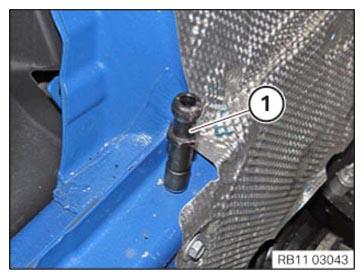
- Unscrew the guide pin (1).
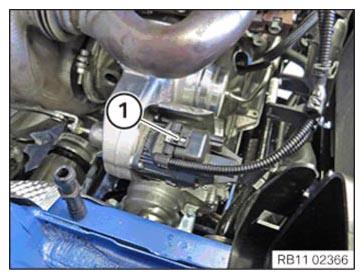
- Unlock plug connection (1) and disconnect.
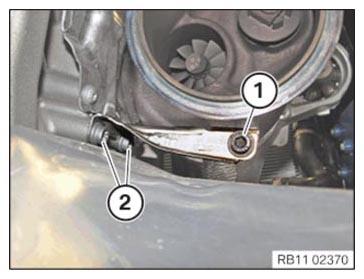
- Loosen screw (1).
- Release screw (2) and remove the support.
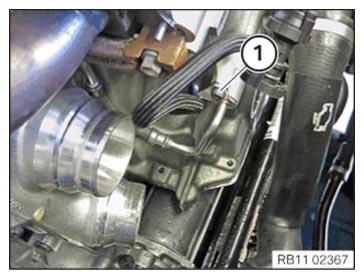
- Loosen screw (1).
- Detach oil feed line from engine block.
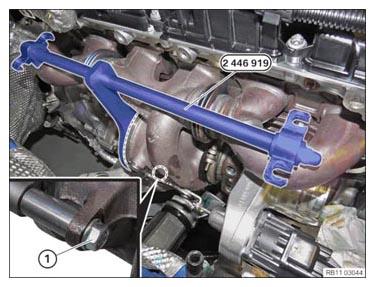
- Install the special tool 2 446 919 on the exhaust turbocharger and secure it with the bolt (1).
- Make sure that the special tool 2 446 919 is flush with the exhaust turbocharger in the marked area.
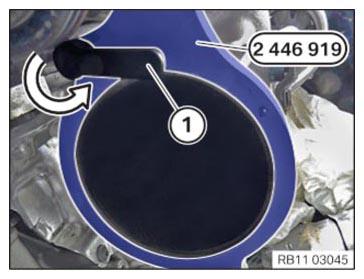
- Secure the special tool 2 446 919 by turning the clamping lever (1) in the direction of the arrow.NOTE: The clamping lever that is shown in the graphic is already in its end position.
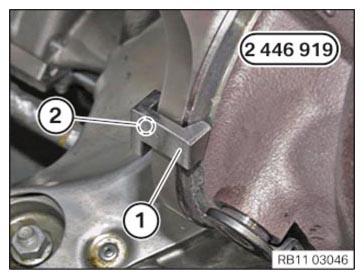
- Position the holder (1) and fasten it with the bolt (2).NOTE: Holder 1 is used for the final mounting of the special tool 2 446 919.
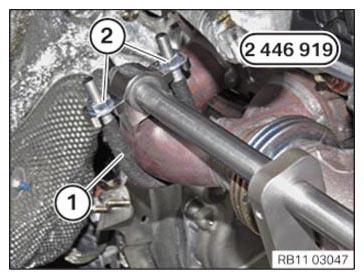
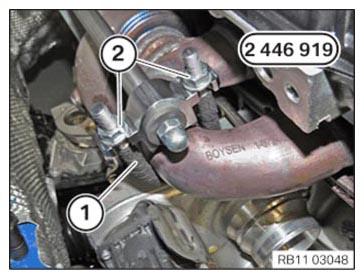
- Position the retainer (1) and secure it with the nuts (2).TIGHTENING TORQUES SPECIFICATION
U bolt to special tool 2 919 (446) The tightening torque must be observed! Risk of damage to the exhaust manifold! Tightening torque 1 Nm - Position the retainer (1) and secure it with the nuts (2).TIGHTENING TORQUES SPECIFICATION
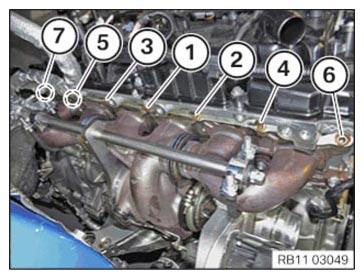
U bolt to special tool 2 919 (446) The tightening torque must be observed! Risk of damage to the exhaust manifold! Tightening torque 1 Nm - Release nuts in the order (7) till (1) in semicircular pattern.
- Secure exhaust turbocharger against falling down.
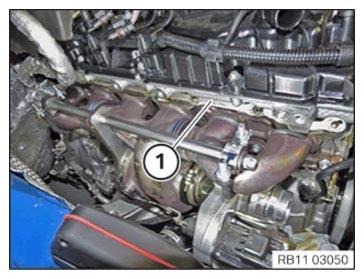
- Remove the sliding rail (1).NOTE: Do not damage the thermal compensating elements. Disassembly and installation including intermediate storage of the exhaust turbocharger is only permitted with mounted special tool 2 466 919.
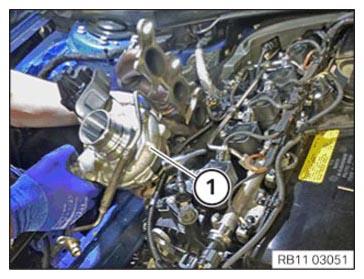
- Thermal compensating element of the exhaust turbocharger (1) or exhaust manifold should not be bent or deformed.
- Carefully guide out and remove the exhaust turbocharger (1).