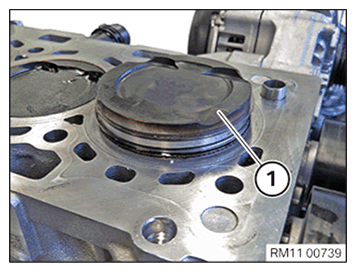
Removing all pistons with connecting rod
Preliminary work
- Refer to REMOVING THE ENGINE FROM THE FRONT AXLE .
- Refer to REPLACING THE LAMBDA OXYGEN SENSOR
- Refer to REPLACING THE OXYGEN MONITOR SENSOR
- Refer to REMOVING CATALYTIC CONVERTER .
- Refer to PREPARE THE ASSEMBLY JIG .
- Refer to INSTALLING THE ENGINE ON THE ASSEMBLY JIG
- Refer to REMOVE BEARING BRACKET .
- Refer to REMOVE FRONT AXLE DIFFERENTIAL .
- Refer to DRAINING THE MOTOR OIL .
- Refer to REMOVE BOTTOM CLEAN AIR PIPE .
- Refer to REMOVE CHARGE AIR LINE
- Refer to REMOVE TANK VENT VALVE .
- Refer to REMOVING THE INTAKE PLENUM .
- Refer to REMOVE BOTH ACTUATORS (ENGINE REMOVED)
- Refer to REMOVE FRONT ENGINE ENCAPSULATION .
- Refer to REMOVE IGNITION COILS .
- Refer to REMOVE THE HIGH PRESSURE LINE BETWEEN THE RAIL AND THE HIGH PRESSURE PUMP .
- Refer to REMOVE HIGH PRESSURE PUMP .
- Refer to REMOVE THE INJECTORS FOR CYLINDERS 1 TO 3 .
- Refer to REMOVE THE INJECTORS FOR CYLINDERS 4 TO 6 .
- Refer to REMOVING THE CYLINDER HEAD COVER .
- Refer to DETACH OIL SUPPLY LINE FROM THE ENGINE BLOCK .
- Refer to REMOVING THE OIL RETURN LINE FOR THE EXHAUST TURBOCHARGER .
- Refer to REMOVING THE EXHAUST TURBOCHARGER SUPPORT .
- Refer to REMOVING STARTER MOTOR .
- Refer to TURNING THE ENGINE ON THE VIBRATION DAMPER
- Refer to BLOCKING THE CRANKSHAFT IN THE TDC FIRING POSITION OF THE FIRST CYLINDER (AUTOMATIC TRANSMISSION) .
- Refer to BLOCKING THE CAMSHAFTS .
- Refer to REMOVING CHAIN TENSIONER .
- Refer to RELEASING THE VANOS CENTRAL VALVE .
- Refer to REMOVING INTAKE ADJUSTER .
- Refer to REMOVE EXHAUST CAMSHAFT ADJUSTER .
- Refer to DISASSEMBLING THE SPECIAL TOOL 2 358 122 .
- Refer to REMOVING THE AUXILIARY COOLANT PUMP .
- Refer to REMOVING THE FRONT SECTION OF THE COOLANT RETURN LINE .
- Refer to REMOVE THE REAR SECTION OF THE COOLANT RETURN LINE (FRONT SECTION IS REMOVED) .
- Refer to REMOVE THE COOLANT FEED LINE (COOLANT RETURN LINE IS REMOVED) .
- Refer to REMOVE CYLINDER HEAD .
- Refer to REMOVING THE CYLINDER HEAD GASKET .
- Refer to SEAL THE OIL DUCT .
- Refer to REMOVE OIL SUMP .
- Refer to REMOVE THE OIL VACUUM PUMP .
- Refer to REMOVING THE OIL DEFLECTOR
NOTE:
The description is for one component only. The procedure is identical for all further components.
Removing the piston with connecting rod
NOTE:
TECHNICAL INFORMATION
Piston, piston pin, connecting rod and connecting rod bearing shells are matched to each other and balanced.
Always install the pistons, piston pins, connecting rods and connecting rod bearing shells in the cylinder from which they were removed.
Piston, piston pin, connecting rod and connecting rod bearing shells are matched to each other and balanced.
Always install the pistons, piston pins, connecting rods and connecting rod bearing shells in the cylinder from which they were removed.
NOTE:
TECHNICAL INFORMATION
The connecting rods of the engine are balanced and matched to each other.
A single connecting rod is not permitted to be replaced. Always replace all connecting rods.
The connecting rods of the engine are balanced and matched to each other.
A single connecting rod is not permitted to be replaced. Always replace all connecting rods.
Detach the lower connecting rod bearing
NOTE:
RISK OF DAMAGE
Damage on the cylinder wall and oil spray nozzles.
A large force can scratch the cylinder wall and bend the oil spray nozzles.
Damage on the cylinder wall and oil spray nozzles.
A large force can scratch the cylinder wall and bend the oil spray nozzles.
- Carefully shift the piston and connecting rod in the engine block.
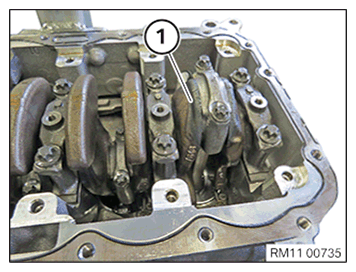
- Turn the crankshaft until the connecting rod bearing journal (1) reaches a vertical position.NOTE: RISK OF DAMAGE
Engine damage caused by incorrectly installed bearing shells and bearing brackets.
If the bearing shells and bearing brackets are installed incorrectly, then engine damage can occur.- Always install all bearing shells and bearing brackets in the same position from which they were removed.
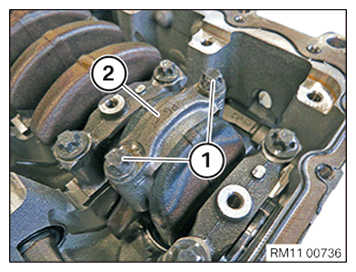
- Unscrew the connecting rod bolts (1).
- Remove the connecting rod bearing cap (2) and put to one side in the correct order.
Make sure that the connecting rod bearing cap (2) can be re-exchanged in the correct position.
NOTE: RISK OF DAMAGE
Engine damage caused by incorrectly installed bearing shells and bearing brackets.
If the bearing shells and bearing brackets are installed incorrectly, then engine damage can occur.- Always install all bearing shells and bearing brackets in the same position from which they were removed.
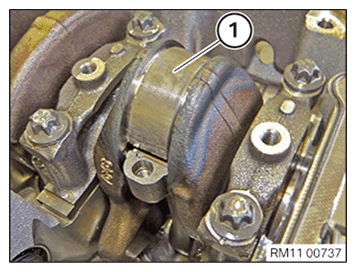
- Remove the connecting rod bearing (1).
Make sure that the connecting rod bearing (1) can be re-exchanged in the correct position.
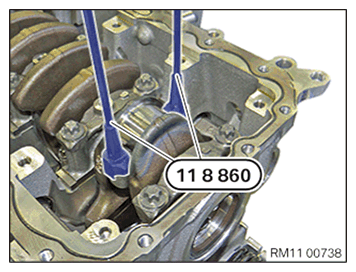
- Screw special tool 0 496 144 (11 8 860)
in at large connecting rod eye.
- Press piston (1) with connecting rod up and out of crankcase.