Installing all pistons with connecting rod
NOTE:
The description is for one component only. The procedure is identical for all further components.
Installing piston with connecting rod
NOTE:
RISK OF DAMAGE
Damage on the cylinder wall and oil spray nozzles.
Major force can scratch the cylinder wall and bend the oil spray nozzles.
Damage on the cylinder wall and oil spray nozzles.
Major force can scratch the cylinder wall and bend the oil spray nozzles.
- Carefully move the piston and connecting rod in the engine block.
Aligning piston rings
Aligning piston rings
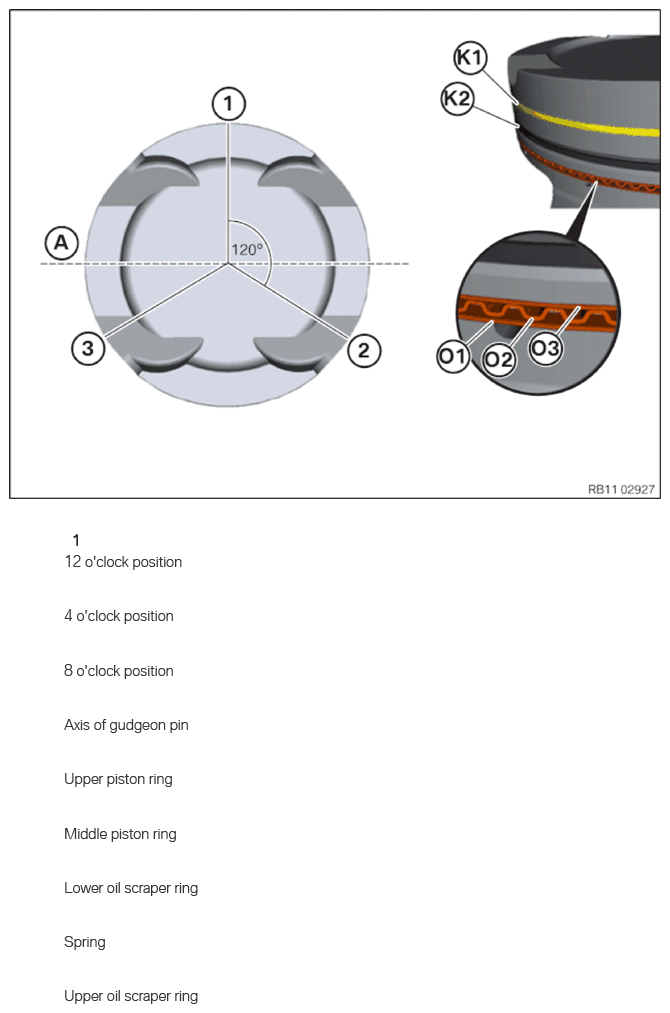
- Align the contact points of all piston rings by 120° each.
The piston ring gaps must not be positioned in line with the axis of the gudgeon pin (A).
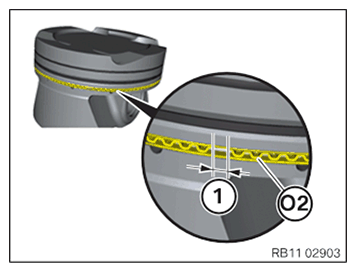
Piston ring Alignment Lower oil scraper ring (03) 12 o'clock position (1) Spring (O2) 4 o'clock position (2) Upper oil scraper ring (O1) 8 o'clock position (3) Central piston ring (K2) 12 o'clock position (1) Upper piston ring (K1) 4 o'clock position (2) - Make sure that the spring (O2) does not overlap the piston ring gap (1).
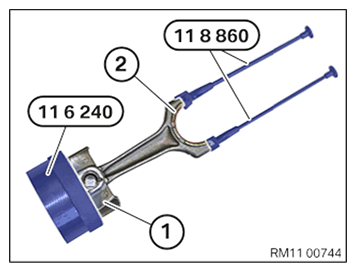
- Coat the pistons (1) and piston rings lightly with oil.
- Insert the pistons (1) with the piston rings into the bush 0495 373 (11 6 240).
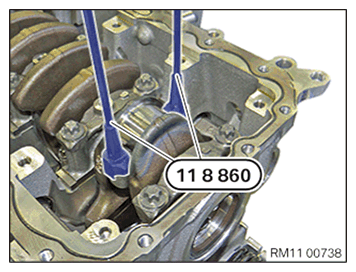
- Screw special tool 0496 144 (11 8 860)
on at large connecting rod eye (2).
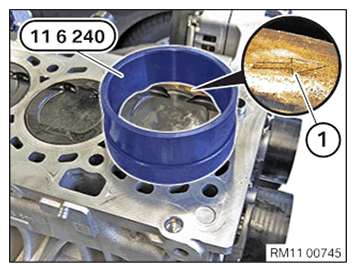
- Align the piston so that the arrow (1) points to cylinder 1.
- Insert the piston with the connecting rod into the special tool 0495 373 (11 6 240)
and guide it into the cylinder.NOTE: RISK OF DAMAGE
Damage on the cylinder wall and oil spray nozzles.
Major force can scratch the cylinder wall and bend the oil spray nozzles.- Carefully move the piston and connecting rod in the engine block.
- Push in piston by hand with only little force. Do not use striking tools.
Install the lower connecting rod bearing
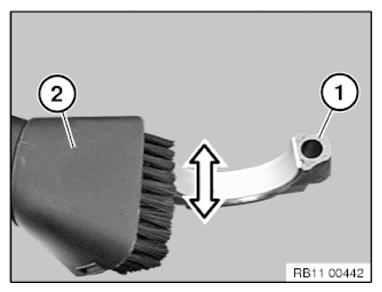
- Vacuum the connecting rod bearing shell and cracked surface (1) with a vacuum cleaner (2).
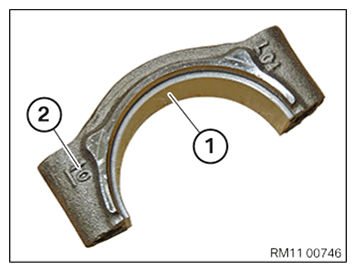
- Insert the connecting rod bearing shell (1) into the connecting rod bearing cap (2).
- Apply a light coat of oil to the connecting rod bearing shell (1).
- If necessary, screw the assembly tool 0496 144 (11 8 860) into the large connecting rod eye.
- Pull the connecting rod up to the connecting rod bearing journal.NOTE: RISK OF DAMAGE
Engine damage caused by incorrectly installed bearing shells and bearing supports.
Engine damage may result from incorrectly installing bearing shells and bearing supports.- Always Install all bearing shells and bearing supports in the same position from which they were removed.
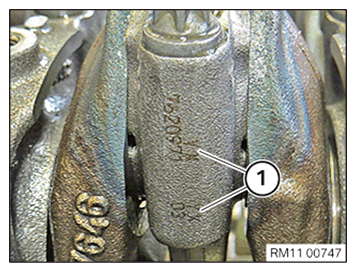
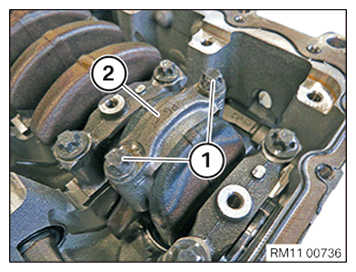
- Attach the connecting rod bearing caps to the connecting rod until the designations (1) match.
Make sure that the connecting rod bearing (2) is attached to the same connecting rod that it was detached from.
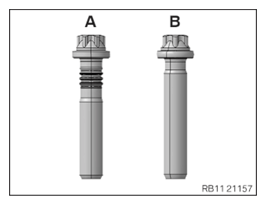
- A mixed installation of connecting rod bolts (A) and (B) on a connecting rod bearing cap is not
permitted.NOTE: TECHNICAL INFORMATION
When installing new connecting rod bolts, ensure that two identical connecting rod bolts are used on one connecting rod bearing cap.
A mixed installation of different connecting rod bolts on one connecting rod bearing cap is not permitted. - Replace screws (1).
- Tighten the screws.
Make sure that the connecting rod bearing cap (2) rests completely on the connecting rod.
TIGHTENING TORQUES SPECIFICATIONConnecting rod bearing cap to connecting rod Replace screws.
Tighten screws crosswise.Jointing torque 20 Nm 1. Angle of rotation 70° 2. Angle of rotation 70°
Follow-up Work
- Refer to INSTALLING THE OIL DEFLECTOR
- Refer to INSTALL THE OIL VACUUM PUMP .
- Refer to REFITTING SUMP .
- Refer to SEALING THE OIL DUCT .
- Refer to CLEAN SEALING SURFACES .
- Refer to INSTALLING THE CYLINDER HEAD .
- Refer to ATTACH THE OIL RETURN LINE FOR THE EXHAUST TURBOCHARGER .
- Refer to BLOCKING THE CAMSHAFTS
- Refer to INSTALLING THE INTAKE ADJUSTER .
- Refer to INSTALL EXHAUST CAMSHAFT ADJUSTER .
- Refer to PRELOAD TIMING CHAIN
- Refer to TIGHTENING THE VANOS CENTRAL VALVE .
- Refer to DISASSEMBLING ALL SPECIAL TOOLS
- Refer to CHECKING CAMSHAFT TIMING .
- Refer to DISASSEMBLING ALL SPECIAL TOOLS
- Refer to INSTALLING THE THERMOSTAT ON THE TRANSMISSION OIL LINES .
- Refer to INSTALL THE STARTER MOTOR (ACOUSTIC COVER REMOVED)
- Refer to INSTALL THE CYLINDER HEAD COVER (ENGINE REMOVED)
- Refer to INSTALL BOTH ACTUATORS (ENGINE REMOVED)
- Refer to PREPARE FOR THE INSTALLATION OF THE HIGH PRESSURE PUMP
- Refer to INSTALLING HIGH PRESSURE PUMP .
- Refer to PREPARE THE INJECTORS FOR INSTALLATION .
- Refer to INSTALLING THE RAIL
- Refer to INSTALLING THE HIGH-PRESSURE LINE BETWEEN THE HIGH-PRESSURE PUMP AND THE HIGH-PRESSURE RAIL .
- Refer to INSTALLING THE IGNITION COILS .
- Refer to INSTALLING THE INTAKE PLENUM .
- Refer to INSTALLING THE TANK VENT VALVE .
- Refer to INSTALLING OIL FEED LINE FOR EXHAUST TURBOCHARGER (ENGINE ENCAPSULATION REMOVED)
- Refer to INSTALL FRONT ENGINE ENCAPSULATION .
- Refer to INSTALL THE COOLANT FEED LINE FOR THE EXHAUST TURBOCHARGER (COOLANT RETURN LINE REMOVED)
- Refer to INSTALL THE COOLANT RETURN LINE FOR THE EXHAUST TURBOCHARGER (AUXILIARY COOLANT PUMP REMOVED)
- Refer to INSTALLING AUXILIARY COOLANT PUMP FOR THE EXHAUST TURBOCHARGER .
- Refer to TOPPING UP THE MOTOR OIL
- Refer to INSTALL THE ACOUSTIC COVER OF THE OIL SUMP (ENGINE REMOVED)
- Refer to REMOVE ENGINE FROM ASSEMBLY STAND