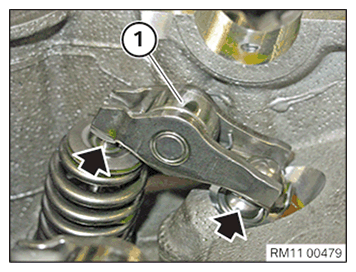
Remove all roller cam followers
NOTE:
DANGER
High-voltage system.
The high-voltage system operates on the basis of hazardous, electrical voltage and high currents. Danger to life through electric shock!
High-voltage system.
The high-voltage system operates on the basis of hazardous, electrical voltage and high currents. Danger to life through electric shock!
- All work on the high-voltage system may only be carried out by specially trained and technically experienced personnel.
- For additional information see:
- For additional information see:
WARNING:
Working on 12 V vehicle electrical system.
Risk of short circuits! Risk of fire!
Risk of short circuits! Risk of fire!
- Make sure that no charger is connected to the jump start support point in the engine compartment.
- Detach battery earth lead from battery.
- With auxiliary batteries: Detach all battery earth leads from additional batteries.
WARNING:
Working on fuel system.
Risk of fire! Danger of explosion!
Risk of fire! Danger of explosion!
- When working on the fuel system, make sure that the workbay is sufficiently ventilated, e.g. using extraction unit.
- Tightly seal off open lines and connections; collect any escaping fuel directly at the point of exit.
- No fire, sparks, open flames or smoking.
CAUTION:
On releasing high pressure line, fuel may emerge at high speed.
Danger of injury!
Danger of injury!
- Wear suitable personal protective equipment.
- Allow the cooling system to cool down to a temperature below 40°C before starting installation work.
- Note warnings on cylinder head cover.
NOTE:
RISK OF DAMAGE
Damage to battery terminal, the safety battery terminal or the intelligent battery sensor (IBS).
Damaged battery terminals can lead to malfunctions or vehicle electrical system faults.
Damage to battery terminal, the safety battery terminal or the intelligent battery sensor (IBS).
Damaged battery terminals can lead to malfunctions or vehicle electrical system faults.
- Pull off battery terminal from battery pole by carefully moving to and fro. Do not pry off using a tool.
NOTE:
TECHNICAL INFORMATION
Collect and dispose of emerging fluids. Observe country-specific waste disposal regulations.
Collect and dispose of emerging fluids. Observe country-specific waste disposal regulations.
Preliminary works
- Refer to BRING FRONT COMPARTMENT LID IN THE SERVICE POSITION .
- Refer to REMOVING THE ACOUSTIC COVER .
- Refer to REMOVE THE SEAL FOR THE REAR BONNET .
- Refer to REMOVE THE COVER OF THE ENGINE COMPARTMENT AT THE REAR LEFT
- Refer to REMOVE LEFT AND RIGHT WIPER ARM .
- Refer to REMOVE THE COVER OF THE REAR RIGHT ENGINE COMPARTMENT .
- Refer to REMOVING TRAILING LINK AT SPRING BOLT .
- Refer to REMOVING THE CENTER BULKHEAD UPPER PART .
- Refer to REMOVING THE RIGHT SEALING FRAME .
- Refer to LOOSENING HIGH-VOLTAGE CABLES ON THE ELECTRICAL MACHINE ELECTRONICS .
- Refer to REMOVING ACOUSTIC COVER AT REAR .
- Refer to REMOVING LEFT SEALING FRAME .
- Refer to REMOVING THE CENTER BULKHEAD LOWER SECTION
- Refer to REMOVING INTAKE SILENCER HOUSING .
- Refer to REMOVE RESONATOR .
- Refer to REMOVING CLEAN AIR PIPE .
- Refer to REMOVE CHARGE AIR LINE .
- Refer to REMOVE THE CYLINDER HEAD COVER ACOUSTIC COVER
- Refer to REMOVE IGNITION COILS .
- Refer to REMOVING ALL SPARK PLUGS .
- Refer to REMOVE THE HIGH PRESSURE LINE BETWEEN THE HIGH PRESSURE PUMP AND THE RAIL .
- Refer to REMOVE FUEL DELIVERY LINE .
- Refer to REMOVE HIGH PRESSURE PUMP .
- Refer to REMOVE HIGH-PRESSURE RAIL .
- Refer to REMOVING THE DME CONTROL UNIT .
- Refer to REMOVE THE INTEGRATED POWER SUPPLY MODULE (PDM) .
- Refer to REMOVE CONTROL UNIT BRACKET .
- Refer to REMOVE THE FRONT UNDERBODY PROTECTION OR FRONT THRUST FIELD .
- Refer to REMOVING THE UNDERBODY PROTECTION OF THE STEERING GEAR AND FRONT STIFFENING PLATE RESPECTIVELY .
- Refer to REMOVING REAR STIFFENING PLATE .
- Refer to DRAINING THE COOLANT FROM THE HIGH-TEMPERATURE COOLING SYSTEM .
- Refer to DRAIN THE COOLANT FROM THE LOW-TEMPERATURE COOLING SYSTEM
- Refer to REMOVING THE ACOUSTIC COVER FOR THE ENGINE AT THE FRONT .
- Refer to REMOVING AUXILIARY COOLANT PUMP FOR THE EXHAUST TURBOCHARGER .
- Refer to REMOVE FRONT ENGINE ENCAPSULATION .
- Refer to REMOVING BOTH ACTUATORS .
- Refer to REMOVING THE CYLINDER HEAD COVER .
- Refer to REMOVE TANK VENT VALVE .
- Refer to REMOVE INTAKE PLENUM .
- Refer to REMOVING THE SERVOMOTOR FOR THE ECCENTRIC SHAFT .
- Refer to CHECKING THE POSITION OF THE INTAKE CAMSHAFT .
- Refer to REMOVE THE TORSION SPRINGS .
- Refer to REMOVING ALL GATES .
- Refer to REMOVING ALL INTERMEDIATE LEVERS .
- Refer to PARTIALLY RELEASING ACOUSTIC COVER OF OIL SUMP .
- Refer to REMOVING THE THERMOSTAT FROM THE TRANSMISSION OIL LINES .
- Refer to TURNING THE ENGINE ON THE VIBRATION DAMPER
- Refer to BLOCKING THE CAMSHAFTS
- Refer to BLOCK THE CRANKSHAFT IN HE TDC FIRING POSITION OF CYLINDER 1 .
- Refer to REMOVING CHAIN TENSIONER .
- Refer to RELEASING THE VANOS CENTRAL VALVE OF THE INTAKE SIDE , or RELEASING THE VANOS CENTRAL VALVE OF THE EXHAUST SIDE .
- Refer to REMOVE EXHAUST CAMSHAFT ADJUSTER .
- Refer to REMOVING INTAKE ADJUSTER .
- Refer to DISASSEMBLING THE SPECIAL TOOL 2 358 122 .
- Refer to REMOVE EXHAUST CAMSHAFT .
- Refer to REMOVE INTAKE CAMSHAFT .
- Detach and remove the roller cam followers (1) on the intake side from hydraulic valve clearance compensating elements (arrows).
- Place all the roller cam followers (1) in order in the special tool 0 495 105 (11 4 480).
- Detach and remove the roller cam followers (1) on the output side from hydraulic valve clearance compensating elements (arrows).
- Place all the roller cam followers (1) in order in the special tool 0 495 105 (11 4 480).